Research Article
What Is AOD-9604? Growth Hormone Fragment Guide

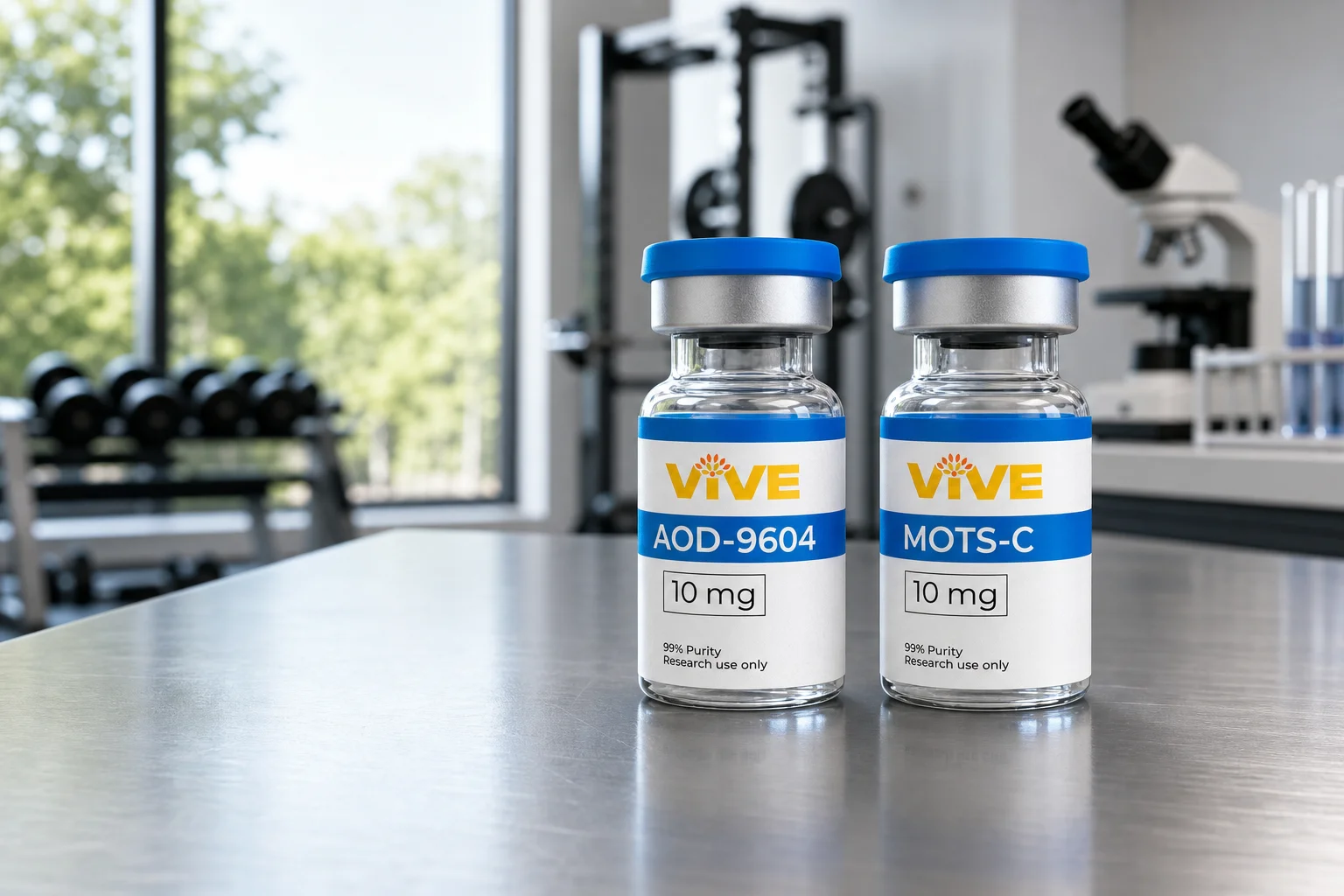
What is AOD-9604? It's a synthetic fragment of human growth hormone, isolated to the 176-191 amino acid sequence linked to fat metabolism, studied without affecting blood sugar regulation the way full-length HGH can. Researchers browse the VivePeptides catalog to source it alongside other metabolic peptides for controlled laboratory work.
By Vive Team
What Is AOD-9604 Used for in Research Settings?
AOD-9604, the growth hormone fragment 176-191, refers to a chain of amino acids modeled on the C-terminal region of the human growth hormone molecule. AOD-9604 is best described as a fragment human growth hormone research uses to isolate fat-metabolizing activity from growth-promoting activity, rather than the complete molecule. AOD-9604 was synthesized so laboratory models could study fat metabolism without affecting the cell-proliferation signaling associated with full-length human growth hormone.
The name breaks down simply. AOD stands for Anti-Obesity Drug, a label carried over from its early development pipeline, and 9604 references its internal catalog identifier. Because it isolates a single fragment rather than the whole hormone, AOD-9604 research has stayed narrowly focused on lipolysis (fat breakdown) and adipocyte activity rather than the broader growth hormone axis that governs height and tissue growth. This narrower focus is part of why AOD-9604 continues to draw research interest decades after its original discovery, even though it was never approved as a commercial drug.
How AOD-9604 Interacts With Fat Metabolism
Growth hormone's fat-burning effect works primarily through lipolysis, the breakdown of stored triglycerides into free fatty acids, while simultaneously suppressing lipogenesis, the conversion of excess energy into stored fat. Preclinical study of AOD-9604 has focused on whether the isolated fragment can trigger this same lipolytic pathway on its own, separate from the receptor-binding region responsible for HGH's other, more systemic effects.
This distinction matters for one reason: full-length human growth hormone has long been studied for its association with insulin resistance when used outside a monitored clinical framework. Because AOD-9604 was engineered to isolate only the fat-metabolism fragment, published research has examined whether it can influence fat metabolism without affecting blood glucose levels or growth-plate activity, the two properties most closely tied to HGH's broader hormonal profile. This is a different mechanism than growth hormone secretagogues like Sermorelin growth-hormone peptide, which prompt the pituitary to release the entire native hormone rather than isolating a single fragment. Researchers comparing mechanisms across peptide classes can also read What Is SS-31 (Elamipretide)? Mitochondrial Peptide Research Guide to see how a mitochondrial-support peptide approaches energy metabolism from an entirely different angle.

AOD-9604 and Weight Loss Research: What the Data Shows
AOD-9604 moved through early-stage clinical trials in the mid-2000s as part of an anti-obesity drug development program, with researchers tracking changes in fat mass among study participants. The fragment did not ultimately advance to market as an approved weight loss medication, but the trial data generated lasting interest in fragment-based peptide therapy as a research avenue distinct from GLP-1 and dual-agonist approaches.
Today, AOD-9604 is more often discussed alongside other metabolic peptides studied for body composition and fat loss outcomes, including Retatrutide triple-agonist peptide research, which works through an entirely different, receptor-based mechanism. The comparison is useful for researchers mapping how different peptide classes, fragment-based, incretin-based, and growth-hormone-releasing, each approach the same broad question of metabolic regulation from a different angle. The CDC and the World Health Organization both describe obesity as a multifactorial condition, and no single compound class fully explains how the body regulates fat storage and energy expenditure.
AOD-9604 in Combination Peptide Research
Some laboratories study AOD-9604 as a single-compound model, while others look at it alongside a broader peptide panel to compare how different mechanisms of action affect fat metabolism, growth hormone signaling, and body composition markers side by side. This kind of comparative research design helps distinguish which observed changes are unique to a fragment-based approach and which overlap with other metabolically active peptides.
Because AOD-9604 does not activate the growth hormone receptor the way growth hormone releasing peptides do, it is sometimes included in study designs as a control arm rather than an active comparator, isolating fat-metabolism effects from broader hormone level changes. Researchers evaluating fragment-based compounds alongside growth hormone secretagogues and GLP-1 peptides often look at how each class is positioned within the current body of research before designing a combination protocol.
As with any research combining multiple compounds, data quality depends heavily on accurate reconstitution, consistent storage, and careful documentation of dosing intervals. Any published results describing combination protocols should be read as specific to that study's design rather than generalized dosing advice, since sample sizes in fragment-peptide research remain small relative to more established pharmaceutical classes.
Reconstitution, Dosing, and Research Protocols
AOD-9604 is supplied as a lyophilized powder for laboratory use, and reconstitution technique affects how consistently a solution can be prepared for controlled study. Standard peptide research protocols call for sterile bacteriostatic water, added slowly down the interior wall of the vial to avoid disrupting the powder's structure, followed by gentle swirling rather than shaking. For a full walkthrough of technique, storage temperature, and shelf-life considerations, see our guide to the complete guide to reconstituting peptides with bacteriostatic water.
Dosing in published research protocols has varied by study design, and reconstituted solutions are typically stored refrigerated and used within the timeframe set by the individual protocol. As with any peptide intended strictly for laboratory and research use, handling should follow the study's own controlled procedures rather than any consumer dosing guidance found online. Proper labeling, including reconstitution date and concentration, also helps keep multi-week research protocols consistent across a lab.
Safety Considerations and Reported Side Effects
Because AOD-9604 was discontinued as a drug candidate rather than approved, no consumer safety profile exists for it, and any reported side effects come only from the limited pharmaceutical trial data published during its development. Early trial reporting noted mild injection-site irritation as the most commonly logged issue, though the published sample sizes were small and the compound was never carried through a full regulatory safety review.
This is why any legitimate discussion of AOD-9604 belongs strictly in a research and laboratory context. AOD-9604 is not marketed or studied as a treatment, and every application discussed here is strictly for laboratory and research use, not human dosing. There is no dosing standard suitable for human use, and no long-term data exists on how repeated administration might interact with other metabolic or hormonal pathways. Researchers comparing fragment peptides against other metabolically active compounds, including mitochondrial-support peptides, can find more on what is ss-31 (elamipretide)? mitochondrial peptide research guide for a look at how a structurally unrelated peptide class approaches similar research questions around energy metabolism.
Frequently Asked Questions
What is AOD-9604? AOD-9604 is a synthetic fragment representing amino acids 176 to 191 of human growth hormone, isolated for its association with fat metabolism. It was developed to separate the lipolytic properties of growth hormone from its growth-promoting effects, and it is available strictly for laboratory and research use, not human consumption.
Is AOD-9604 the same as human growth hormone? No. AOD-9604 is a small fragment of the full hormone, not the complete molecule. Full-length human growth hormone affects growth, cell proliferation, and multiple metabolic pathways, while AOD-9604 was engineered to isolate only the region researchers associate with fat metabolism, without affecting the hormone's other systemic actions.
What side effects have been reported in AOD-9604 research? Published trial data from its development noted mild injection-site irritation as the most common finding. Because the compound was discontinued before regulatory approval, no comprehensive, long-term safety data exists, and any side effects profile remains limited to the small research trials conducted during its original development period.
How does AOD-9604 differ from GLP-1 peptides like Semaglutide or Tirzepatide? GLP-1 and dual-agonist peptides act on incretin receptors to influence appetite and insulin signaling, while AOD-9604 is a growth hormone fragment studied for a narrower lipolytic effect. The two peptide classes are researched through different receptor pathways, even though both fall under the broader umbrella of metabolic and weight loss research.
Is AOD-9604 available for research purchase online? Yes, AOD-9604 is available through research peptide suppliers for laboratory use only. Buyers should confirm third-party purity testing and proper cold-chain shipping before use in any controlled study, since research-grade peptides require careful handling from the moment they arrive.
Source Your Research Peptides With Confidence
AOD-9604 remains one of the more narrowly studied growth hormone fragments, and getting clean, reproducible results starts with handling it correctly from the moment the vial is reconstituted. For a step-by-step walkthrough of proper technique, see more on the complete guide to reconstituting peptides with bacteriostatic water.
Research Use Only
All information in this article is intended for educational and research purposes only. VivePeptides products are not intended for human or veterinary use.