Research Article
AOD-9604 vs MOTS-c: Metabolic Peptide Comparison
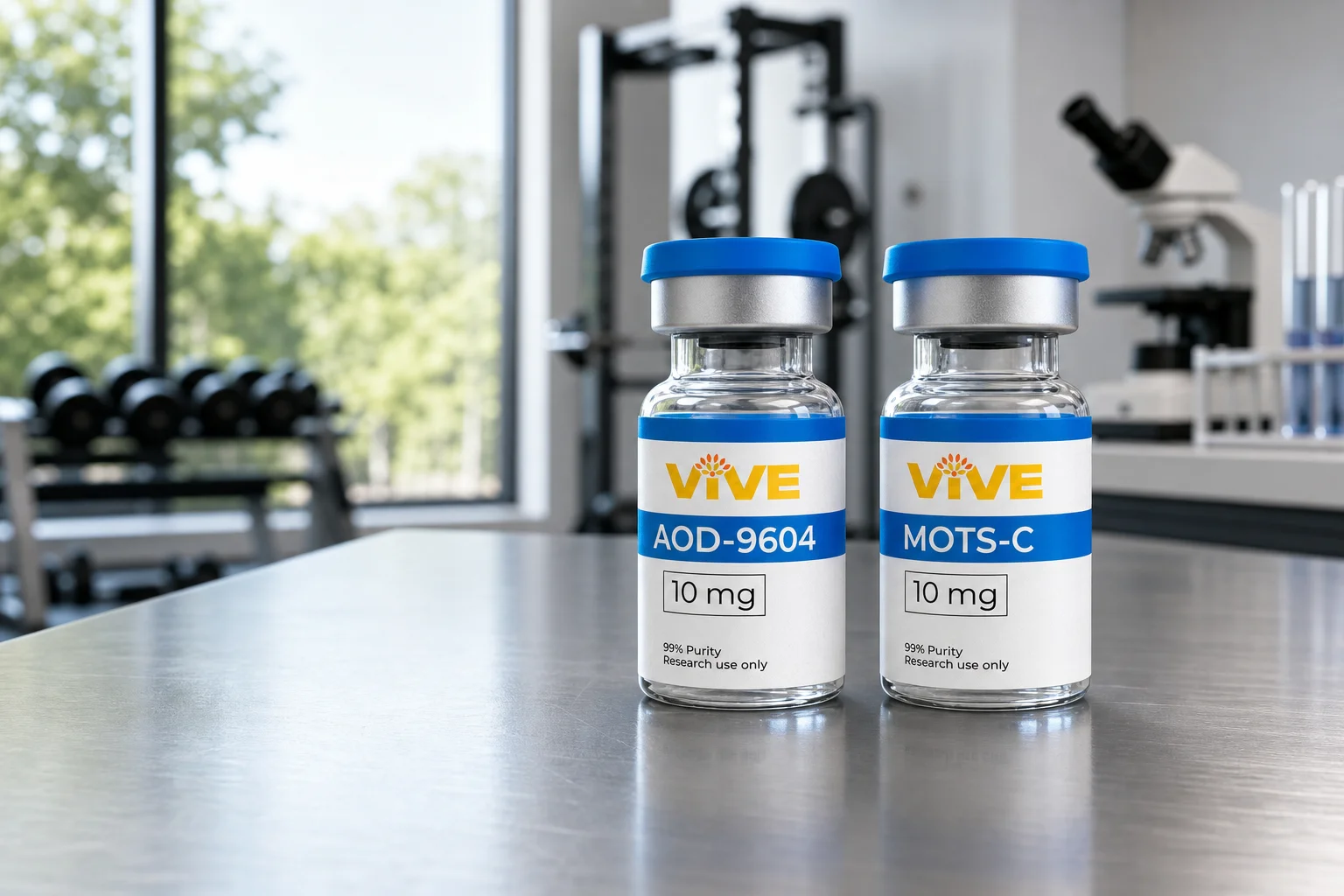
AOD-9604 vs MOTS-c comes down to mechanism, not potency: AOD-9604 is a growth hormone fragment studied for its role in fat metabolism, while research-grade MOTS-c is a mitochondrial-derived peptide studied for cellular energy and insulin sensitivity. Both surface in metabolic health research, but they signal through separate pathways entirely.
By Vive Team
What Is AOD-9604? A Growth Hormone Fragment Built for Fat Metabolism Research
AOD-9604 is a synthetic fragment representing amino acids 176 to 191 of human growth hormone, the region researchers have linked to lipolytic, or fat-breakdown, activity. Isolating this small growth hormone fragment matters because it appears to separate fat metabolism effects from the growth-promoting and blood-glucose effects tied to full-length growth hormone. In the studies researchers cite most often, AOD-9604 has not been shown to raise IGF-1 levels or bind the growth hormone receptor the way native growth hormone does.
Instead, AOD-9604 research centers on beta-3 adrenergic receptor activity on adipocytes, or fat cells, a pathway connected to fat metabolism and lipolysis rather than tissue growth. That narrower mechanism is why AOD-9604 shows up in body composition and fat loss research: it targets one downstream effect of growth hormone signaling instead of the broader hormonal cascade. Researchers who also work with research-grade Tesamorelin, a peptide that acts upstream at the GHRH receptor, often reference AOD-9604 by contrast, since the two sit at opposite ends of the same signaling chain.
AOD-9604 originated from obesity-focused pharmaceutical research in the early 2000s, where the fragment approach was designed specifically to avoid the diabetogenic and growth-related side effects seen with unmodified growth hormone dosing. That original clinical program did not proceed past early-stage trials for its intended drug indication, but the underlying research on the fragment's lipolytic activity continued, and AOD-9604 remains widely available for laboratory research into fat metabolism pathways independent of the broader growth hormone axis.
What Is MOTS-c? A Mitochondrial-Derived Peptide for Cellular Energy Research
MOTS-c is a mitochondrial-derived peptide, meaning it is encoded within mitochondrial DNA rather than the cell's nuclear genome. Research from USC's Lee laboratory, published in Cell Metabolism in 2015, first characterized MOTS-c and described how the peptide translocates to the nucleus under metabolic stress to activate AMPK, the enzyme that functions as a master switch for cellular energy balance.
That AMPK activation is the core of how MOTS-c works: switching on AMPK drives increased glucose uptake in skeletal muscle, supports insulin sensitivity, and helps regulate mitochondrial function under metabolic load. Because AMPK sits upstream of so many downstream pathways, MOTS-c research spans exercise capacity, fat metabolism, and age-related shifts in metabolic efficiency. It is one of the most studied examples of a mitochondrial-derived peptide precisely because a single signaling event connects to so many measurable outcomes.
Exercise physiology researchers have taken a particular interest in MOTS-c because circulating levels of the peptide appear to respond to physical exertion in animal models, rising alongside markers of metabolic demand. That observation is part of why MOTS-c research often sits at the intersection of exercise science and mitochondrial biology rather than in a single, narrow subfield. It also explains why MOTS-c is discussed less as a fat-targeting peptide and more as a systemic regulator of how tissue produces and uses energy.
AOD-9604 vs MOTS-c: Where the Mechanisms Diverge
Laid side by side, AOD-9604 vs MOTS-c is really a comparison of a fragment peptide against a full mitochondrial-derived peptide, and of a single-receptor mechanism against a systemic energy-sensing one. AOD-9604 acts locally on fat cells through a receptor pathway tied to lipolysis. MOTS-c acts more broadly, reaching skeletal muscle and other insulin-sensitive tissue through AMPK to influence glucose handling and mitochondrial output.
Neither peptide functions as a growth hormone replacement, and neither is positioned to substitute for the diet exercise habits that remain the baseline variable in any metabolic health research protocol. What differs is the research question each peptide is suited to answer. If the research interest is isolated fat metabolism without broader hormonal involvement, AOD-9604's fragment-based mechanism is the more direct model. If the research interest is cellular energy production, insulin sensitivity, or mitochondrial function as a system, MOTS-c is the more relevant comparison point. Some research programs studying peptide therapy protocols track both peptides side by side precisely because they answer different questions rather than competing versions of the same one.

Body Composition and Fat Loss: Comparing the Research Data
Body composition research on AOD-9604 generally focuses on fat mass rather than lean mass, consistent with its narrow lipolytic mechanism. Because it does not appear to elevate IGF-1 or trigger the anabolic signaling associated with full growth hormone, researchers studying fat loss outcomes with AOD-9604 are typically isolating a single variable: fat-cell lipolysis, independent of muscle-building or blood sugar changes.
MOTS-c research approaches body composition from a different angle. Since AMPK activation affects how muscle tissue uses glucose and manages energy, MOTS-c is more often discussed alongside metabolic efficiency and exercise capacity than pure fat-cell signaling. Some comparison literature also references it near GLP-1 class peptides. Teams already working through our guide to tirzepatide retatrutide next generation glp research peptides will recognize the pattern: newer weight loss peptides tend to work on several pathways simultaneously, while AOD-9604 and MOTS-c each isolate one.
Metabolic Health, Insulin Sensitivity, and AMPK Signaling
Insulin sensitivity is where the AOD-9604 vs MOTS-c comparison becomes clearest. AOD-9604 research has not established a direct effect on insulin signaling, since its mechanism sits downstream at the fat cell rather than at glucose regulation broadly. MOTS-c research, by contrast, consistently ties AMPK activation to improved glucose uptake and insulin sensitivity in skeletal muscle models, positioning it closer to metabolic health research on blood sugar regulation than to fat-cell-specific lipolysis.
This is also where mitochondrial function draws the sharpest line between the two peptides. AOD-9604 does not act on mitochondria directly. MOTS-c's entire discovery came from mitochondrial DNA, and its downstream effects on cellular energy and metabolic efficiency are inseparable from mitochondrial signaling. Researchers building comparison protocols across immune and metabolic peptide classes, including those covered in more on best peptides immune system research, often note that mitochondrial-derived peptides like MOTS-c sit at a genuinely different regulatory layer than fragment peptides like AOD-9604.
Frequently Asked Questions
Is AOD-9604 the same as human growth hormone? No. AOD-9604 is a small fragment representing amino acids 176 to 191 of human growth hormone, isolated because that region is linked to fat metabolism. It does not appear to trigger the full receptor binding, IGF-1 elevation, or tissue-growth effects associated with intact human growth hormone.
How does MOTS-c differ from other growth hormone peptides in this catalog? MOTS-c is not part of the growth hormone axis at all. It is a mitochondrial-derived peptide that activates AMPK to influence cellular energy and glucose handling, while peptides like Sermorelin or Tesamorelin act on GHRH receptors upstream of growth hormone release.
Can AOD-9604 and MOTS-c be studied together? Some research protocols track both peptides in parallel because they act on distinct pathways, fat-cell lipolysis for AOD-9604 and AMPK-driven cellular energy for MOTS-c, without direct mechanistic overlap. Any combined protocol should be designed and reviewed independently by the research team.
Does either peptide affect insulin sensitivity? MOTS-c research is more directly tied to insulin sensitivity through AMPK activation and improved glucose uptake in skeletal muscle. AOD-9604 research has not established a comparable direct effect on insulin signaling, since its mechanism is centered on fat-cell lipolysis rather than glucose regulation.
Is either peptide a substitute for diet and lifestyle changes? No research on AOD-9604 or MOTS-c positions either peptide as a replacement for foundational diet exercise habits. Both are studied as one variable within a broader metabolic health research framework, not as standalone interventions.
Compare Metabolic Peptides in the VivePeptides Catalog
Researchers weighing AOD-9604 vs MOTS-c for a specific protocol can review full specifications, reconstitution data, and related metabolic peptides in the full peptide library.
Research Use Only
All information in this article is intended for educational and research purposes only. VivePeptides products are not intended for human or veterinary use.