Research Article
How to Read a Peptide COA: A Researchers Guide
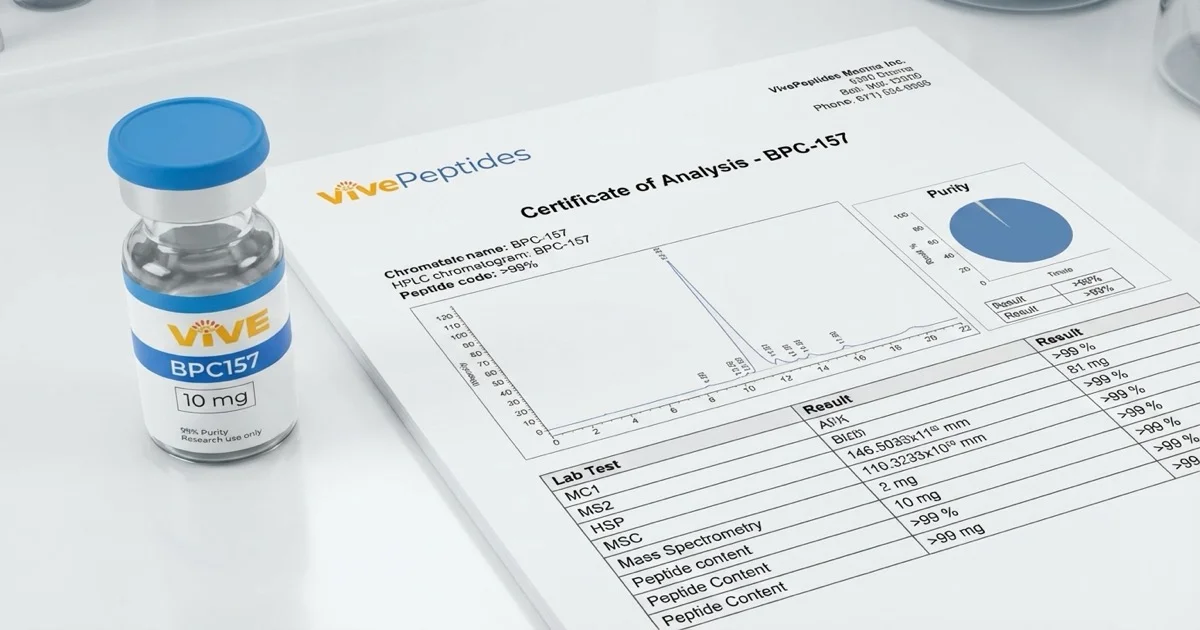
A peptide Certificate of Analysis (COA) is the primary document that confirms what is actually inside a research vial. For any researcher sourcing peptides for laboratory work, knowing how to read one correctly separates reliable data from compromised experiments. This guide walks through every section of a COA, line by line, so you can evaluate purity, identity, and safety data with confidence.
Research Use Only: All content on this page pertains to peptides intended for in-vitro laboratory research purposes only. VivePeptides products are not intended for human or veterinary use, and nothing here constitutes medical advice or clinical guidance.
A Certificate of Analysis is a documented record issued by an analytical laboratory confirming that a specific peptide batch has been tested and meets defined quality specifications. Each COA is tied to a unique batch or lot number and should correspond directly to the vial you received.
Unlike a general product specification sheet, a COA reports actual measured results, not targets. That distinction is what gives COA data its value: you are reading instrument-generated output, not marketing copy.
A complete, research-grade COA contains at minimum:
- Compound name and sequence -- the full amino acid sequence of the peptide
- Batch or lot number -- the traceable identifier that ties this document to your vial
- Date of analysis -- when the tests were performed
- Analytical methods used -- typically HPLC and mass spectrometry
- Measured results -- purity percentage, observed mass, and any safety metrics
- Issuing laboratory identity -- name and accreditation of the testing facility
If any of these elements are missing, the document cannot be considered a complete COA.
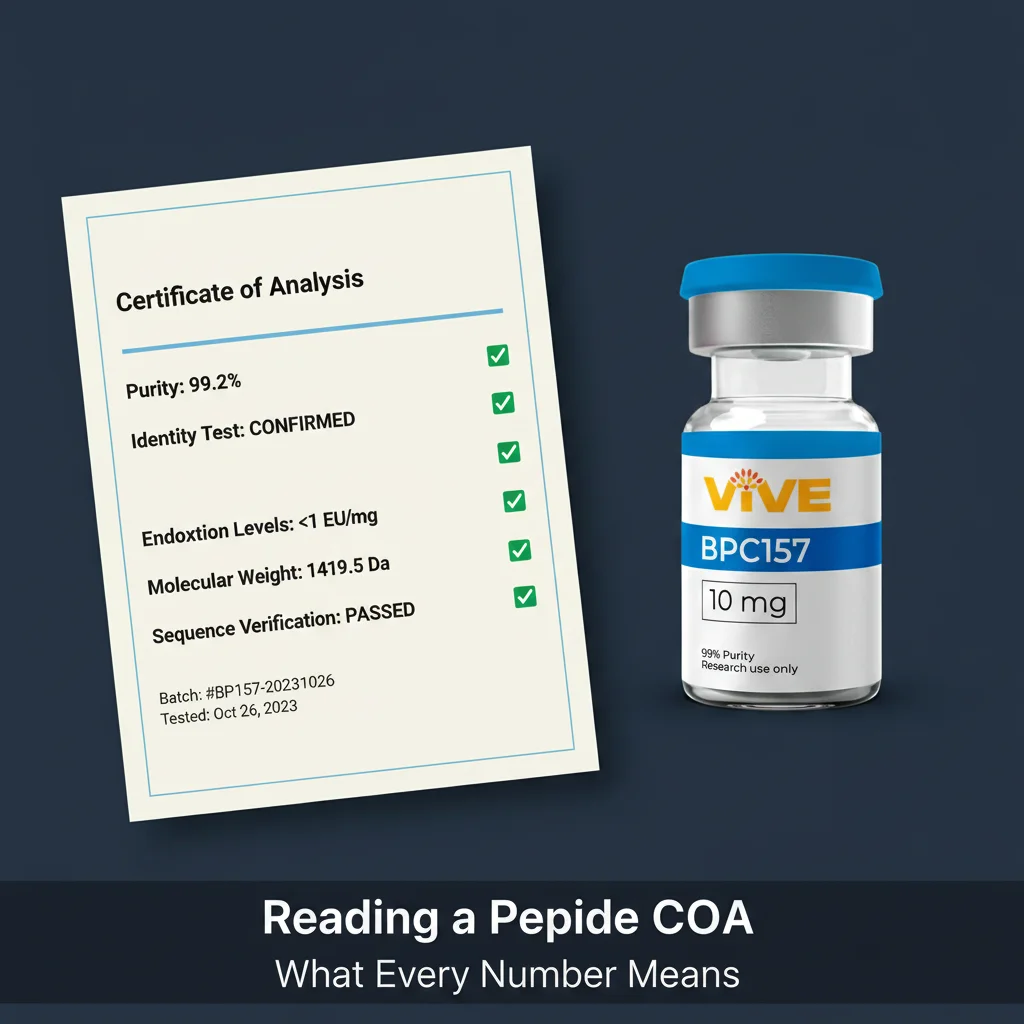
How to Read Each Section of a Peptide COA
The following steps cover every major section found on a well-structured peptide COA. Work through them in order when evaluating any document.
1
Confirm the Batch Number Matches Your Vial
Before reviewing any data, cross-reference the lot or batch number printed on your vial label against the number on the COA header. A COA from a different batch has no bearing on what is in your vial. Suppliers who issue batch-specific COAs -- meaning a unique document per production run, not a generic template -- provide meaningfully more reliable documentation. VivePeptides issues batch-specific COAs tied to each production run so researchers can trace results directly to their order.
2
Read the HPLC Purity Result
High-Performance Liquid Chromatography (HPLC) is the standard method for quantifying peptide purity. The result is expressed as a percentage representing the target peptide relative to other peptide-related impurities detected in the same sample. These impurities typically include deletion sequences (fragments where one or more amino acids were skipped during synthesis), truncated chains, and oxidized variants. For research-grade work, a minimum of 95% HPLC purity is the baseline floor. Anything at or above 98% is considered high-purity research standard. VivePeptides holds a 99%+ purity threshold across its catalog.
3
Interpret the Mass Spectrometry (MS) Result
Mass spectrometry confirms identity, not just purity. The instrument measures the precise molecular weight of the compound present in the sample and compares it against the theoretical mass of the target peptide sequence. A match within plus or minus 1 Dalton (Da) of theoretical mass is generally acceptable. Any significant deviation indicates the compound is not what the label claims, has been modified, or is contaminated with a structurally distinct impurity. HPLC alone cannot confirm identity -- only MS delivers that verification. A COA without an MS result is incomplete for research purposes.
4
Check Net Peptide Content (If Listed)
Net peptide content is one of the most frequently misunderstood metrics on a COA. While HPLC purity measures the target peptide against other peptide-related species, net peptide content measures actual peptide mass as a percentage of total vial weight -- including water, salt counterions (TFA or acetate), and residual synthesis solvents. A peptide vial can read 99% HPLC purity and only 75-85% net peptide content. That gap matters when performing precise quantitative research. If a COA lists net peptide content, use that figure -- not the labeled vial weight -- to calculate actual compound mass for your experiments.
5
Review Endotoxin Testing Data
Bacterial endotoxin testing (often via the Limulus Amebocyte Lysate, or LAL, assay) measures lipopolysaccharide contamination that can trigger inflammatory responses in biological systems. Endotoxins are a common contaminant in peptides synthesized in non-sterile environments. For cell-culture or in-vitro research, high endotoxin levels will corrupt experimental results. Acceptable limits vary by application, but many research-grade suppliers target below 5 EU/mg. Not all COAs include endotoxin data -- its presence signals a higher-tier quality commitment from the supplier.
6
Verify the Issuing Laboratory
A COA issued by the supplier's in-house lab carries an inherent conflict of interest -- the party that profits from the sale is also the party certifying its quality. Third-party COAs from independent, ISO 17025-accredited laboratories carry significantly more weight because the testing entity has no financial stake in the results. When evaluating a supplier, ask whether COA data comes from internal or external testing. Third-party verification is the standard that serious research procurement requires.
Key Insight: HPLC purity and net peptide content are two different measurements. A compound can be 99% pure by HPLC while only 78% of the vial's total weight is actual peptide. Always clarify which figure your dosing math is based on before running quantitative assays.
HPLC Purity vs. Net Peptide Content: A Direct Comparison
Understanding the difference between these two metrics is foundational for accurate research preparation.
Metric | What It Measures | Typical Range | Use In Research
---|---|---|---
HPLC Purity | Target peptide vs. peptide-related impurities | 95% to 99%+ | General quality benchmark
Net Peptide Content | Actual peptide mass vs. total vial weight (water, salts, solvents) | 70% to 90% | Accurate dosing in quantitative assays
MS Identity | Observed molecular weight vs. theoretical | Within +/- 1 Da | Sequence and identity confirmation
Endotoxin Level | Bacterial lipopolysaccharide contamination | <5 EU/mg (research) | Cell-based and biological assays
Red Flags That Indicate a Fraudulent or Insufficient COA
Not every document labeled "COA" represents genuine analytical data. Researchers should watch for the following warning signs when evaluating supplier documentation.
Red Flag
Round-Number Purity Results
Genuine HPLC instruments produce results like 98.3%, 99.1%, or 97.8%. A COA showing exactly 99.00% or 98.00% almost certainly reflects a typed number rather than an instrument output. Analytical measurements rarely land on clean round numbers.
Red Flag
No Third-Party Laboratory Identity
A COA with no issuing lab name, no accreditation number, and no contact information for the testing facility cannot be independently verified. Legitimate analytical labs include their identity on every document they issue.
Red Flag
Missing Mass Spectrometry Data
HPLC purity alone does not confirm that the compound in the vial is the correct peptide. Without mass spectrometry identity data, a high purity reading could reflect a highly pure but incorrect compound. Both tests together are required for complete verification.
Red Flag
Generic COA Not Tied to a Batch
A COA without a batch or lot number applies to no specific production run. It may represent a historical test from a different synthesis run or a different raw material lot. Always require batch-specific documentation tied to your order.
How VivePeptides Approaches COA Transparency
Every peptide in the VivePeptides catalog ships with a batch-specific Certificate of Analysis generated by independent U.S. analytical laboratories. Each COA includes HPLC purity data, mass spectrometry identity confirmation, and where applicable, endotoxin testing results. Researchers sourcing compounds like BPC-157 or Semaglutide for laboratory work can review the relevant COA prior to purchase and match it directly to the batch number on their vial upon delivery.
This level of documentation is not standard across all suppliers. Many vendors issue a single COA for a product line rather than per-batch documentation, which means the analytical data attached to your vial may represent a test performed on a completely different production run.
99%+
HPLC purity standard on every VivePeptides batch -- verified by independent U.S. laboratories
Preparing Your Peptide for Research After COA Review
Once you have confirmed purity, identity, net content, and laboratory credentials from the COA, the next step before beginning any in-vitro protocol is reconstitution. Most lyophilized peptides require a sterile bacteriostatic carrier -- Bac Water is the standard choice for research applications -- combined with a clean, low-protein-binding reconstitution process. Always store reconstituted peptides at appropriate temperatures per the compound's known stability profile, and document the reconstitution date as part of your experimental record.
A COA confirms what was in the vial at the time of testing. Proper handling from that point forward is the researcher's responsibility.
Frequently Asked Questions
What is a peptide COA and why does it matter for research?
A peptide Certificate of Analysis (COA) is a document issued by an analytical laboratory that reports the measured results of purity, identity, and safety testing for a specific batch of peptide. It matters because it provides objective, instrument-generated confirmation that the compound matches its label claims. Without a verified COA, researchers have no way to confirm what is actually in the vial they are working with, which undermines experimental validity from the start.
What HPLC purity percentage is considered research-grade for peptides?
For research-grade peptides, 95% HPLC purity is the minimum acceptable floor, with 98% representing a strong research standard. Compounds at 99%+ purity are considered high-purity research quality and are appropriate for the most demanding in-vitro protocols. Purity below 95% introduces a meaningful concentration of peptide-related impurities (deletion sequences, truncated fragments, oxidized variants) that can interfere with experimental results.
What is the difference between HPLC purity and net peptide content?
HPLC purity measures the target peptide as a percentage of total peptide-related species detected in the sample. Net peptide content measures the actual peptide mass as a percentage of total vial weight, including water, TFA or acetate salt counterions, and residual solvents from synthesis. A peptide can show 99% HPLC purity while having net peptide content as low as 70-85%. When running quantitative assays where precise concentration matters, net peptide content is the figure that should inform your calculation -- not the labeled vial weight or HPLC purity percentage alone.
How can I tell if a peptide COA is legitimate or fabricated?
Several indicators separate genuine COAs from fraudulent documents. Legitimate COAs show purity results with decimal precision (98.4%, not 98.00%), list an identifiable third-party laboratory with contact and accreditation information, include both HPLC and mass spectrometry data, and carry a batch number traceable to a specific production run. Fabricated COAs often show suspiciously round numbers, lack a named testing laboratory, contain only one of the two required analytical methods, or apply to a product generally rather than a specific batch. Always request the COA before purchase and verify the batch number matches your vial upon delivery.
Do all peptide suppliers provide third-party COAs?
No. Many peptide suppliers issue COAs generated by their own in-house laboratories, which creates a conflict of interest since the same party selling the product is also certifying its quality. Third-party COAs from independent, ISO 17025-accredited analytical laboratories represent a higher standard because the testing facility has no financial relationship with the outcome. Researchers sourcing peptides for serious laboratory work should prioritize suppliers that use independent external testing and make COA documentation available per batch, not just per product line.
Research Use Only
All information in this article is intended for educational and research purposes only. VivePeptides products are not intended for human or veterinary use.