
Growth & Repair
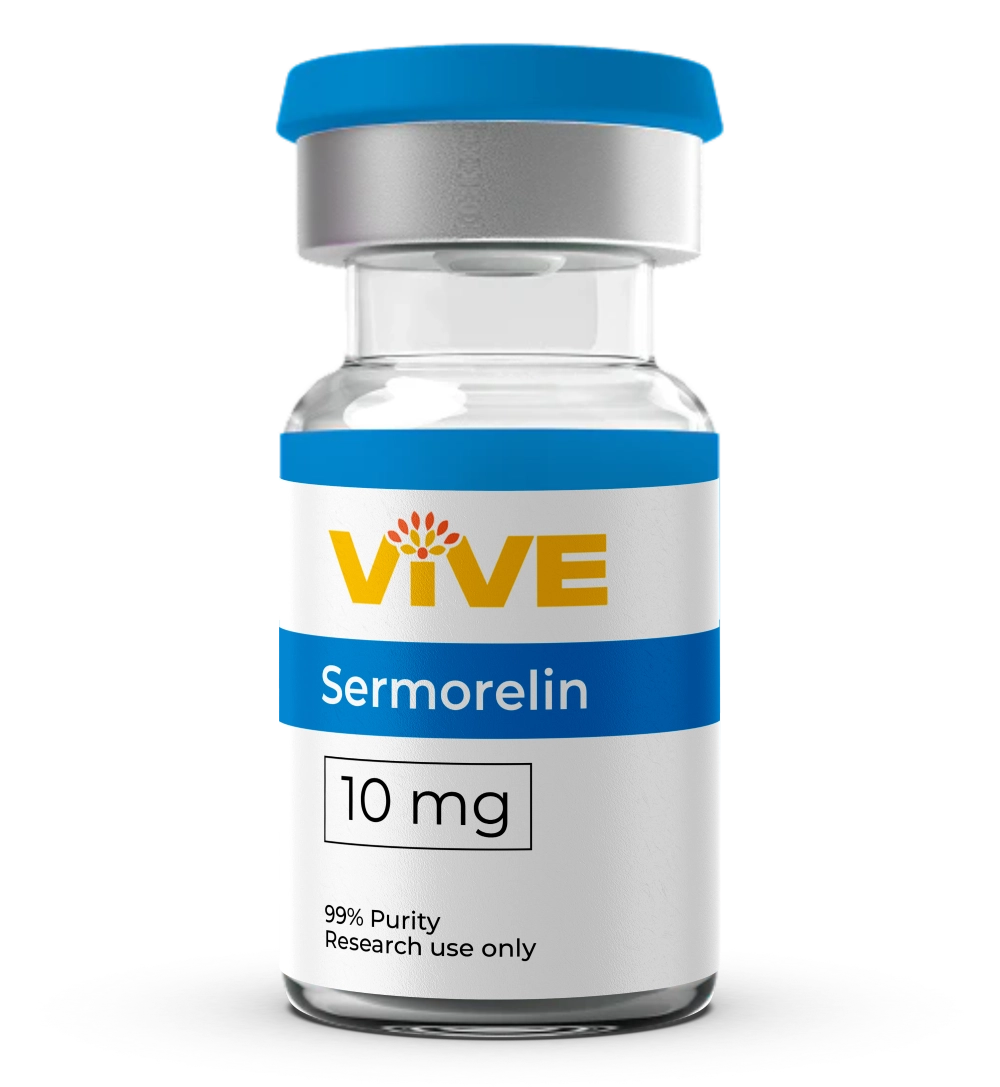
Sermorelin
Research Use OnlyThese products are sold strictly for laboratory and research use only and are not approved for human consumption, diagnosis, or therapeutic treatment. Not for human or veterinary use. These statements have not been evaluated by the Food and Drug Administration, and nothing on this page constitutes medical advice or a health claim.
- Size
- 10mg
Specifications
Sermorelin Technical Profile
OVERVIEW
What Is Sermorelin Peptide?
Sermorelin is a synthetic peptide consisting of 29 amino acids that represents the biologically active N-terminal fragment of human growth hormone-releasing hormone (GHRH). First developed in the 1980s and subsequently approved by the FDA for diagnostic and therapeutic use in growth hormone deficiency, Sermorelin has become one of the most extensively studied peptides in endocrine research. Its ability to stimulate growth hormone release through natural physiological pathways has made it a foundational compound in pituitary function and aging research.
As a research peptide, Sermorelin belongs to the class of GHRH analogs. Unlike exogenous growth hormone administration, Sermorelin works by stimulating the anterior pituitary gland to produce and secrete growth hormone in a pulsatile pattern that mimics the body's natural release cycle. This characteristic has made Sermorelin particularly valuable in research exploring age-related decline in growth hormone secretion, body composition changes, and neuroendocrine function.
- 01
GHRH (1-29) Analog
Synthetic 29-amino-acid peptide representing the active fragment of human growth hormone-releasing hormone
- 02
≥99% HPLC Purity
Every batch verified via high-performance liquid chromatography
- 03
USA Made & Verified
Third-party analytical testing performed in USA laboratories
RESEARCH
Sermorelin Mechanism of Action in Research
The Sermorelin mechanism of action centers on its interaction with growth hormone-releasing hormone receptors (GHRHR) located on somatotropic cells in the anterior pituitary gland. Research over the past three decades has established Sermorelin as a highly specific GHRH receptor agonist with a well-characterized signaling cascade.
GHRHR Binding and cAMP Signaling
Sermorelin binds to the GHRHR on anterior pituitary somatotrophs, activating a G-protein coupled receptor signaling cascade. This binding triggers adenylyl cyclase activation, increasing intracellular cyclic adenosine monophosphate (cAMP) levels. The elevated cAMP activates protein kinase A (PKA), which phosphorylates downstream targets including the transcription factor CREB. Research indicates this pathway leads to both acute growth hormone release from stored vesicles and long-term upregulation of GH gene transcription (Frohman et al., 1992).
Growth Hormone Pulsatile Release
Unlike direct GH administration, Sermorelin promotes a pulsatile release pattern regulated by the inhibitory hormone somatostatin. In laboratory studies, Sermorelin administration has been observed to produce GH secretion patterns that closely resemble endogenous GHRH-stimulated release, including appropriate feedback regulation. This pulsatile characteristic distinguishes Sermorelin from continuous GH elevation approaches and has been a primary focus of research into physiological hormone replacement strategies.
IGF-1 Axis Stimulation
The growth hormone released in response to Sermorelin stimulates hepatic production of insulin-like growth factor-1 (IGF-1). Research in animal models has demonstrated that Sermorelin-stimulated GH release produces downstream IGF-1 elevations proportional to the GH pulse amplitude. The GH/IGF-1 axis is one of the most widely studied endocrine pathways, and Sermorelin continues to serve as a primary tool for investigating this system in preclinical research settings.
COMPARISON
Sermorelin vs CJC-1295: Research Peptide Comparison
Sermorelin
Both Sermorelin and CJC-1295 are synthetic analogs of growth hormone-releasing hormone studied for their ability to stimulate pituitary GH secretion. While they share a common mechanism, they differ in structure, pharmacokinetics, and duration of action. Understanding these differences helps researchers select the appropriate compound for their specific laboratory protocols.
CJC-1295
Both peptides continue to be subjects of active investigation. Sermorelin's shorter half-life makes it better suited for research requiring pulsatile GH patterns, while CJC-1295 is preferred for studies investigating sustained GH elevation. VivePeptides offers both Sermorelin and CJC-1295 + Ipamorelin at research-grade purity from our USA-based facility.
| Feature | Sermorelin | CJC-1295 |
|---|---|---|
| Origin | GHRH (1-29) N-terminal fragment | Modified GHRH (1-29) with DAC option |
| Amino Acids | 29 | 30 |
| CAS Number | 86168-78-7 | 863288-34-0 |
| Molecular Weight | 3357.9 Da | 3647.3 Da (without DAC) |
| Primary Research Focus | Pulsatile GH release and pituitary function | Sustained GH and IGF-1 elevation |
| Half-Life | Short (minutes to hours) | Extended (hours to days with DAC) |
| Proposed Mechanism | Direct GHRHR agonism, cAMP signaling | GHRHR agonism with albumin binding (DAC) |
| Research Volume | 200+ published studies | 50+ published studies |
RESEARCH STUDIES
Sermorelin Research Applications & Published Studies
Sermorelin research spans over three decades of published preclinical and clinical literature. The following areas represent the most actively investigated applications of Sermorelin peptide in laboratory, animal model, and clinical research settings. All references are to research contexts only.
Growth Hormone Deficiency Research
Sermorelin was originally developed and FDA-approved for evaluating and treating growth hormone deficiency. Walker et al. (1990) published studies demonstrating that Sermorelin administration produced significant increases in GH secretion in both pediatric and adult subjects. Subsequent research by Vittone et al. (1997) examined Sermorelin's effects on GH secretion patterns in aging populations, establishing the foundation for age-related GH research.
Body Composition and Metabolic Studies
Published research has examined Sermorelin's effects on body composition parameters. Khorram et al. (1997) reported observations of changes in lean body mass, body fat percentage, and skin elasticity in elderly subjects receiving Sermorelin over a 16-week period. These studies contributed to the body of research exploring growth hormone secretagogues as tools for investigating age-related metabolic changes.
Sleep and Neuroendocrine Research
Research has explored Sermorelin's relationship with sleep architecture and neuroendocrine function. Steiger et al. (1992) published findings on GHRH's effects on sleep EEG patterns, demonstrating associations between GH-releasing peptides and slow-wave sleep in research subjects. These studies expanded the scope of Sermorelin research into the neuroscience of sleep regulation.
QUALITY ASSURANCE
Quality & Testing Standards
VivePeptides maintains rigorous quality control for every batch of Sermorelin peptide. Our commitment to research-grade purity ensures that laboratories receive consistent, reliable compounds for their investigations.
HPLC & Mass Spectrometry
Every batch of Sermorelin undergoes high-performance liquid chromatography (HPLC) and mass spectrometry analysis to confirm identity, purity, and molecular weight.
Third-Party Verified
All VivePeptides Sermorelin is independently verified through third-party analytical laboratories based in the USA. Testing documentation is available for every lot.
≥99% Purity Standard
Our Sermorelin consistently meets or exceeds ≥99% purity as determined by HPLC analysis, ensuring research-grade quality for laboratory applications.
FAQ
Frequently Asked Questions About Sermorelin
What is Sermorelin used for in research?
What purity is VivePeptides Sermorelin?
How should Sermorelin be stored?
What is the difference between Sermorelin and CJC-1295?
Is VivePeptides Sermorelin third-party tested?
IGF-1 LR3
Extended half-life insulin-like growth factor for growth pathway studies
AOD 9604
Explore More Research Peptides
GH fragment peptide for metabolic and body composition research
Selank · Semax · Tesamorelin · NAD+ · SNAP-8 · All Peptides →
Add To Research Cart
Sermorelin
99%+ purity · USA lab tested · secure shipping
These products are sold strictly for laboratory and research use only and are not approved for human consumption, diagnosis, or therapeutic treatment. Not for human or veterinary use. These statements have not been evaluated by the Food and Drug Administration, and nothing on this page constitutes medical advice or a health claim.