Research Article
HPLC vs Mass Spec: Which COA Number Matters

Every peptide certificate of analysis carries two different kinds of proof, and the HPLC vs mass spec comparison decides which one actually matters: one number measures purity, the other confirms identity. Before you browse the VivePeptides catalog, knowing what each test catches, and what it misses, changes how you read every COA.
By Vive Team
What Is the Difference Between HPLC and Mass Spectrometry Testing?
High-performance liquid chromatography (HPLC) and mass spectrometry answer two different questions about the same vial, and misreading the HPLC vs mass spec distinction is the most common mistake on a peptide COA.
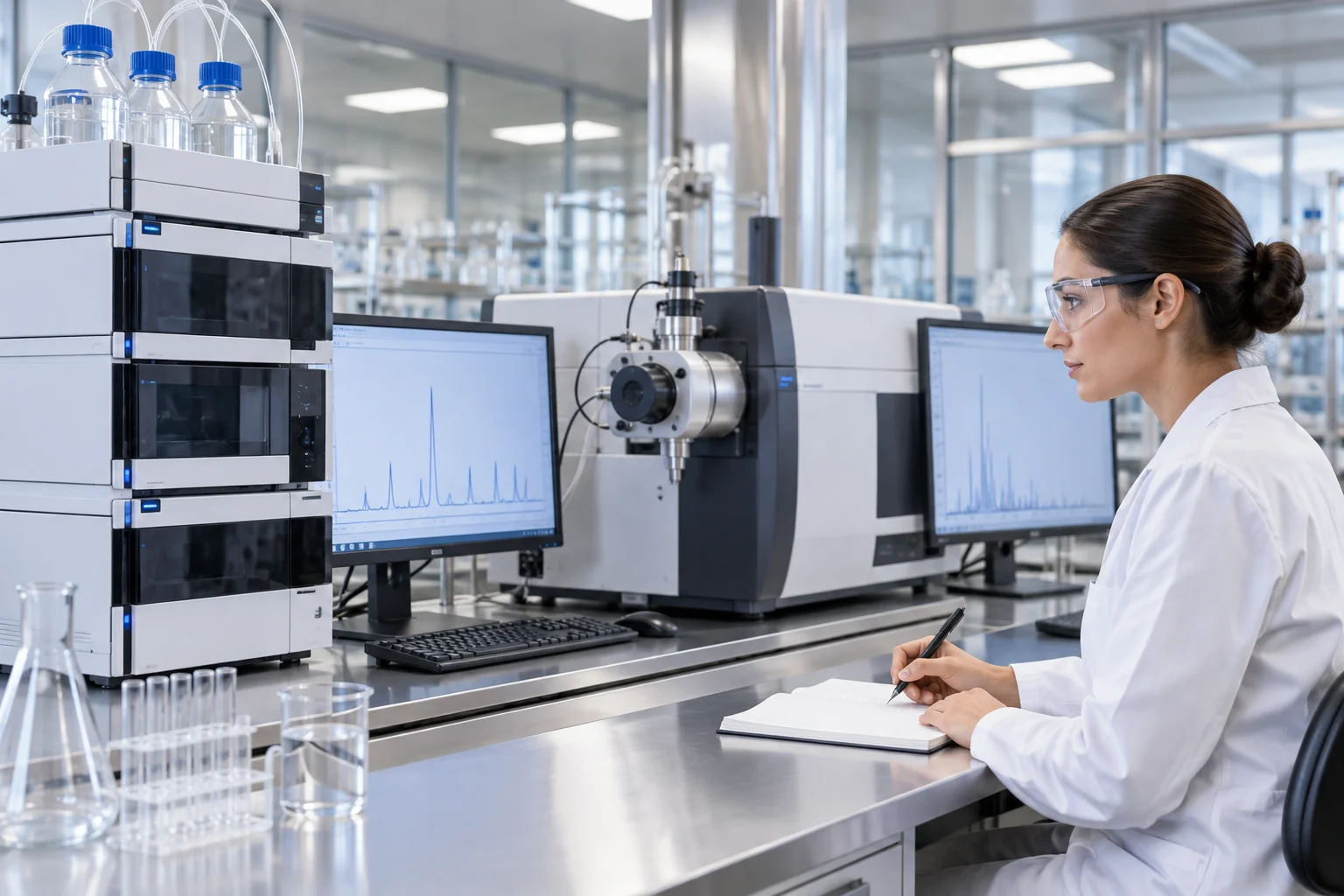
HPLC works by pushing a liquid sample through a column packed with a solid stationary phase, while a liquid solvent, the mobile phase, carries the sample's components along at a controlled flow rate. Each analyte interacts with the stationary phase to a different degree, so the components separate and exit the column at different times, called the retention time. This separation is the entire basis of HPLC purity testing. A detector at the end of the column records each compound as a peak, and the size of that peak relative to the total area tells you how much of the sample is the intended peptide versus everything else. This is the analytical method behind the purity percentage you see on a COA.
Mass spectrometry works on a completely different principle. Instead of separating components based on how long they take to move through a column, a mass spectrometer ionizes the molecules in a sample and measures their mass. That mass is compared against the expected mass of the actual peptide, not an estimate. High-performance liquid chromatography HPLC and mass spectrometry are often run together, with HPLC separating the components first and a mass spec detector identifying each one as it comes off the column, a setup often labeled LC-MS.
The distinction that matters: liquid chromatography HPLC purity tells you how clean a sample is. Mass spectrometry tells you whether the molecule in that sample is actually the peptide the label claims.
What Does the HPLC Purity Percentage on a COA Actually Measure?
The purity percentage most peptide COAs list is calculated from the HPLC chromatogram: the area under the main peak divided by the total area of all detected peaks, expressed as a percentage. A result of 98% purity means that, by this analytical method, 98% of everything the detector picked up in that sample matches the retention time of the intended peptide, with the remaining 2% attributed to related impurities, degradation products, or leftover solvent from synthesis.
What this number does not confirm is identity. HPLC purity testing measures how consistent and clean a sample is relative to itself. It does not independently prove which molecule that 98% actually is, because retention time alone can be shared by more than one compound. Two different molecules that happen to move through the column at a similar rate can produce overlapping peaks, which is one reason quality control programs pair HPLC with a second method rather than relying on chromatography HPLC data alone. This holds across widely researched compounds, including research-grade BPC-157 batches, where HPLC purity is typically the headline figure vendors report first.
What Does Mass Spec Testing Show That HPLC Testing Doesn't?
Mass spectrometry answers a question HPLC cannot: is this molecule actually the peptide it claims to be? Because mass spec measures the precise mass of the molecules in a sample rather than how long they take to travel through a column, it can confirm the exact chemical identity of the primary compound, along with related peptide fragments or synthesis byproducts that share a similar retention time on an HPLC run. Mass spec testing adds a layer of identity detection that HPLC alone cannot provide.
This matters because HPLC purity and molecular identity are not the same claim. A sample can produce a clean, sharp peak, and still contain the wrong peptide, or a peptide with a missing or added amino acid, if that variant happens to move through the stationary phase at nearly the same rate as the intended compound. Mass spec testing catches that kind of substitution because it identifies molecules by mass, not by timing.
Why Do Some Peptide COAs List HPLC Purity But No Mass Spec Data?
HPLC testing is faster and less expensive to run than mass spectrometry, which is why many peptide vendors report HPLC purity as their primary or only figure. A single HPLC run confirms purity in minutes, while mass spec testing needs separate instrumentation and a higher per-sample cost.
For a research operation processing many batches, HPLC purity testing functions as a fast quality control checkpoint. Mass spec testing is often reserved for confirming a new batch or verifying a new supplier. A COA that lists only an HPLC purity percentage is not automatically incomplete, but it is only answering half of the HPLC vs mass spec question: it tells you how clean the sample is, not conclusively what it is.
Can a Peptide Pass HPLC Purity Testing But Fail Mass Spec Identity Testing?
Yes, and this is the exact scenario that separates HPLC purity from confirmed identity. A sample can post a clean 99% HPLC purity result while mass spec testing reveals the primary peak is a related but structurally different peptide, a truncated fragment, or a compound from an entirely different synthesis batch. The HPLC chromatogram only reports that one component dominates the sample; it says nothing about whether that component is correct.
This is one reason researchers evaluating a new compound are increasingly asking for both HPLC and mass spec results before relying on a vendor's purity claim alone. A high purity percentage on its own is not proof of correct identity, and treating it as such is the most common misread of a peptide COA.
Which Number Matters Most in the HPLC vs Mass Spec Comparison on a COA?
When a COA lists both, the mass spec identity confirmation is generally the more decisive number, because it answers the more fundamental question: is this the peptide it claims to be. HPLC purity still matters, since a correctly identified peptide contaminated with degradation byproducts or synthesis leftovers is still a lower-quality research sample. But identity usually needs to be confirmed before purity becomes a meaningful number at all, since a high purity reading on the wrong molecule tells you nothing useful.
In practice, the most reliable peptide COAs pair both figures in the same direction: a high HPLC purity percentage confirmed by a mass spec result matching the expected molecular mass, such as the documentation behind research-grade Retatrutide batches. When the two disagree, or only one is reported, that gap is worth asking a vendor about directly.
How Do I Read and Compare HPLC and Mass Spec Sections on a Peptide COA?
Reading a peptide COA gets easier once you know which section answers which question. Start with the HPLC section: look for the purity percentage, and check whether the report shows the actual chromatogram or just the final number. A chromatogram with one dominant peak and minimal shoulder peaks is a stronger result than a bare percentage with no supporting data.
Next, check whether a mass spec section is present at all. If it is, compare the reported mass against the expected molecular weight of the peptide, which should be listed in the same section or on the product page. A match within the lab's stated tolerance confirms identity. If no mass spec section appears, the COA is reporting purity only, and identity has not been independently confirmed by that document.
Finally, check that the batch or lot number on the COA matches the batch number on the vial. A correct COA for the wrong batch confirms nothing about what is actually in your hands.
Frequently Asked Questions
Which test is more accurate for confirming peptide purity, HPLC or mass spec? HPLC is the standard method for a purity percentage because it directly measures how much of a sample matches the expected retention time. Mass spec is not built to calculate purity the same way. So in the HPLC vs mass spec comparison, HPLC is the more direct measurement for purity, while mass spec is the more accurate method for confirming identity.
Is HPLC or mass spec better for verifying peptide purity? Neither test alone is complete. HPLC is the faster, standard method for a purity percentage, while mass spec adds an identity check that HPLC cannot provide on its own. For full confidence in a research peptide, the two methods generally work best together rather than as an either-or choice.
Do I need both HPLC and mass spec results on a COA? A COA with both HPLC purity and mass spec identity data is stronger by default, since it confirms two different properties of a sample rather than one. HPLC-only COAs are common in the industry and not automatically a red flag, but a mass spec result gives independent confirmation of what the sample actually is, not just how clean it appears.
What HPLC purity percentage is considered acceptable for research peptides? Many research peptide vendors report purity in the 98% range or higher, though acceptable thresholds can vary by compound and intended research use. A lower percentage is not automatically disqualifying, but it usually warrants asking the vendor for the full chromatogram rather than relying on the number alone.
Can HPLC miss contaminants or wrong compounds that mass spec would catch? Yes. HPLC identifies compounds by how long they take to move through a column, so a contaminant or a different molecule that shares a similar retention time can hide inside what looks like a single clean peak. Mass spec testing catches this because it measures mass directly, which is why the two methods are often paired for research use.
Check the Full COA Before You Order Your Next Batch
Every listing in the full peptide library includes a batch-specific certificate of analysis, so you can compare HPLC and mass spec results before you order your next research batch.
Research Use Only
All information in this article is intended for educational and research purposes only. VivePeptides products are not intended for human or veterinary use.