Research Article
Cagrilintide vs Vive GLP(R): Stocking Guide

Cagrilintide and Vive GLP(R) compounds sit in different pharmacological classes, and that distinction should drive how a research program allocates freezer space and budget. This comparison of cagrilintide vs Vive GLP(R) covers mechanism, demand, storage, and margin, starting with research-grade Semaglutide as the most established compound in the GLP-1 receptor agonist category.
By Vive Team
Cagrilintide vs Vive GLP(R): What's the Core Difference?
Cagrilintide is a long-acting amylin analogue originally developed by Novo Nordisk. It binds amylin and calcitonin receptors rather than the GLP-1 receptor, and that single distinction is the reason cagrilintide vs Vive GLP(R) is a mechanism question before it becomes a stocking question. Vive GLP(R) is the umbrella term for the GLP-1 receptor agonist compounds in our catalog, including semaglutide, liraglutide, and tirzepatide, each of which activates the GLP-1 receptor to influence insulin secretion and appetite signaling. Cagrilintide does not touch that receptor at all. Its target, the amylin receptor, sits on a separate signaling pathway that slows gastric emptying and blunts glucagon release through a different mechanism entirely.
Published research on cagrilintide and semaglutide together, often described as a cagrilintide semaglutide combination, treats the two compounds as complementary rather than interchangeable, because a dual amylin and GLP-1 receptor agonist approach engages two independent metabolic pathways instead of one. For a research program, that means cagrilintide is not a substitute line item for semaglutide or any other Vive GLP(R) product. It is an adjacent compound class that some protocols study alongside a GLP-1 receptor agonist, and others study on its own.
How Cagrilintide's Mechanism Compares to GLP-1 Receptor Agonists
GLP-1 receptor agonists like semaglutide and liraglutide were originally developed for type 2 diabetes research before their weight loss research applications expanded. They work by binding the GLP-1 receptor on pancreatic and central nervous system tissue, which increases glucose-dependent insulin secretion, slows gastric emptying, and reduces appetite signaling in the hypothalamus. Pharmaceutical medications built on semaglutide, cleared by the FDA for chronic weight management at doses including a semaglutide 2.4 mg once-weekly formulation, are part of why demand for the GLP-1 receptor agonist category has stayed high in research settings too.
Cagrilintide works through a parallel but distinct pathway. As a long-acting amylin analogue, it activates amylin and calcitonin receptors, which slows gastric emptying through a separate mechanism and suppresses glucagon secretion independent of the GLP-1 receptor. Novo Nordisk's published Phase 2 and Phase 3 trial data on the cagrilintide semaglutide combination, paired at doses including cagrilintide 2.4 mg with matching semaglutide, reported meaningful body weight reduction compared to semaglutide monotherapy alone, which is the pharmacological basis for stocking both compound classes rather than treating them as competitors. Other compounds in the same research space, including survodutide, a GLP-1/glucagon dual agonist, and tirzepatide, a GIP/GLP-1 dual agonist, extend the same idea: combination and dual-receptor approaches are where current obesity and metabolic research is headed, not single-receptor monotherapy.
Demand, Reorder Frequency, and Dosing Volume for Cagrilintide vs Vive GLP(R)
Cagrilintide vs Vive GLP(R) demand is not a fixed comparison; it shifts with what published research covers that quarter. GLP-1 receptor agonists carry the deeper track record. Semaglutide and liraglutide have years of published trial data behind the parent pharmaceutical compounds, which keeps steady baseline interest in the GLP-1 receptor agonist category across research programs. Cagrilintide interest tends to move with new data releases, since it is a newer compound class with a shorter publication history, so reorder patterns for it run less predictable than the steadier cadence typical of Vive GLP(R) products.
Dosing volume should follow the protocol, not the other way around. Since Phase 2 and Phase 3 trials commonly ran the cagrilintide semaglutide combination at matched weekly doses, protocols studying that combination need proportional stock of both compounds rather than a heavier allocation of one. A research program running cagrilintide monotherapy studies, by contrast, does not need matching semaglutide volume at all. Reorder frequency should follow the actual protocol mix a program runs, not a blanket assumption that one compound class outsells the other. Programs studying combination protocols should stock cagrilintide and Vive GLP(R) products in the ratio their own studies call for, and revisit that ratio whenever a new published dataset shifts which protocols researchers are running.
Storage and Reconstitution Stability for Bulk Stocking
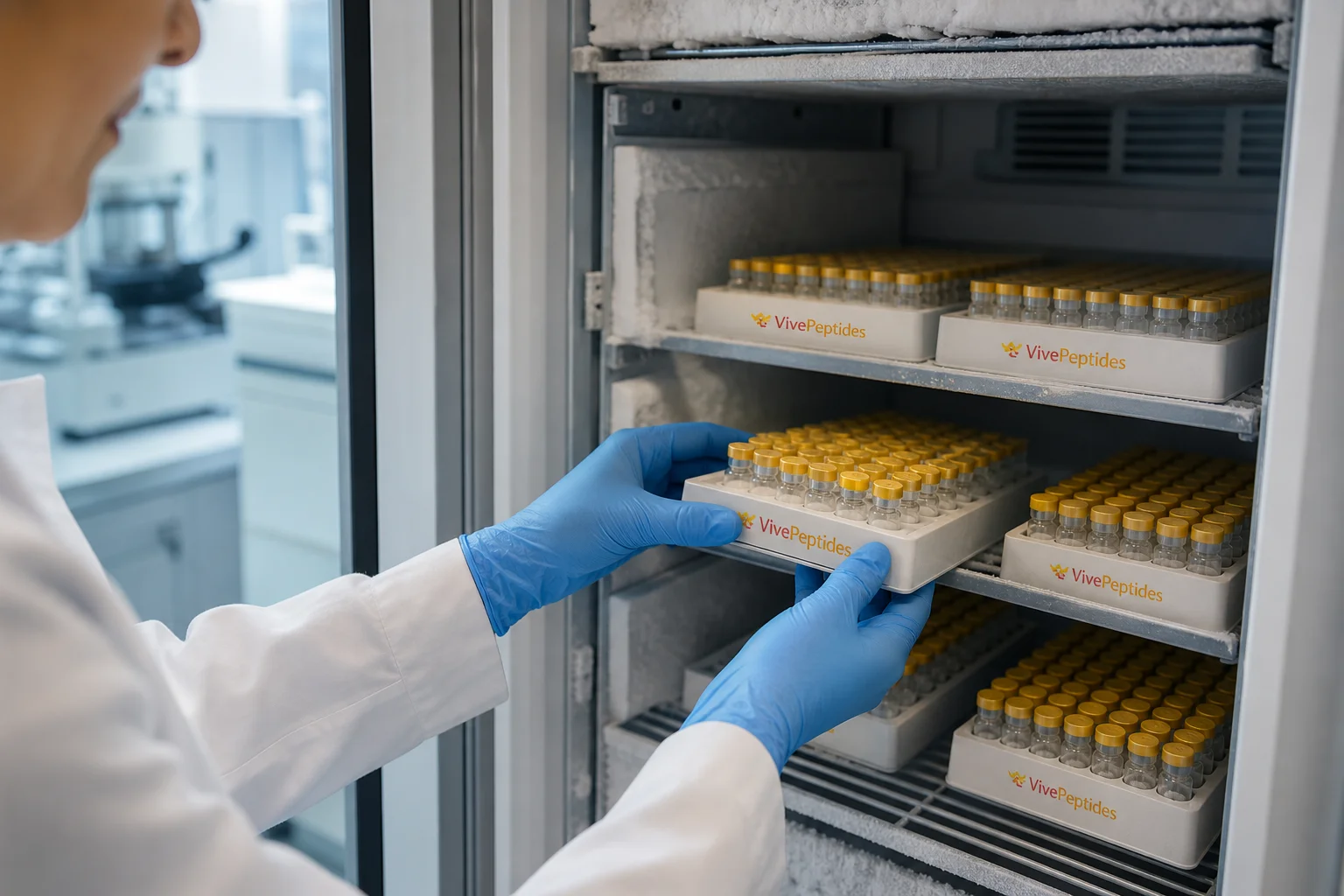
Storage requirements for research peptides generally follow the same core principles regardless of compound class: lyophilized (freeze-dried) peptide is far more stable than reconstituted solution, and both cagrilintide and Vive GLP(R) products should usually be kept frozen or refrigerated per the documentation that ships with each vial. Reconstituted peptide solution is the more fragile state for any compound in this category, and stability windows can vary by formulation, so a research program should always confirm the specific reconstituted stability window against the product documentation rather than assuming one compound's timeline applies to another. Reconstitution water quality and technique also affect how long a reconstituted vial stays stable, which is a variable a bulk buyer controls directly regardless of which compound class is on the shelf.
For volume stocking, that shared storage profile is convenient: a lab does not need two separate storage protocols for cagrilintide vs Vive GLP(R) products, just consistent freezer or refrigerator discipline and accurate labeling so reconstituted vials from different compound classes are not confused with each other.
Cost, Margin, and Combination Stocking Strategy
Margin comparisons between cagrilintide and Vive GLP(R) products should be built from your own supplier pricing and reorder volume, not a general industry figure, since research peptide pricing varies by supplier and batch size in ways a blanket number cannot capture. What is more useful than a single price comparison is the stocking logic underneath it: cagrilintide and Vive GLP(R) products are not substitutes competing for the same shelf space, so stocking both rarely cannibalizes either one's sales. A researcher studying Tirzepatide dual-agonist peptide protocols, which pair GIP and GLP-1 receptor activity, is not the same buyer as one studying a cagrilintide-only amylin pathway, and a program running the cagrilintide semaglutide combination needs both compounds on hand at once rather than choosing one over the other.
That logic also applies to stocking cagrilintide and Vive GLP(R) together for combination protocols: because the two compound classes act on different receptors, most published combination research pairs them rather than substituting one for the other, so a program supporting combination-protocol researchers should carry proportional volume of both instead of treating the decision as either-or. The practical stocking rule is to let your own protocol mix, not a general market assumption, set the ratio, and to revisit that ratio each time published trial data or your researcher base shifts which protocols are most active.
Frequently Asked Questions
Is cagrilintide the same thing as a GLP-1 like semaglutide? No. Cagrilintide is a long-acting amylin analogue that binds amylin and calcitonin receptors, while semaglutide is a GLP-1 receptor agonist that binds the GLP-1 receptor. They influence appetite and metabolic signaling through separate pathways, which is why published research frequently studies a cagrilintide semaglutide combination rather than treating the two as interchangeable options within the same compound class.
What is Vive GLP(R) and how is it different from standard GLP-1 compounds? Vive GLP(R) is our category name for the GLP-1 receptor agonist research peptides in the VivePeptides catalog, including semaglutide, liraglutide, and tirzepatide. Each activates the GLP-1 receptor, the same target used by standard GLP-1 pharmaceutical compounds, so the mechanism stays consistent across the category. Cagrilintide is different because it acts on amylin receptors instead.
How long is reconstituted cagrilintide stable compared to Vive GLP(R)? Reconstituted stability for both cagrilintide and Vive GLP(R) products depends on formulation, reconstitution water quality, and storage temperature, so the exact window should always be confirmed against the documentation for that specific vial rather than assumed. As a category, reconstituted peptide solution is generally less stable than lyophilized powder, which is why refrigeration and prompt use matter for both.
Do cagrilintide and Vive GLP(R) require different storage conditions? Not fundamentally. Both compound classes are typically stored frozen or refrigerated as lyophilized powder and refrigerated once reconstituted, following the documentation for each specific product. The storage principles are shared across the category; what changes is the individual product's documented stability window, which a research program should verify per vial rather than assuming uniformity across every compound.
Will stocking both cagrilintide and Vive GLP(R) cannibalize sales of each other? Generally no, because the two compound classes serve different research questions. Researchers studying amylin receptor pathways are not typically the same buyers choosing between GLP-1 receptor agonist products, and combination protocols studying the cagrilintide semaglutide pairing require both on hand simultaneously. Stocking both usually expands the range of protocols a program can support rather than splitting demand for one against the other.
Stock Research-Grade Peptides With VivePeptides
Whether your program is building out cagrilintide protocols, Vive GLP(R) combination studies, or both, VivePeptides supplies the research-grade compounds and documentation your lab needs to make that stocking decision with confidence. Browse the VivePeptides catalog to compare current inventory across the GLP-1 receptor agonist and amylin analogue categories.
Research Use Only
All information in this article is intended for educational and research purposes only. VivePeptides products are not intended for human or veterinary use.