
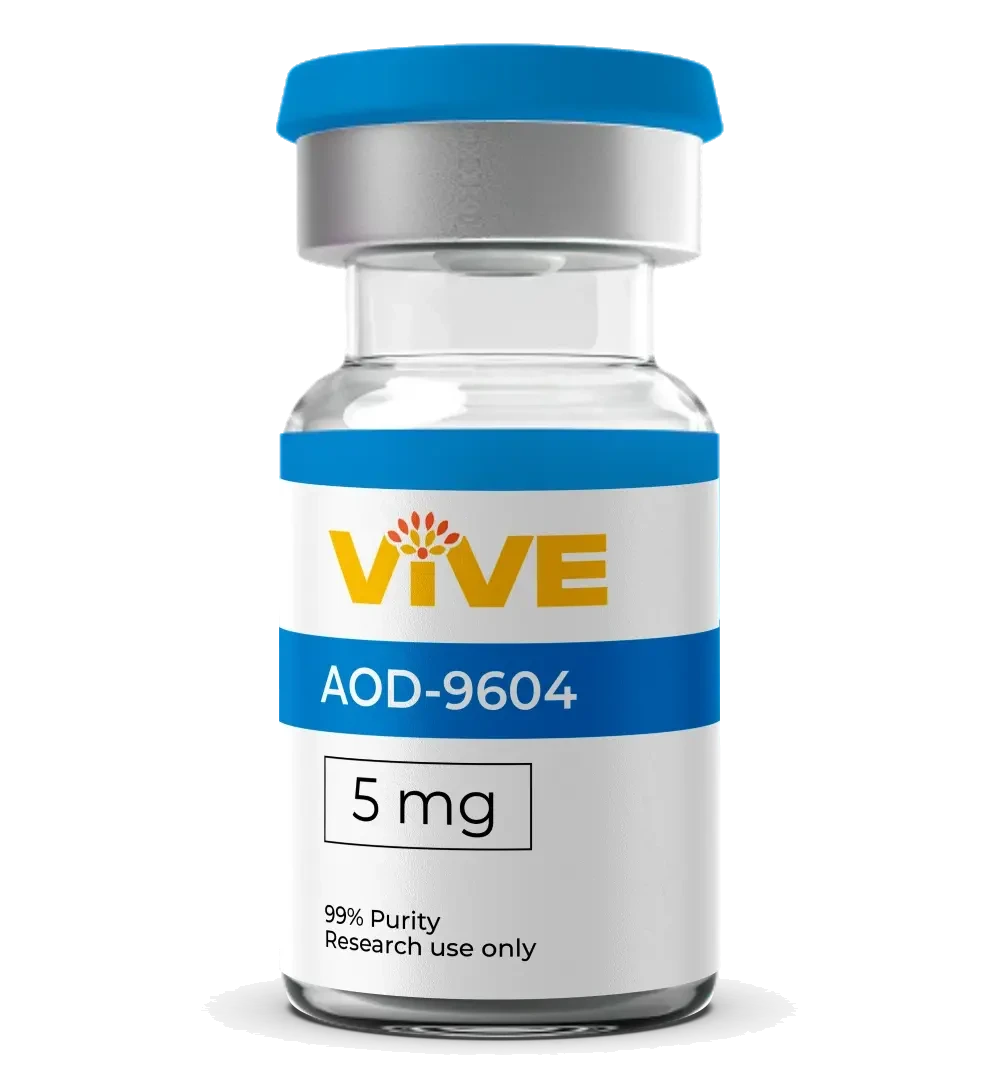
AOD-9604
Research Use OnlyThese products are sold strictly for laboratory and research use only and are not approved for human consumption, diagnosis, or therapeutic treatment. Not for human or veterinary use. These statements have not been evaluated by the Food and Drug Administration, and nothing on this page constitutes medical advice or a health claim.
- Size
- 5mg
Specifications
AOD-9604 Technical Profile
OVERVIEW
What Is AOD-9604 Peptide?
AOD-9604 is a synthetic peptide fragment derived from the C-terminus of human growth hormone (hGH), corresponding to the hGH(176-191) region with an added N-terminal tyrosine residue. Its full sequence, Tyr-Leu-Arg-Ile-Val-Gln-Cys-Arg-Ser-Val-Glu-Gly-Ser-Cys-Gly-Phe, includes a disulfide bridge that contributes to its structural stability. The name AOD-9604 stands for Anti-Obesity Drug-9604, reflecting the original research context in which this fragment was isolated and characterized.
As a research peptide, AOD-9604 occupies a distinct position in the landscape of metabolic research compounds. It was specifically designed to isolate the fat-metabolism activity associated with the C-terminal domain of hGH, separating that lipolytic signal from the broader hormonal and growth-promoting effects of the full hGH molecule. This makes the AOD-9604 peptide a useful tool for researchers investigating adipose tissue biology, lipid metabolism pathways, and the molecular pharmacology of growth hormone fragments in controlled laboratory settings.
VivePeptides supplies AOD-9604 as a 5mg lyophilized white powder with verified ≥99% purity by HPLC. Each vial carries a CAS number of 221231-10-3, molecular formula C78H123N23O23S2, and an approximate molecular weight of 1815.1 g/mol. This product is intended solely for in vitro and preclinical laboratory research by qualified investigators.
- 01
hGH C-Terminal Fragment
Synthetic 16-residue peptide corresponding to the hGH(176-191) sequence with an N-terminal tyrosine addition
- 02
≥99% HPLC Purity
Every batch of AOD-9604 5mg verified via high-performance liquid chromatography for identity and purity
- 03
USA Made and Verified
Third-party analytical testing performed in USA-based laboratories on every production lot
RESEARCH
AOD-9604 Mechanism of Action: Lipolysis and Fat Metabolism Pathways
The central focus of AOD-9604 peptide research has been the molecular mechanisms by which the hGH C-terminal fragment interacts with adipose tissue to influence lipid metabolism. Preclinical studies suggest that AOD-9604 mimics the lipolytic activity of full hGH within fat cells while operating through pathways that do not appear to engage the classical IGF-1 axis or produce the insulin-antagonizing effects associated with intact growth hormone. This functional separation is what drove early research interest in the fragment.
In adipocyte cell culture models and animal studies, AOD-9604 has been examined for its ability to stimulate lipolysis (the breakdown of stored triglycerides into free fatty acids and glycerol) and to inhibit lipogenesis (the synthesis and accumulation of new fat). Researchers have proposed that the peptide interacts with receptors or intracellular signaling nodes in adipose tissue that are distinct from the growth hormone receptor pathways responsible for IGF-1 stimulation, though the precise binding site and downstream cascade remain areas of active investigation in the published literature.
A key research distinction is that preclinical models investigating AOD-9604 have generally reported no significant impact on fasting blood glucose or circulating IGF-1 levels at the concentrations studied, in contrast to observations with intact hGH. This profile makes AOD-9604 a valuable comparator compound for researchers seeking to dissect the individual functional domains of growth hormone in metabolic contexts.
Lipolysis Stimulation in Adipocyte Models
Preclinical research using AOD-9604 in fat cell models has examined the peptide's capacity to activate lipolytic pathways, promoting breakdown of stored triglycerides. Studies by Heffernan et al. (2001) in the Journal of Clinical Endocrinology and Metabolism investigated the hGH 177-191 fragment and reported observations of enhanced fat mobilization in relevant animal models, contributing foundational data to the AOD-9604 research literature.
Lipogenesis Inhibition
Complementary to lipolysis research, laboratory investigations have explored whether AOD-9604 can suppress the formation of new adipose tissue. In vitro and rodent model studies associated with Ng, Bornstein, and related hGH fragment lipolysis work examined the inhibitory side of fat metabolism, suggesting the peptide may modulate lipogenic enzyme activity or substrate availability in adipocytes under experimental conditions.
IGF-1 and Glucose Independence
One of the most cited aspects of AOD-9604 research is the apparent decoupling of its adipose-targeted activity from the IGF-1 and blood glucose effects of full hGH. Animal model data have consistently noted that AOD-9604 peptide did not produce the hyperinsulinemic or IGF-1-elevating responses observed with exogenous intact growth hormone, positioning it as a selective research probe for the hGH lipolytic domain.
Disulfide Bridge and Structural Stability
The AOD-9604 sequence contains a disulfide bridge between the two cysteine residues at positions 7 and 14 of the fragment. This bridge confers structural rigidity to the peptide loop and is thought to be important for maintaining the bioactive conformation required for receptor engagement in research models. Proper reconstitution and storage protocols are critical to preserving disulfide bond integrity in laboratory settings.
COMPARISON
AOD-9604 vs Full hGH Fragment and Other Metabolic Research Peptides
AOD-9604
Researchers working in metabolic biology and adipose tissue pharmacology often evaluate AOD-9604 alongside related compounds, including the unmodified hGH(177-191) fragment, full-length recombinant hGH, and other peptides with reported effects on fat metabolism such as CJC-1295 and GHRP-6. Each compound presents a different mechanistic profile, specificity, and research application, making direct comparison useful for study design.
Full hGH Fragment and Other Metabolic Research Peptides
AOD-9604 is distinguished primarily by the addition of the N-terminal tyrosine residue to the native hGH(177-191) sequence, a modification that was introduced to improve stability and bioavailability in preclinical models. VivePeptides offers AOD-9604 5mg alongside other metabolic research peptides, all at research-grade purity from our USA-tested supply chain.
| Feature | AOD-9604 | hGH(177-191) Fragment | Full-Length hGH | CJC-1295 |
|---|---|---|---|---|
| Origin | Synthetic hGH C-terminal fragment, Tyr-modified | Native hGH C-terminal fragment (unmodified) | 191-amino-acid recombinant human growth hormone | Synthetic GHRH analogue with DAC modification |
| CAS Number | 221231-10-3 | Not independently registered (parent hGH) | Multiple registrations (recombinant forms) | 863288-34-0 (DAC form) |
| Molecular Weight | approx 1815.1 g/mol | approx 1648 g/mol | approx 22,124 g/mol | approx 3647 g/mol |
| Primary Research Focus | Lipolysis and lipogenesis in adipose tissue models | hGH lipolytic domain activity | Broad GH-axis, growth, metabolism, IGF-1 stimulation | GH secretion stimulation via GHRH receptor |
| IGF-1 Effect in Preclinical Models | Not observed in published animal studies | Minimal reported effect | Significant IGF-1 elevation | Elevated IGF-1 and GH release |
| Glucose/Insulin Effect | Not observed at studied concentrations | Minimal reported effect | Insulin-antagonizing effects reported | Indirect via GH axis |
| Research Literature Volume | Moderate, focused on fat metabolism | Limited (precursor literature) | Extensive, broad endocrine research | Moderate, GH secretagogue focus |
| VivePeptides Vial Size | 5mg | Not offered separately | Not offered | Available separately |
RESEARCH STUDIES
AOD-9604 Research Applications and Published Studies
The published research record for AOD-9604 peptide spans early characterization work on the lipolytic fragment of hGH through preclinical animal model studies and into early-phase clinical investigation, the latter now primarily of historical interest. Researchers continue to use AOD-9604 as a tool compound to probe the molecular biology of adipose tissue and to understand how discrete domains of growth hormone contribute to metabolic regulation. All study references below are to preclinical, laboratory, or early research contexts.
Heffernan et al. (2001), Journal of Clinical Endocrinology and Metabolism
This foundational study examined the hGH 177-191 fragment, the peptide core of AOD-9604, in animal models to evaluate its effects on fat metabolism independent of the IGF-1-stimulating properties of full growth hormone. The authors reported data consistent with selective lipolytic activity in adipose tissue, without the glucose-disrupting effects associated with intact hGH. This work established much of the mechanistic framework cited in subsequent AOD-9604 research and is frequently referenced as the primary preclinical evidence for the peptide's metabolic selectivity.
Ng, Bornstein and hGH Fragment Lipolysis Literature
A body of work associated with Ng, Bornstein, and collaborators contributed to characterizing the structure-activity relationship of hGH C-terminal fragments. These studies explored which residues within the 176-191 region were necessary for lipolytic signaling in fat cell models and helped justify the specific modifications incorporated into AOD-9604. The disulfide bridge between the two cysteine residues was identified as structurally important in this line of research, providing biochemical rationale for the peptide's conformation-dependent activity in adipocyte assays.
Early Clinical Investigation (Historical Context)
AOD-9604 is notable among research peptides for having progressed through Phase I and Phase II clinical investigations in humans, sponsored by Metabolic Pharmaceuticals Ltd., primarily in the early 2000s. These trials investigated safety and metabolic parameters in human subjects and generated pharmacokinetic data. This historical clinical record is referenced in the scientific literature to contextualize the compound's early development trajectory. VivePeptides supplies AOD-9604 strictly for research use only, and this historical clinical context does not alter the research-use-only status of this product.
Adipose Tissue Biology and Lipogenesis Inhibition Models
Beyond lipolysis, in vitro research models have been used to investigate AOD-9604's potential to suppress lipogenic pathways in pre-adipocyte and adipocyte cell lines. These studies have examined endpoints including fatty acid synthase activity, acetyl-CoA carboxylase expression, and triglyceride accumulation assays. The dual-action profile (promoting fat breakdown while suppressing fat synthesis) observed in cell models has been a recurring theme in AOD-9604 research publications and is considered a defining characteristic of this hGH fragment in preclinical literature.
QUALITY ASSURANCE
Quality and Testing Standards for AOD-9604 5mg
VivePeptides maintains rigorous analytical quality control across every production lot of AOD-9604 peptide. Our commitment to research-grade standards ensures that investigators receive a consistent, well-characterized compound for use in their laboratory protocols. Each vial of AOD-9604 5mg ships as a lyophilized white powder tested for identity, purity, and structural integrity before release.
HPLC and Mass Spectrometry Analysis
Every batch of VivePeptides AOD-9604 undergoes high-performance liquid chromatography (HPLC) to confirm purity and mass spectrometry analysis to verify molecular identity and confirm the correct molecular weight of approximately 1815.1 g/mol. The presence of the disulfide bridge is verified as part of the structural confirmation protocol.
Third-Party Independent Testing
All AOD-9604 lots are independently verified through third-party analytical laboratories based in the USA. VivePeptides does not release product until third-party testing confirms identity and purity specifications are met. Certificate of analysis documentation is available for every lot upon request by qualified researchers.
≥99% Purity Standard
VivePeptides AOD-9604 consistently meets or exceeds ≥99% purity as determined by HPLC analysis. This standard ensures that researchers working with our AOD-9604 peptide can trust the compound's integrity and comparability across experimental replicates and between research groups.
Storage and Handling Specifications
AOD-9604 5mg is supplied as lyophilized white powder and should be stored at -20°C in a desiccated environment protected from light. The lyophilized form is stable under these conditions. For reconstitution in laboratory settings, bacteriostatic water or sterile water is the recommended solvent. Once reconstituted, solutions should be stored at 2-8°C and used promptly. Avoid repeated freeze-thaw cycles to maintain peptide integrity.
FAQ
Frequently Asked Questions About AOD-9604
What is AOD-9604 used for in research?
What purity is VivePeptides AOD-9604?
What does 'AOD 9604 dosage' mean in a research protocol context?
How should AOD-9604 5mg be stored and reconstituted in a laboratory setting?
Where can I buy AOD-9604 for research purposes?
Add To Research Cart
AOD-9604
99%+ purity · USA lab tested · secure shipping
You May Also Research
Related Compounds
These products are sold strictly for laboratory and research use only and are not approved for human consumption, diagnosis, or therapeutic treatment. Not for human or veterinary use. These statements have not been evaluated by the Food and Drug Administration, and nothing on this page constitutes medical advice or a health claim.