
Cognitive & Mood
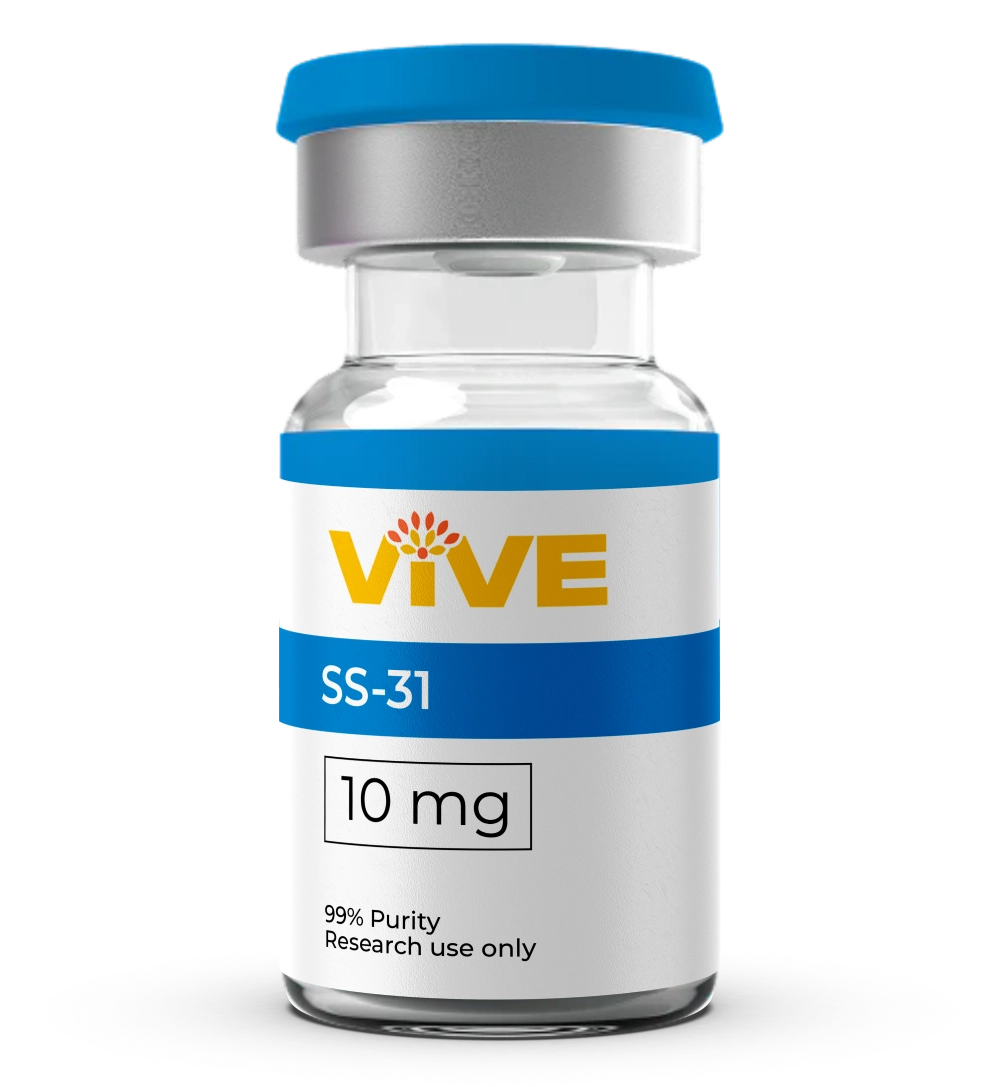
SS-31
Research Use OnlyThese products are sold strictly for laboratory and research use only and are not approved for human consumption, diagnosis, or therapeutic treatment. Not for human or veterinary use. These statements have not been evaluated by the Food and Drug Administration, and nothing on this page constitutes medical advice or a health claim.
Formula
- Size
- 10mg
Specifications
SS-31 Technical Profile
OVERVIEW
What Is SS 31 Peptide?
SS 31 is a synthetic, cell-permeable tetrapeptide designed to selectively target the inner mitochondrial membrane. Also known as Elamipretide, MTP-131, and Bendavia, SS 31 was developed by Hazel Szeto and Peter Bhatt at Weill Cornell Medical College as part of the Szeto-Schiller (SS) peptide series. It has emerged as one of the most important research tools for studying mitochondrial dysfunction, with preclinical and clinical studies spanning cardiovascular, renal, neurological, and aging research.
As a research peptide, SS 31 belongs to the Szeto-Schiller class of mitochondria-targeted antioxidant peptides. Its unique structure, incorporating the unnatural amino acid 2',6'-dimethyltyrosine (Dmt), enables selective accumulation in the inner mitochondrial membrane at concentrations 1,000-fold to 5,000-fold higher than the surrounding cytoplasm. This targeting specificity, combined with its small molecular weight of 639.8 Da, has made SS 31 a foundational compound in mitochondrial biology research.
- 01
Mitochondria-Targeted Tetrapeptide
Synthetic 4-amino-acid peptide that selectively accumulates in the inner mitochondrial membrane
- 02
≥99% HPLC Purity
Every batch verified via high-performance liquid chromatography
- 03
USA Made & Verified
Third-party analytical testing performed in USA laboratories
RESEARCH
SS 31 Mechanism of Action in Research
The SS 31 mechanism of action is centered on its unique ability to selectively target and accumulate within the inner mitochondrial membrane. Research has identified cardiolipin binding as the primary molecular interaction driving its effects on mitochondrial function and bioenergetics.
Cardiolipin Binding and Stabilization
SS 31 selectively binds to cardiolipin, a phospholipid found exclusively in the inner mitochondrial membrane that is essential for electron transport chain function. Research by Birk et al. (2013) published in the Journal of the American Chemical Society demonstrated that SS 31 interacts with cardiolipin through electrostatic and hydrophobic interactions, stabilizing its structure and preventing oxidative damage. Cardiolipin peroxidation is a hallmark of mitochondrial dysfunction, and SS 31's protective effect on this critical lipid represents its primary therapeutic mechanism.
Electron Transport Chain Optimization
By stabilizing cardiolipin, SS 31 improves the organization and function of respiratory chain supercomplexes (Complexes I, III, and IV). Research indicates this supercomplex stabilization enhances electron transfer efficiency, reduces electron leak, and increases ATP production. Szeto et al. (2014) published findings demonstrating that SS 31 improved mitochondrial coupling efficiency in multiple preclinical models, directly linking cardiolipin stabilization to improved bioenergetic output.
Reactive Oxygen Species Reduction
SS 31 research has consistently demonstrated reduced mitochondrial reactive oxygen species (ROS) production. Rather than functioning as a conventional antioxidant that scavenges existing ROS, SS 31 reduces ROS generation at the source by improving electron transport chain efficiency. This mechanistic distinction is important because it addresses the cause of oxidative stress rather than its downstream effects. Published studies have shown that SS 31 reduces mitochondrial superoxide production without disrupting normal ROS signaling required for cellular homeostasis.
COMPARISON
SS 31 vs MOTS-c: Research Peptide Comparison
SS 31
Both SS 31 and MOTS-c are peptides studied for their effects on mitochondrial function, but they differ fundamentally in origin, structure, and mechanism. SS 31 is a synthetic tetrapeptide that targets the inner mitochondrial membrane, while MOTS-c is a mitochondrial-derived peptide encoded by mitochondrial DNA. Understanding these differences helps researchers select the appropriate compound for their specific laboratory protocols.
MOTS-c
Both peptides are valuable tools in mitochondrial research. SS 31 is the primary compound for studying mitochondrial membrane function and bioenergetics, while MOTS-c is preferred for metabolic signaling and exercise physiology research. VivePeptides offers both SS 31 and MOTS-c at research-grade purity from our USA-based facility.
| Feature | SS 31 | MOTS-c |
|---|---|---|
| Origin | Synthetic (Szeto-Schiller series) | Endogenous (mitochondrial DNA encoded) |
| Amino Acids | 4 | 16 |
| CAS Number | 736992-21-5 | 1627580-64-6 |
| Molecular Weight | 639.8 Da | 2174.6 Da |
| Primary Research Focus | Cardiolipin stabilization and ETC function | AMPK activation and metabolic regulation |
| Target Location | Inner mitochondrial membrane | Cytoplasm and nucleus |
| Proposed Mechanism | Cardiolipin binding, ROS reduction | AMPK/AICAR pathway, gene regulation |
| Research Volume | 150+ published studies | 30+ published studies |
RESEARCH STUDIES
SS 31 Research Applications & Published Studies
SS 31 research spans over fifteen years of published preclinical and clinical literature. The following areas represent the most actively investigated applications. All references are to research contexts only.
Cardiovascular Research
SS 31 has been extensively studied in cardiovascular models. Dai et al. (2013) published findings in the Journal of the American Heart Association demonstrating SS 31's effects on cardiac mitochondrial function in aging models. Subsequent clinical studies have examined Elamipretide in heart failure with reduced ejection fraction, with multiple Phase 2 and Phase 3 trials investigating its potential to improve cardiac energetics and function.
Renal and Kidney Research
Published research has examined SS 31 in kidney injury models. Szeto et al. (2011) reported observations of SS 31's effects on mitochondrial function in ischemia-reperfusion kidney injury models. These studies demonstrated that mitochondria-targeted therapy could preserve renal function by protecting mitochondrial integrity during acute stress, contributing to the growing body of research on mitochondrial dysfunction in kidney disease.
Neurological and Aging Research
SS 31 research has expanded into neurological applications and aging biology. Yin et al. (2016) published studies examining SS 31's effects on mitochondrial function in neurodegeneration models. Research into SS 31 and aging has demonstrated improvements in multiple age-related mitochondrial parameters, including ATP production, ROS levels, and mitochondrial membrane potential in animal models (Siegel et al., 2013).
QUALITY ASSURANCE
Quality & Testing Standards
VivePeptides maintains rigorous quality control for every batch of SS 31 peptide. Our commitment to research-grade purity ensures that laboratories receive consistent, reliable compounds for their investigations.
HPLC & Mass Spectrometry
Every batch of SS 31 undergoes high-performance liquid chromatography (HPLC) and mass spectrometry analysis to confirm identity, purity, and molecular weight.
Third-Party Verified
All VivePeptides SS 31 is independently verified through third-party analytical laboratories based in the USA. Testing documentation is available for every lot.
≥99% Purity Standard
Our SS 31 consistently meets or exceeds ≥99% purity as determined by HPLC analysis, ensuring research-grade quality for laboratory applications.
FAQ
Frequently Asked Questions About SS 31
What is SS 31 used for in research?
What purity is VivePeptides SS 31?
How should SS 31 be stored?
What is the difference between SS 31 and Elamipretide?
Is VivePeptides SS 31 third-party tested?
BPC-157
NAD+ Precursors
Gastric pentadecapeptide for multi-pathway protective research
Compounds for NAD+ metabolism and mitochondrial function research
Explore More Research Peptides
Selank · Semax · Tesamorelin · NAD+ · SNAP-8 · All Peptides →
Add To Research Cart
SS-31
99%+ purity · USA lab tested · secure shipping
These products are sold strictly for laboratory and research use only and are not approved for human consumption, diagnosis, or therapeutic treatment. Not for human or veterinary use. These statements have not been evaluated by the Food and Drug Administration, and nothing on this page constitutes medical advice or a health claim.