
GLP-1 & Metabolic
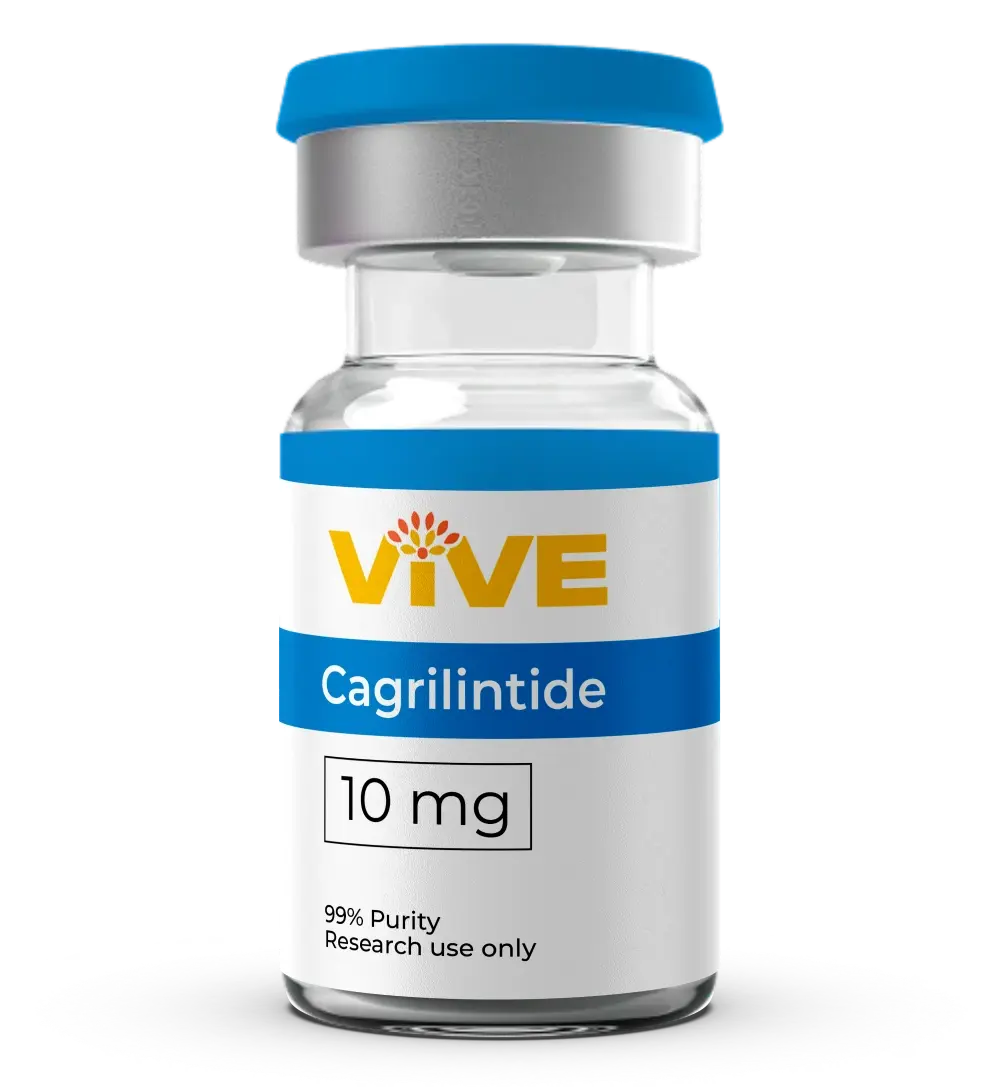
Cagrilintide
Research Use OnlyThese products are sold strictly for laboratory and research use only and are not approved for human consumption, diagnosis, or therapeutic treatment. Not for human or veterinary use. These statements have not been evaluated by the Food and Drug Administration, and nothing on this page constitutes medical advice or a health claim.
- Size
- 10mg
Specifications
Cagrilintide Technical Profile
OVERVIEW
What Is Cagrilintide?
Cagrilintide (development code AM833, CAS 1415456-99-3) is a long-acting synthetic analog of human amylin, supplied as a lyophilized powder for laboratory research. Amylin, also called islet amyloid polypeptide (IAPP), is a 37 residue hormone co-secreted with insulin from pancreatic beta cells, and it is one of the principal endogenous signals studied in models of meal termination, gastric motility, and postprandial glucagon regulation. Native human amylin is poorly suited to experimental work because it aggregates readily into amyloid fibrils and clears within minutes, which is the specific problem cagrilintide was engineered to solve.
Structurally, cagrilintide retains the 37 residue amylin backbone with substitutions at positions 14, 17, and 37 that suppress fibril formation and improve metabolic stability, plus an eicosanedioic (C20) fatty diacid attached through a gamma glutamic acid linker. That acyl chain drives reversible albumin binding in circulation, which slows renal clearance and extends the reported elimination half-life into the range of roughly 159 to 195 hours. The practical result for a research setting is a stable, soluble amylin receptor agonist with a duration of action measured in days rather than minutes. Researchers who buy cagrilintide from VivePeptides receive a lyophilized preparation at greater than or equal to 99% purity from a trusted USA supplier.
- 01
Long-Acting Amylin Analog
37 residue amylin backbone with C20 diacid acylation for albumin binding and extended half-life
- 02
≥99% HPLC Purity
Every batch verified via high-performance liquid chromatography
- 03
USA Made & Verified
Third-party analytical testing performed in USA laboratories
RESEARCH
Cagrilintide Mechanism of Action in Research
The cagrilintide mechanism of action described in the literature is non-selective agonism across the amylin receptor family. Amylin receptors are not single proteins but heterodimers: a calcitonin receptor core paired with one of three receptor activity-modifying proteins, giving AMY1 (RAMP1), AMY2 (RAMP2), and AMY3 (RAMP3). Cagrilintide activates all three, and it retains activity at the calcitonin receptor itself. This broad profile distinguishes it from selective amylin analogs and is a recurring variable in comparative receptor pharmacology work (Kruse et al., Journal of Medicinal Chemistry, 2021).
AMY1-3 Receptor Agonism
Signals through calcitonin receptor and RAMP1, RAMP2, and RAMP3 heterodimers, which are densely expressed in the area postrema, nucleus tractus solitarius, and hypothalamus. These hindbrain and hypothalamic nodes are the standard anatomical focus of amylin signaling research.
Albumin-Mediated Protraction
The gamma glutamic acid linked C20 diacid binds serum albumin reversibly, creating a circulating depot that reduces glomerular filtration. Reported elimination half-life sits near 159 to 195 hours, which supports weekly-interval dosing schedules in preclinical protocols.
Anti-Fibrillation Substitutions
Position 14, 17, and 37 substitutions reduce the amyloidogenic behavior that makes native human amylin difficult to formulate and study. This is what allows the analog to be handled as a conventional aqueous research reagent.
COMPARISON
Cagrilintide vs Native Human Amylin: Research Compound Comparison
Cagrilintide
The most informative comparison for cagrilintide is against the endogenous hormone it was designed to replace in experimental systems. Native human amylin is the physiological reference ligand, but its aggregation kinetics and sub-hour half-life confound almost any study longer than an acute infusion. Cagrilintide preserves the receptor pharmacology while removing both liabilities, which is why it has largely displaced native amylin as the tool compound in chronic-exposure models.
Native Human Amylin
Amylin receptor signaling is also studied alongside incretin receptor signaling, since the two pathways converge on energy balance through partly separate routes: amylin acts prominently through hindbrain circuits governing meal size and gastric emptying, while incretin receptor agonists act substantially through hypothalamic and peripheral routes. Researchers investigating that intersection often run cagrilintide in parallel with a multi-receptor incretin agonist such as Vive GLP(R). Both are supplied here for research use only.
| Feature | Cagrilintide | Native Human Amylin |
|---|---|---|
| CAS Number | 1415456-99-3 | 106602-62-4 |
| Molecular Weight | ≈4409 g/mol | ≈3903 g/mol |
| Structure | 37 residues, substituted at positions 14, 17, and 37, C20 diacid acylated | 37 residues, unmodified, C-terminal amide and 2-7 disulfide bridge |
| Elimination Half-Life | Approximately 159 to 195 hours | Approximately 13 minutes |
| Aggregation Behavior | Substitutions suppress amyloid fibril formation | Highly amyloidogenic, forms islet amyloid fibrils |
| Receptor Activity | Non-selective agonist at AMY1, AMY2, AMY3, and the calcitonin receptor | Endogenous agonist at AMY1, AMY2, AMY3 |
| Primary Research Focus | Chronic-exposure metabolic models, receptor pharmacology, weekly-interval protocols | Acute physiological reference ligand, islet amyloid and beta cell studies |
RESEARCH STUDIES
Cagrilintide Research Applications & Published Studies
Published cagrilintide work spans medicinal chemistry, receptor pharmacology, and preclinical metabolic modeling. The foundational paper describing the design rationale, the acylation strategy, and the in vivo pharmacokinetic profile is Kruse and colleagues in the Journal of Medicinal Chemistry (2021), and it remains the standard citation for the analog's structure-activity work. Downstream literature has focused on amylin receptor signaling in hindbrain feeding circuits and on the combination pharmacology of amylin and incretin pathways in animal models.
Receptor Pharmacology
Used as a long-acting probe to characterize AMY1-3 and calcitonin receptor activation, receptor selectivity profiling, and RAMP-dependent signaling bias in cell-based assays.
Preclinical Metabolic Models
Applied in diet-induced obesity and energy-balance models to examine food intake, gastric emptying rate, and body composition endpoints over multi-week exposure windows.
Combination Pathway Research
Studied in parallel with incretin receptor agonists to investigate whether amylin and incretin signaling produce additive or independent effects on energy homeostasis endpoints in animal models.
QUALITY ASSURANCE
Quality & Testing Standards
HPLC Verified ≥99%
Purity confirmed by reverse-phase high-performance liquid chromatography on every production batch.
Mass Spectrometry Confirmed
Molecular identity verified by mass spectrometry against the expected 4409 g/mol target mass.
Third-Party USA Laboratories
Independent analytical testing performed in United States laboratories, with certificates of analysis available.
FAQ
Frequently Asked Questions About Cagrilintide
What is cagrilintide?
What is cagrilintide used for in research?
What is the cagrilintide mechanism of action?
How does cagrilintide differ from native amylin?
What is the molecular weight and CAS number of cagrilintide?
How should cagrilintide be stored and reconstituted?
Is VivePeptides cagrilintide third-party tested?
Add To Research Cart
Cagrilintide
99%+ purity · USA lab tested · secure shipping
These products are sold strictly for laboratory and research use only and are not approved for human consumption, diagnosis, or therapeutic treatment. Not for human or veterinary use. These statements have not been evaluated by the Food and Drug Administration, and nothing on this page constitutes medical advice or a health claim.