
Longevity & Cellular
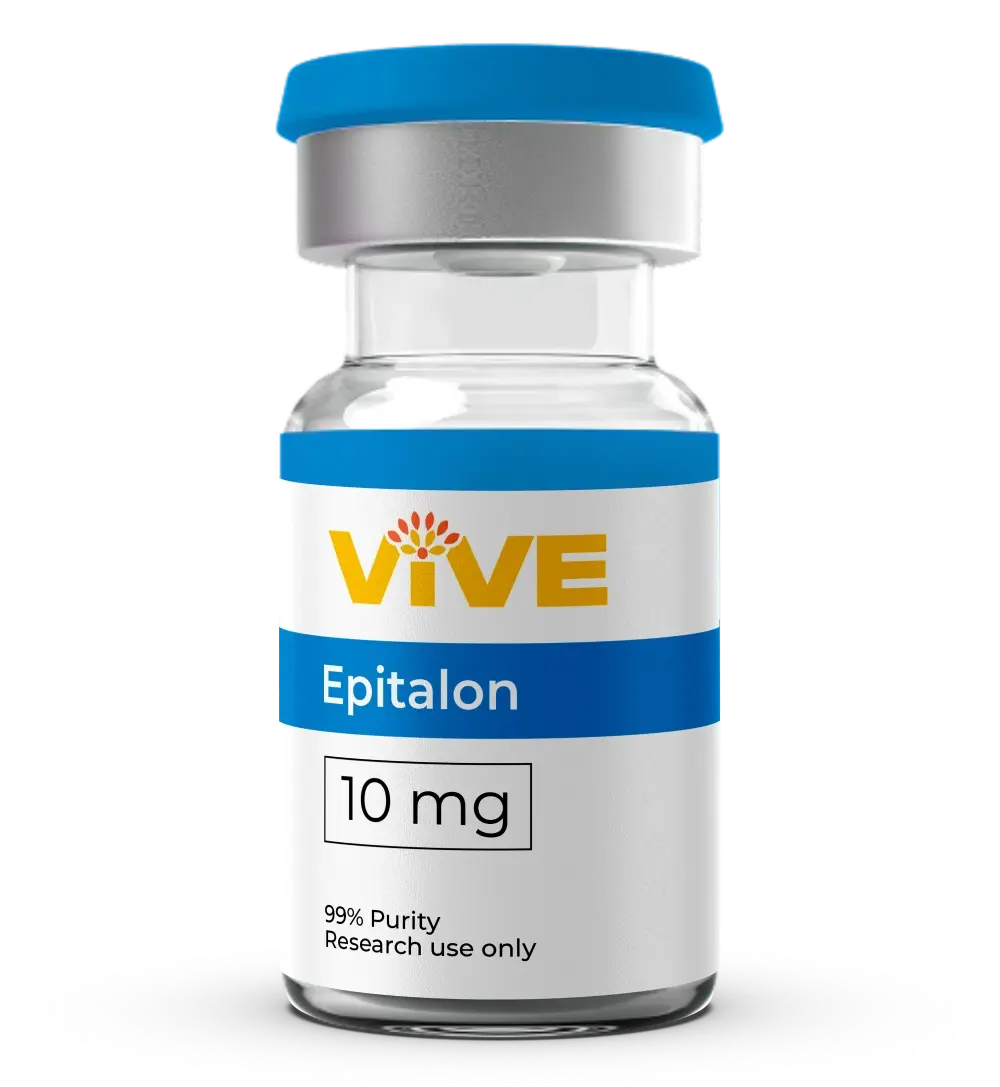
Epitalon
Research Use OnlyThese products are sold strictly for laboratory and research use only and are not approved for human consumption, diagnosis, or therapeutic treatment. Not for human or veterinary use. These statements have not been evaluated by the Food and Drug Administration, and nothing on this page constitutes medical advice or a health claim.
- Size
- 10mg
Specifications
Epitalon Technical Profile
OVERVIEW
What Is Epitalon (Epithalon, AEDG)?
Epitalon is a synthetic tetrapeptide with the amino acid sequence alanine-glutamate-aspartate-glycine (Ala-Glu-Asp-Gly), commonly abbreviated AEDG. It was designed at the St. Petersburg Institute of Bioregulation and Gerontology by Vladimir Khavinson and colleagues as a defined, fully synthetic analog of epithalamin, a bovine pineal gland extract that Russian gerontology groups had studied since the 1970s. Where epithalamin is a heterogeneous polypeptide preparation, Epitalon is a single four-residue sequence with a fixed molecular identity (CAS 307297-39-8, C14H22N4O9, 390.35 g/mol), which is what makes it usable as a reproducible laboratory reagent.
Epitalon research concentrates on three areas: telomerase expression and telomere dynamics in cultured human cells, regulation of pineal melatonin rhythm and circadian output, and lifespan and age-related endpoints in model organisms. Because the peptide is short, water soluble, and chemically well defined, it is frequently used in cell-culture work investigating replicative senescence and the Hayflick limit. Note that Epitalon and Epithalon are two transliterations of the same compound and are used interchangeably in the literature. Researchers who buy Epitalon from VivePeptides receive a lyophilized preparation at greater than or equal to 99% purity from a trusted USA supplier.
- 01
Synthetic AEDG Tetrapeptide
Ala-Glu-Asp-Gly, a defined four-residue analog of the pineal extract epithalamin
- 02
≥99% HPLC Purity
Every batch verified via high-performance liquid chromatography
- 03
USA Made & Verified
Third-party analytical testing performed in USA laboratories
RESEARCH
Epitalon Mechanism of Action in Research
The proposed Epitalon mechanism of action is transcriptional rather than receptor-mediated. Khavinson's group reported that short regulatory peptides such as AEDG can interact directly with double-stranded DNA and influence gene transcription, and the peptide's best-characterized in vitro readout is induction of telomerase (hTERT) activity in human somatic cells (Khavinson, Bondarev & Butyugov, Bulletin of Experimental Biology and Medicine, 2003). The mechanistic picture remains an active research question rather than a settled one.
Telomerase Induction & Telomere Elongation
In human fetal fibroblast cultures, Epitalon induced telomerase enzymatic activity and produced measurable telomere elongation, and treated cultures continued dividing past the passage at which control cultures arrested (Khavinson, Bondarev, Butyugov & Smirnova, Bulletin of Experimental Biology and Medicine, 2004). A 2025 independent replication at Brunel University London reported telomere lengthening across human cell lines through telomerase upregulation or alternative lengthening of telomeres, the first well-documented result of its kind from outside the originating laboratory (Al-Dulaimi et al., Biogerontology, 2025).
Direct Peptide-DNA Interaction & Gene Transcription
Khavinson and colleagues proposed that AEDG-class peptides bind the DNA double helix in a sequence-preferential manner and modulate transcription in a way conceptually similar to transcription factors, rather than acting through a cell-surface receptor (Khavinson, Shataeva & Chernova, Bulletin of Experimental Biology and Medicine, 2003; Neuro Endocrinology Letters, 2005). This model is the basis for most downstream Epitalon research design.
Pineal & Circadian Regulation
Epitalon was derived from a pineal extract, and a significant share of the literature examines its effect on melatonin secretion and circadian output. Reported findings include restoration of age-disrupted melatonin and cortisol rhythms in aged rhesus monkeys, which is why circadian and neuroendocrine models are a standard experimental context for this peptide. ---
COMPARISON
Epitalon vs Epithalamin: Research Compound Comparison
Epitalon
Epitalon and epithalamin appear side by side throughout the gerontology literature and are frequently confused, but they are not the same class of material. Epithalamin is the original bovine pineal gland extract; Epitalon is the synthetic tetrapeptide identified as its putative active component.
Epithalamin
The distinction matters for study design. An extract carries batch-to-batch compositional variability and cannot be specified by a single molecular weight or CAS number, while a synthetic tetrapeptide can be characterized to a defined purity standard and reproduced exactly. VivePeptides Epitalon for sale is manufactured to greater than or equal to 99% purity for reliable laboratory research.
| Feature | Epitalon (AEDG) | Epithalamin |
|---|---|---|
| Material Type | Synthetic tetrapeptide, single defined sequence | Bovine pineal gland peptide extract |
| CAS Number | 307297-39-8 | Not applicable (multi-component extract) |
| Molecular Weight | 390.35 g/mol | Not applicable (heterogeneous preparation) |
| Sequence | Ala-Glu-Asp-Gly (AEDG) | Mixture of pineal polypeptides |
| Batch Reproducibility | High, verifiable by HPLC and mass spectrometry | Variable, dependent on source tissue and extraction |
| Research Applications | Telomerase and telomere assays, circadian models, gene-transcription studies | Historical Russian gerontology and lifespan studies |
| Origin | Synthesized as a defined analog of the extract | Isolated from bovine pineal tissue |
RESEARCH STUDIES
Epitalon Research Applications & Published Studies
The Epitalon literature spans cell-culture telomere biology, circadian neuroendocrinology, and lifespan studies in model organisms. Most of the foundational work originates from a single research institute, so independent replication is an important consideration when interpreting it.
Telomerase & Replicative Senescence
The originating studies reported telomerase activation and telomere elongation in human somatic cell cultures, with treated fibroblasts continuing to divide beyond the point at which untreated cultures arrested (Khavinson et al., Bulletin of Experimental Biology and Medicine, 2003 and 2004). Al-Dulaimi and colleagues (Biogerontology, 2025) subsequently reported telomere lengthening across human cell lines via telomerase upregulation or ALT activity.
Circadian Rhythm & Melatonin Models
Because Epitalon derives from a pineal extract, melatonin and circadian endpoints are a recurring experimental focus. Published work in aged primate and rodent models examines restoration of age-disrupted melatonin and cortisol secretion patterns, making Epitalon a reagent of interest in chronobiology and neuroendocrine aging research.
Lifespan & Age-Related Endpoints in Model Organisms
Rodent and invertebrate studies report effects on mean lifespan and age-associated markers, including work in female rats under varying light regimens (Vinogradova et al., 2007) and dose-dependent lifespan extension in Drosophila melanogaster. A 2025 review consolidates the Epitalon literature and its methodological limitations (Araj et al., International Journal of Molecular Sciences, 2025). Epitalon has no approved human medical use in any jurisdiction and is sold here strictly as a research chemical.
QUALITY ASSURANCE
Quality & Testing Standards
HPLC & Mass Spectrometry
Every Epitalon batch undergoes HPLC and mass spectrometry analysis to confirm identity, purity, and molecular weight.
Third-Party Verified
All Epitalon is independently tested at third-party USA-based analytical laboratories with lot-specific documentation.
≥99% Purity Standard
VivePeptides Epitalon consistently meets or exceeds ≥99% purity as verified by HPLC for reliable research results.
FAQ
Frequently Asked Questions About Epitalon
What is Epitalon used for in research?
What is the difference between Epitalon and Epithalon?
What purity is VivePeptides Epitalon?
How should Epitalon be stored?
Does Epitalon actually lengthen telomeres?
What is the AEDG peptide?
Is VivePeptides Epitalon third-party tested?
Add To Research Cart
Epitalon
99%+ purity · USA lab tested · secure shipping
You May Also Research
Related Compounds
These products are sold strictly for laboratory and research use only and are not approved for human consumption, diagnosis, or therapeutic treatment. Not for human or veterinary use. These statements have not been evaluated by the Food and Drug Administration, and nothing on this page constitutes medical advice or a health claim.