
Specialty
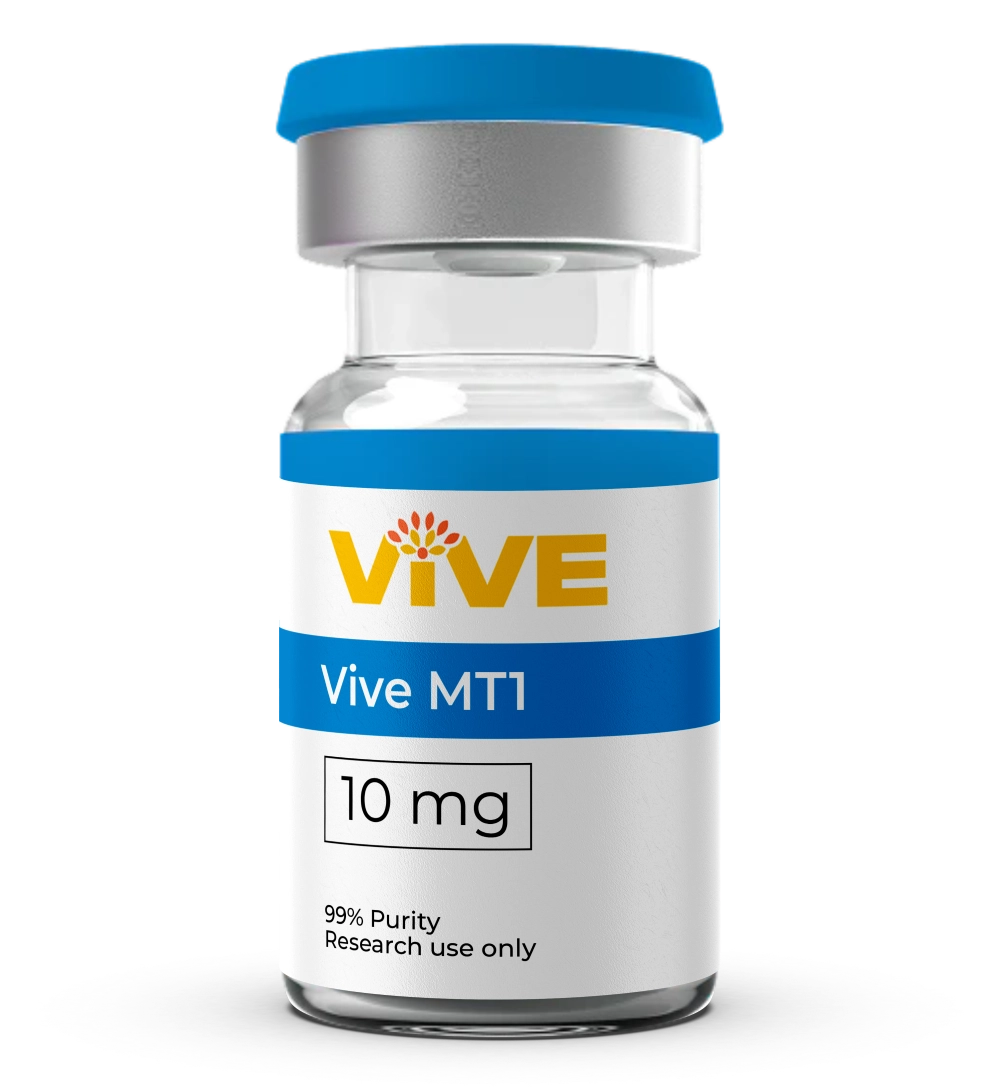
Melanotan 1 (MT1)
Research Use OnlyThese products are sold strictly for laboratory and research use only and are not approved for human consumption, diagnosis, or therapeutic treatment. Not for human or veterinary use. These statements have not been evaluated by the Food and Drug Administration, and nothing on this page constitutes medical advice or a health claim.
- Size
- 10mg
Specifications
Melanotan 1 (MT1) Technical Profile
OVERVIEW
What Is MT-1 Peptide?
MT-1, commonly referred to as Melanotan 1 or by its pharmaceutical research name Afamelanotide, is a synthetic tridecapeptide analog of the naturally occurring alpha-melanocyte-stimulating hormone (α-MSH). Developed in the 1980s at the University of Arizona, MT-1 was designed as a more potent and stable version of α-MSH for research into melanocortin receptor signaling and skin pigmentation biology. The peptide has been the subject of extensive preclinical and clinical research, with published studies spanning over three decades.
Unlike its cyclic counterpart MT-2, Melanotan 1 is a linear peptide with high selectivity for the melanocortin 1 receptor (MC1R). This selectivity has made MT-1 peptide a valuable tool for researchers investigating MC1R-specific signaling pathways. In laboratory settings, MT-1 research has contributed significantly to the scientific understanding of melanogenesis, photoprotection mechanisms, and melanocortin receptor biology.
- 01
Selective MC1R Agonist
Linear 13-amino-acid analog of alpha-melanocyte-stimulating hormone with high MC1R selectivity
- 02
≥99% HPLC Purity
Every batch verified via high-performance liquid chromatography
- 03
USA Made & Verified
Third-party analytical testing performed in USA laboratories
RESEARCH
MT-1 Mechanism of Action in Research
The MT-1 mechanism of action centers on its interaction with melanocortin receptors, particularly MC1R, which plays a central role in melanogenesis. Published research has characterized MT-1 as a potent and selective MC1R agonist, distinguishing it from broader melanocortin receptor agonists. MT-1 research continues to inform our understanding of melanocortin signaling in laboratory and clinical research settings.
Melanocortin 1 Receptor (MC1R) Activation
MT-1 binds to and activates the melanocortin 1 receptor (MC1R) on melanocytes. Research indicates that upon MC1R binding, MT-1 triggers the cAMP signaling cascade, leading to activation of protein kinase A (PKA) and subsequent upregulation of microphthalmia-associated transcription factor (MITF). MITF activation drives the expression of melanogenic enzymes including tyrosinase, TRP-1, and TRP-2, which are essential for eumelanin synthesis (Barnetson et al., 2006). This selective MC1R agonism distinguishes MT-1 from non-selective melanocortin agonists in research applications.
Eumelanin Production Pathway
Studies indicate that MT-1 preferentially promotes the eumelanin synthesis pathway over pheomelanin production. Eumelanin, the brown-black pigment, is associated with photoprotective properties in research models. Published studies have demonstrated that MT-1 administration in research settings shifts the eumelanin-to-pheomelanin ratio, providing researchers with a tool to investigate the biological differences between these melanin subtypes (Brenner & Hearing, 2008). This pathway specificity has made MT-1 peptide a preferred compound in melanogenesis research.
Photoprotection Research Applications
Beyond direct melanogenesis, MT-1 research has explored the peptide's role in DNA repair mechanisms associated with UV-induced damage. Studies suggest that MC1R signaling may influence nucleotide excision repair pathways independently of pigmentation. Researchers have investigated how MT-1-mediated MC1R activation may modulate cellular responses to ultraviolet radiation in laboratory models, adding another dimension to the peptide's research utility (Abdel-Malek et al., 2006). ---
COMPARISON
MT-1 vs MT-2: Research Peptide Comparison
MT-1
MT-1 (Melanotan 1) and MT-2 (Melanotan 2) are both synthetic analogs of alpha-melanocyte-stimulating hormone (α-MSH), but they differ significantly in structure, receptor selectivity, and research applications. Understanding these differences is essential for researchers selecting the appropriate compound for their specific melanocortin receptor studies.
MT-2
Both peptides are valuable tools in melanocortin research, but their receptor selectivity profiles make them suitable for different experimental paradigms. MT-1 is preferred when MC1R-specific data is required, while MT-2 is used in studies requiring broader melanocortin system activation. VivePeptides offers both MT-1 for sale and MT-2 at research grade purity from our USA-based facility.
| Feature | MT-1 (Melanotan 1) | MT-2 (Melanotan 2) |
|---|---|---|
| Structure | Linear tridecapeptide | Cyclic heptapeptide |
| Amino Acids | 13 | 7 |
| CAS Number | 75921-69-6 | 121062-08-6 |
| Molecular Weight | 1646.85 Da | 1024.18 Da |
| Receptor Selectivity | Highly selective for MC1R | Non-selective (MC1R, MC3R, MC4R, MC5R) |
| Primary Research Focus | MC1R-specific melanogenesis research | Broad melanocortin receptor research |
| Stability | Stable linear structure | Cyclized for enhanced stability |
| Proposed Mechanism | cAMP/PKA/MITF via MC1R | Multi-receptor melanocortin activation |
| Research Volume | 100+ published studies | 200+ published studies |
RESEARCH STUDIES
MT-1 Research Applications & Published Studies
MT-1 research spans over three decades of published literature across preclinical and clinical research contexts. The following areas represent the most actively investigated applications of MT-1 peptide. All references are to research contexts only.
Melanogenesis and Pigmentation Research
The primary body of MT-1 research concerns its effects on melanogenesis. Barnetson et al. (2006) published a randomized controlled study in the Journal of Investigative Dermatology demonstrating that Afamelanotide increased melanin density in human skin. Subsequent research by Langan et al. (2009) further characterized the pigmentary response to MT-1, establishing dose-response relationships in research settings. These studies established MT-1 as a key pharmacological tool for melanogenesis investigation.
Photoprotection and DNA Repair Studies
Research has explored MT-1's potential role in photoprotection beyond pigmentation. Abdel-Malek et al. (2006) published findings in the FASEB Journal suggesting that MC1R activation by α-MSH analogs, including MT-1, may enhance DNA repair mechanisms in UV-irradiated melanocytes. Song et al. (2009) extended this work by investigating the relationship between MC1R signaling and nucleotide excision repair, contributing to our understanding of melanocortin-mediated cellular protection pathways.
Melanocortin Receptor Biology
MT-1 has served as a valuable probe for melanocortin receptor pharmacology. Sawyer et al. (1980) first characterized the structure-activity relationships of α-MSH analogs including the MT-1 precursor compounds. More recent work by García-Borrón et al. (2014) utilized MT-1 and related compounds to map MC1R signaling networks, contributing to the broader understanding of melanocortin receptor biology and pharmacology.
QUALITY ASSURANCE
Quality & Testing Standards
VivePeptides maintains rigorous quality control for every batch of MT-1 peptide. Our commitment to research-grade purity ensures that laboratories receive consistent, reliable compounds for their investigations.
HPLC & Mass Spectrometry
Every batch of MT-1 undergoes high-performance liquid chromatography (HPLC) and mass spectrometry analysis to confirm identity, purity, and molecular weight.
Third-Party Verified
All VivePeptides MT-1 is independently verified through third-party analytical laboratories based in the USA. Testing documentation is available for every lot.
≥99% Purity Standard
Our MT-1 consistently meets or exceeds ≥99% purity as determined by HPLC analysis, ensuring research-grade quality for laboratory applications.
FAQ
Frequently Asked Questions About MT-1
What is MT-1 used for in research?
What purity is VivePeptides MT-1?
How should MT-1 be stored?
What is the difference between MT-1 and MT-2?
Is VivePeptides MT-1 third-party tested?
BPC-157
GHK-Cu Copper Peptide
Research grade gastric pentadecapeptide for tissue biology studies
Research grade copper peptide for skin and tissue biology studies
SNAP-8
Explore More Research Peptides
Anti-wrinkle research peptide (Acetyl Octapeptide-3)
All Peptides → · Melanotan 2 (MT-2) · BPC-157 · Selank · GHK-Cu · TB-500 · BAC Water
Add To Research Cart
Melanotan 1 (MT1)
99%+ purity · USA lab tested · secure shipping
These products are sold strictly for laboratory and research use only and are not approved for human consumption, diagnosis, or therapeutic treatment. Not for human or veterinary use. These statements have not been evaluated by the Food and Drug Administration, and nothing on this page constitutes medical advice or a health claim.