
Longevity & Cellular
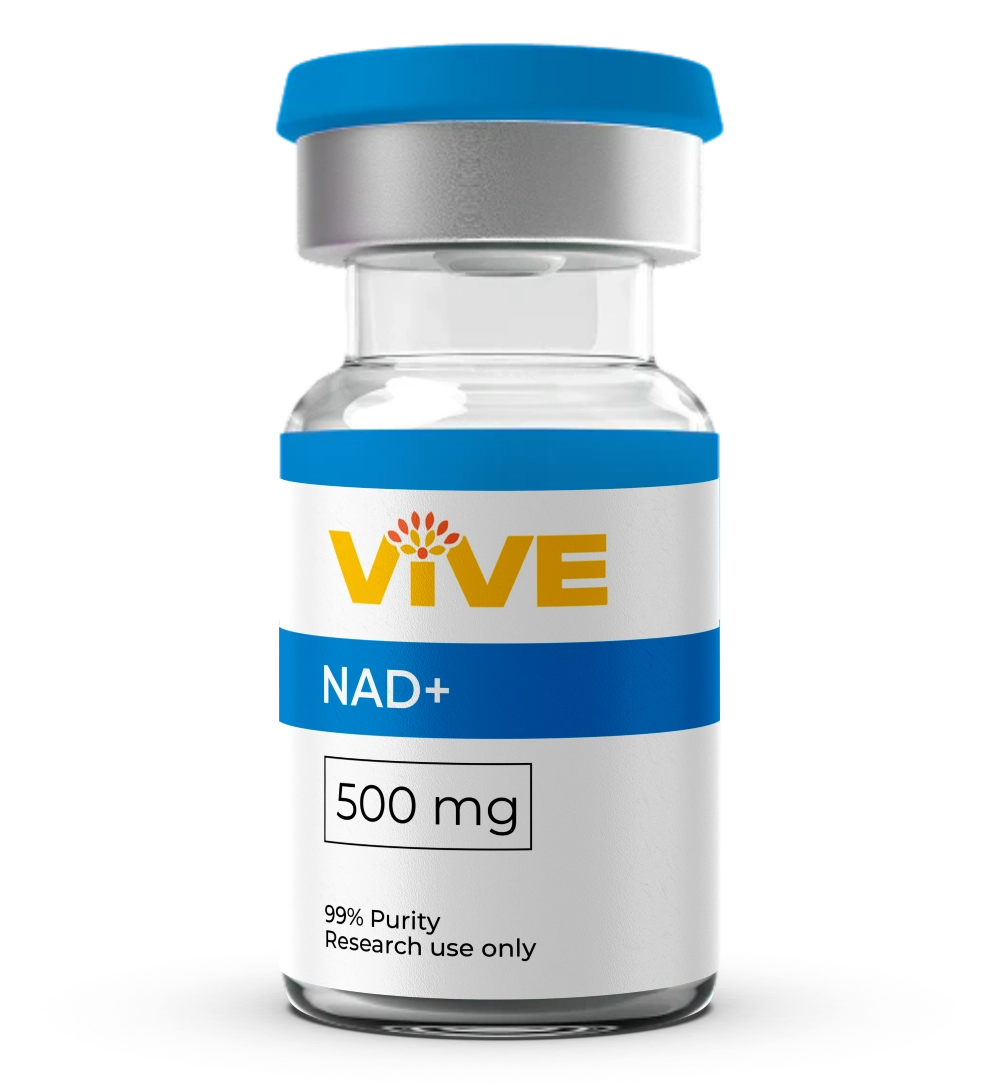
NAD+
Research Use OnlyThese products are sold strictly for laboratory and research use only and are not approved for human consumption, diagnosis, or therapeutic treatment. Not for human or veterinary use. These statements have not been evaluated by the Food and Drug Administration, and nothing on this page constitutes medical advice or a health claim.
- Size
- Default Title
Specifications
NAD+ Technical Profile
OVERVIEW
What Is NAD+?
NAD+ (nicotinamide adenine dinucleotide) is a coenzyme present in every living cell and essential for fundamental biological processes including cellular energy metabolism, DNA repair, and gene expression regulation. NAD+ functions as a critical electron carrier in metabolic reactions, shuttling electrons between enzymes in glycolysis, the citric acid cycle, and oxidative phosphorylation. First described by Arthur Harden and William John Young in 1906, NAD+ is one of the most studied molecules in biochemistry.
NAD+ research has experienced a renaissance in the 21st century with the discovery of its role as a substrate for sirtuins, PARPs (poly-ADP-ribose polymerases), and CD38/CD157 ectoenzymes. NAD+ anti-aging research has been particularly influential, with studies documenting age-related NAD+ decline across multiple species and tissue types. NAD+ cellular energy research continues to reveal the central importance of this molecule in metabolic health, making it an indispensable tool for laboratories investigating bioenergetics, epigenetics, and aging biology. Researchers who buy NAD+ from VivePeptides receive ≥99% purity from a trusted USA supplier.
- 01
Essential Coenzyme
Dinucleotide cofactor central to cellular energy metabolism and redox biology
- 02
≥99% HPLC Purity
Every batch verified via high-performance liquid chromatography
- 03
USA Made & Verified
Third-party analytical testing performed in USA laboratories
RESEARCH
NAD+ Mechanism of Action in Research
The NAD+ mechanism of action encompasses its dual roles as a redox cofactor and a signaling substrate. NAD+ research has identified multiple enzymatic pathways that consume and regenerate NAD+, creating a dynamic metabolic network.
Redox Metabolism and Electron Transfer
In its primary metabolic role, NAD+ serves as an electron acceptor in catabolic reactions. During glycolysis and the citric acid cycle, NAD+ is reduced to NADH by accepting hydride ions from metabolic intermediates. NADH then donates electrons to Complex I of the mitochondrial electron transport chain, driving ATP synthesis through oxidative phosphorylation. This NAD+/NADH redox cycling is essential for cellular energy production and represents a core focus of NAD+ cellular energy research.
Sirtuin Substrate and Epigenetic Regulation
NAD+ sirtuins research has emerged as one of the most active areas of NAD+ investigation. Sirtuins (SIRT1-7) are NAD+-dependent deacylase enzymes that remove acetyl and other acyl groups from proteins, consuming NAD+ in the process to produce nicotinamide and O-acetyl-ADP-ribose. Sirtuin activity directly depends on NAD+ availability, linking cellular metabolic status to epigenetic regulation, protein function, and stress response pathways (Imai & Guarente, Trends in Cell Biology, 2014).
DNA Repair Pathways (PARP Activity)
NAD+ is the essential substrate for poly-ADP-ribose polymerases (PARPs), enzymes that catalyze the addition of ADP-ribose polymers to proteins at sites of DNA damage. PARP-mediated DNA repair consumes substantial amounts of NAD+, and research indicates that excessive PARP activation can deplete cellular NAD+ pools. Understanding the competition between PARPs and sirtuins for available NAD+ is a major focus of current NAD+ research. ---
COMPARISON
NAD+ vs NMN: Research Compound Comparison
NAD+
NAD+ and NMN (nicotinamide mononucleotide) are both studied in the context of NAD+ metabolism research. NMN is a direct biosynthetic precursor to NAD+, and understanding their relationship is key for researchers in this field.
NMN
NAD+ is the active form directly used as a coenzyme and enzyme substrate, making it essential for in vitro enzymatic assays and direct cellular studies. NMN is valuable for studying NAD+ biosynthesis pathways and cellular uptake mechanisms. VivePeptides NAD+ for sale is manufactured to ≥99% purity for reliable laboratory research.
| Feature | NAD+ | NMN (Nicotinamide Mononucleotide) |
|---|---|---|
| CAS Number | 53-84-9 | 1094-61-7 |
| Molecular Weight | 663.43 Da | 334.22 Da |
| Role | Active coenzyme (end product) | Biosynthetic precursor to NAD+ |
| Structure | Dinucleotide (NMN + AMP) | Mononucleotide |
| Cell Uptake | Large molecule, limited direct uptake | Smaller, studied for cellular uptake via SLC12A8 |
| Enzymatic Function | Direct substrate for sirtuins, PARPs, CD38 | Requires conversion to NAD+ via NMNAT enzymes |
| Research Applications | Direct enzyme studies, in vitro assays | Precursor biology, NAD+ boosting research |
| Stability | Requires careful storage, light-sensitive | Relatively more stable |
RESEARCH STUDIES
NAD+ Research Applications & Published Studies
NAD+ research represents one of the most prolific fields in modern biochemistry, with thousands of published studies spanning metabolism, aging, and disease biology.
Aging and Longevity Research
NAD+ anti-aging research was catalyzed by the discovery that NAD+ levels decline with age in multiple tissues and species. Yoshino et al. (Cell Metabolism, 2011) published landmark findings on age-related NAD+ decline and its metabolic consequences. Subsequent studies by Gomes et al. (Cell, 2013) demonstrated that restoring NAD+ levels in aged mice reversed markers of mitochondrial dysfunction, generating significant interest in NAD+ biology across the geroscience research community.
Sirtuin Biology
NAD+ sirtuins research is extensively published, with key contributions from the laboratories of Leonard Guarente, David Sinclair, and others. Imai & Guarente (Trends in Cell Biology, 2014) published comprehensive reviews establishing the "NAD world" hypothesis, proposing that NAD+ availability coordinates systemic metabolic regulation through sirtuin activity across multiple tissues.
Metabolic and Mitochondrial Research
NAD+ cellular energy research encompasses studies of mitochondrial function, bioenergetics, and metabolic disease models. Published research has examined how NAD+ depletion affects electron transport chain function, mitochondrial membrane potential, and cellular ATP production. These studies utilize research-grade NAD+ in both cell-free enzymatic assays and cellular model systems.
QUALITY ASSURANCE
Quality & Testing Standards
HPLC & Mass Spectrometry
Every NAD+ batch undergoes HPLC and mass spectrometry analysis to confirm identity, purity, and molecular weight.
Third-Party Verified
All NAD+ is independently tested at third-party USA-based analytical laboratories with lot-specific documentation.
≥99% Purity Standard
VivePeptides NAD+ consistently meets or exceeds ≥99% purity as verified by HPLC for reliable research results.
FAQ
Frequently Asked Questions About NAD+
What is NAD+ used for in research?
What purity is VivePeptides NAD+?
How should NAD+ be stored?
What is the difference between NAD+ and NADH?
Is VivePeptides NAD+ third-party tested?
Add To Research Cart
NAD+
99%+ purity · USA lab tested · secure shipping
You May Also Research
Related Compounds
These products are sold strictly for laboratory and research use only and are not approved for human consumption, diagnosis, or therapeutic treatment. Not for human or veterinary use. These statements have not been evaluated by the Food and Drug Administration, and nothing on this page constitutes medical advice or a health claim.