US 3rd Party Tested          Free BAC Water on All Orders          Free Shipping          For Lab Use          Secure Checkout          US 3rd Party Tested          Free BAC Water on All Orders          Free Shipping          Trusted By Pharmacies          Secure Checkout
VivePeptides Semax 5 mg vial labeled with "99% Purity" and "Research use only," featuring a blue cap and branding.

Semax

99%+ Purity USA Tested

Research Use Only. Not for Human or Veterinary Use

Semax: ACTH(4-10) analog heptapeptide, CAS 80714-61-0, MW 813.93 g/mol, ≥99% purity. Lyophilized powder for laboratory use.

Price range: $50.00 through $90.00

Peptide Name Semax
CAS Number 80714-61-0
Molecular Formula C₃₉H₅₃N₉O₁₀
Molecular Weight 813.93 g/mol
Sequence Met-Glu-His-Phe-Pro-Gly-Pro
Appearance White lyophilized powder
Purity ≥99% (HPLC)
Storage -20°C, desiccated, protected from light
Solubility Soluble in sterile water

This product is not intended for human or animal use. For scientific research only.

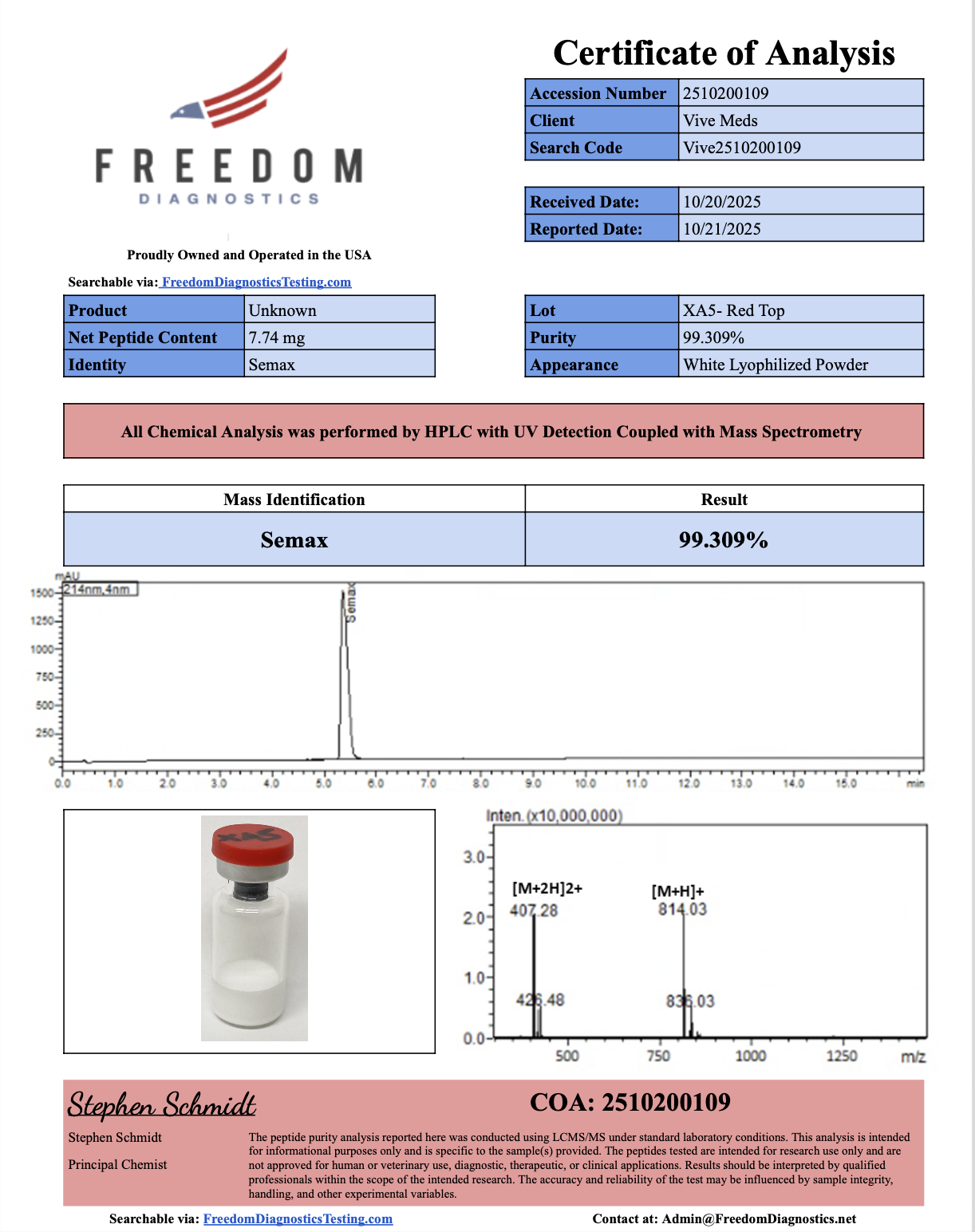
VivePeptides provides detailed analytical results including High-Performance Liquid Chromatography (HPLC) and mass spectrometry data for all peptides. These reports confirm peptide purity, composition, and molecular accuracy, giving researchers full transparency and confidence in the materials used for their studies.

VIEW COA

VivePeptides peptides should be stored in a cool, dry environment and protected from light and moisture. Lyophilized peptides are best kept refrigerated or frozen until use to maintain stability. Once reconstituted for research purposes, peptides should be stored according to standard laboratory protocols, typically under refrigeration, and handled using proper aseptic techniques to preserve integrity throughout the study period.

OVERVIEW

What Is Semax Peptide?

Semax is a synthetic heptapeptide developed at the Institute of Molecular Genetics of the Russian Academy of Sciences as a stabilized analog of the adrenocorticotropic hormone (ACTH) fragment spanning residues 4 through 10. The semax peptide incorporates a Pro-Gly-Pro C-terminal extension to the native ACTH(4-10) sequence (Met-Glu-His-Phe), providing enhanced stability against enzymatic degradation while preserving and extending the neurotrophic properties of the parent fragment.
As a semax research peptide, this compound has been studied across numerous domains of neuroscience, with particular emphasis on neurotrophic factor expression, cognitive function pathways, and neuroprotective mechanisms. Semax BDNF research has been especially prolific, with multiple published studies documenting the peptide’s influence on brain-derived neurotrophic factor and related signaling cascades. Semax nootropic research and semax cognitive research have positioned this compound as a key tool for laboratories investigating neural plasticity and neurodevelopmental biology. Researchers who buy semax from VivePeptides receive ≥99% purity from a trusted USA supplier.

ACTH(4-10) Analog

Synthetic heptapeptide with neurotrophic and cognitive research applications

≥99% HPLC Purity

Every batch verified via high-performance liquid chromatography

USA Tested & Verified

Third-party analytical testing performed in USA laboratories

RESEARCH

Semax Mechanism of Action in Research

The semax mechanism of action centers on neurotrophic factor modulation and neuropeptide signaling pathways. Semax research has revealed that this peptide influences brain function through multiple converging mechanisms distinct from classical ACTH-mediated effects.

BDNF and Neurotrophic Factor Upregulation

Semax BDNF research represents one of the most documented aspects of its mechanism. Studies indicate that semax may significantly upregulate brain-derived neurotrophic factor (BDNF) expression in multiple brain regions, including the hippocampus, cortex, and basal forebrain. Published research demonstrates that semax’s effects on BDNF signaling extend to downstream TrkB receptor activation and related intracellular cascades involved in synaptic plasticity and neuronal survival (Dolotov et al., Neuroscience, 2006).

Melanocortin System Interactions

As an ACTH fragment analog, semax research has explored its interactions with the melanocortin receptor system. While semax lacks the classical adrenocorticotropic activity of full-length ACTH, studies suggest it may interact with melanocortin receptor subtypes (particularly MC4R) in brain regions involved in cognition and neural development. These interactions represent a distinct pathway through which semax may influence neural function.

Neuroprotective Gene Expression

Semax cognitive research has identified broad effects on gene expression in neural tissue. Published studies indicate that semax may modulate the expression of genes involved in neuroprotection, anti-apoptotic pathways, and inflammatory regulation in the central nervous system. Genome-wide expression analyses have documented changes in hundreds of genes following semax administration in research models. —

COMPARISON

Semax vs Selank: Research Peptide Comparison

Semax and selank are complementary nootropic research peptides with distinct pharmacological profiles. This comparison helps researchers choose the appropriate compound for specific experimental questions.
FeatureSemaxSelank
OriginACTH(4-10) analogTuftsin analog (IgG fragment-derived)
CAS Number80714-61-0129954-34-3
Amino Acids77
Molecular Weight813.93 Da751.87 Da
Primary Research FocusNeurotrophic/cognitive researchAnxiolytic/immunomodulatory research
Key PathwayBDNF/TrkB signalingGABAergic system modulation
Parent PeptideACTH(4-10)Tuftsin (Thr-Lys-Pro-Arg)
Immune EffectsLimitedWell-documented immunomodulatory activity
Both semax and selank are available from VivePeptides at ≥99% purity. Researchers studying neurotrophic factor biology and cognitive pathways typically choose semax, while those investigating anxiolytic mechanisms and neuro-immune interactions may prefer selank.

RESEARCH STUDIES

Semax Research Applications & Published Studies

Semax research encompasses a substantial body of published preclinical literature, with studies spanning neurotrophic biology, cognitive function, and neuroprotection.

BDNF and Neurotrophic Factor Studies

Dolotov et al. (Neuroscience, 2006) published foundational semax BDNF research documenting the peptide’s effects on BDNF mRNA expression in rat brain tissue. Additional studies have shown that semax increases NGF (nerve growth factor) and GDNF (glial cell-derived neurotrophic factor) levels in specific brain regions. These neurotrophic factor studies form the cornerstone of semax cognitive research.

Cognitive and Behavioral Research

Published semax research includes multiple behavioral studies using established cognitive paradigms. Studies using the Morris water maze, passive avoidance, and novel object recognition tests in rodent models have documented measurable effects on learning and memory-related behaviors following semax administration. These findings support semax’s classification as a nootropic research peptide.

Neuroprotection Research Models

Semax research has extended to neuroprotection models, including studies of cerebral ischemia, oxidative stress, and neurotoxicity in animal models. Gusev et al. (Doklady Biological Sciences, 2005) published findings on semax in cerebral ischemia models, while additional studies have examined its effects on gene expression patterns following neural insult in research settings.

QUALITY ASSURANCE

Quality & Testing Standards

HPLC & Mass Spectrometry

Every semax batch undergoes HPLC and mass spectrometry analysis to confirm peptide identity, sequence accuracy, and purity.

Third-Party Verified

All semax is independently tested at third-party USA-based analytical laboratories.

≥99% Purity Standard

VivePeptides semax consistently meets or exceeds ≥99% purity for reliable, reproducible research results.

FAQ

Frequently Asked Questions About Semax

What is semax used for in research?

Semax is used in preclinical research to study neurotrophic factor expression (particularly BDNF), cognitive function pathways, neuroprotective mechanisms, and melanocortin receptor signaling. Semax is sold for research use only.

What purity is VivePeptides semax?

VivePeptides semax peptide is manufactured to ≥99% purity as verified by HPLC. Each batch is independently tested at USA-based analytical laboratories.

How should semax be stored?

Lyophilized semax should be stored at -20°C, protected from light and moisture. Reconstituted solutions should be stored at 2–8°C and used within 14 days.

What is the relationship between semax and ACTH?

Semax is a synthetic analog of ACTH(4-10), the fragment of adrenocorticotropic hormone spanning residues 4 through 10 (Met-Glu-His-Phe). Semax extends this sequence with Pro-Gly-Pro for enhanced stability. Importantly, semax lacks the adrenocorticotropic activity of full-length ACTH and does not stimulate cortisol production in research models.

Is VivePeptides semax third-party tested?

Yes. Every lot of VivePeptides semax undergoes independent third-party testing at USA-based laboratories, including HPLC purity analysis and mass spectrometry identity verification. Results are available for qualified researchers.

RELATED PRODUCTS

Related Research Peptides

Explore other research-grade peptides available from VivePeptides. Each product meets the same rigorous purity and testing standards.

Selank

Tuftsin analog anxiolytic research peptide

NAD+

Research grade compound for cellular energy and aging studies

BPC-157

Gastric pentadecapeptide for tissue research

MOTS-c

Mitochondrial-derived peptide for metabolic research

Explore More Research Peptides