
US 3rd Party Tested          Free BAC Water on All Orders          Free Shipping          For Lab Use          Secure Checkout          US 3rd Party Tested          Free BAC Water on All Orders          Free Shipping          Trusted By Pharmacies          Secure Checkout
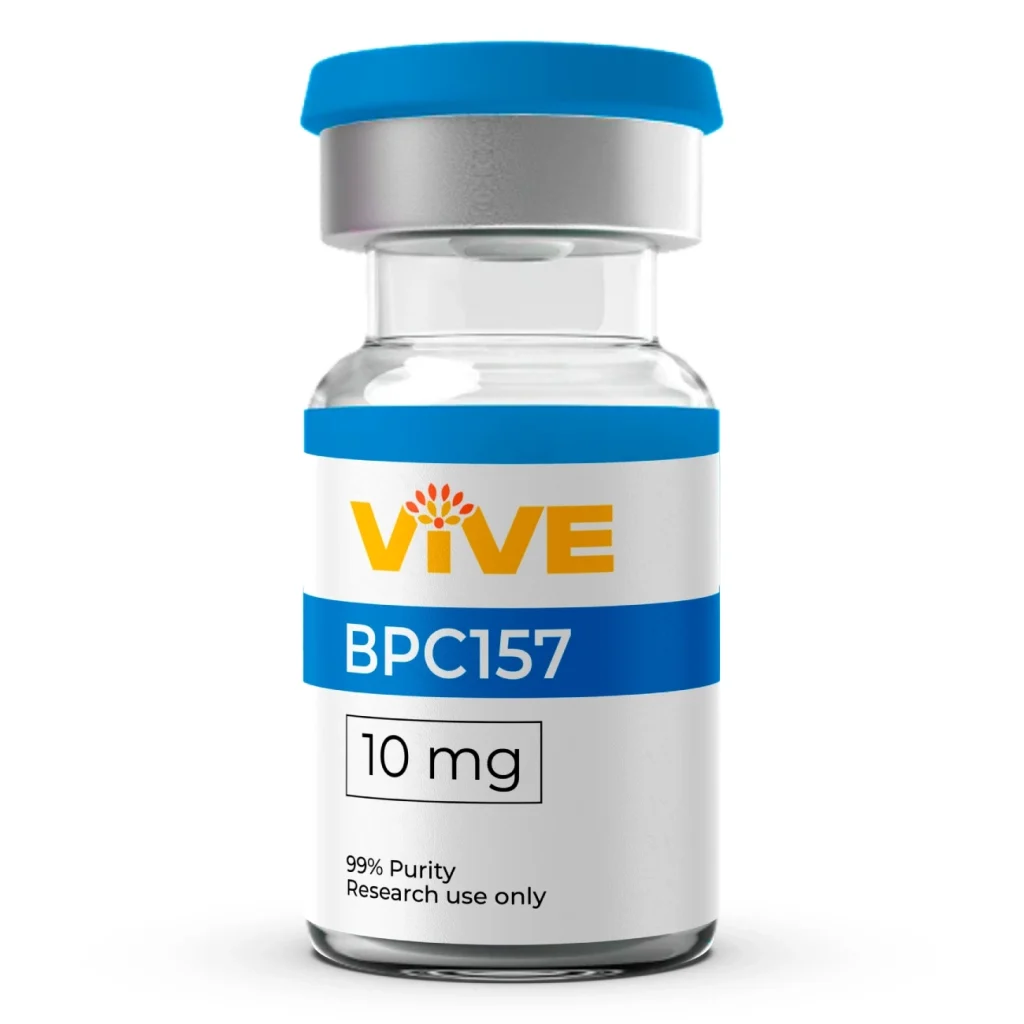
BPC-157 10mg vial from VivePeptides, labeled with 99% purity, for research use only.

BPC-157

99%+ Purity USA Tested

Research Use Only. Not for Human or Veterinary Use

BPC-157: Synthetic pentadecapeptide, CAS 137525-51-0, MW 1419.53 g/mol, ≥99% purity. Lyophilized powder for laboratory use.

$90.00

8 in stock

Peptide Name BPC-157 (Body Protection Compound-157)
CAS Number 137525-51-0
Molecular Formula C₆₂H₉₈N₁₆O₂₂
Molecular Weight 1419.53 g/mol
Sequence Gly-Glu-Pro-Pro-Pro-Gly-Lys-Pro-Ala-Asp-Asp-Ala-Gly-Leu-Val
Appearance White lyophilized powder
Purity ≥99% (HPLC)
Storage -20°C, desiccated, protected from light
Solubility Soluble in sterile water or PBS

This product is not intended for human or animal use. For scientific research only.

VivePeptides provides detailed analytical results including High-Performance Liquid Chromatography (HPLC) and mass spectrometry data for all peptides. These reports confirm peptide purity, composition, and molecular accuracy, giving researchers full transparency and confidence in the materials used for their studies.

VIEW COA

VivePeptides peptides should be stored in a cool, dry environment and protected from light and moisture. Lyophilized peptides are best kept refrigerated or frozen until use to maintain stability. Once reconstituted for research purposes, peptides should be stored according to standard laboratory protocols, typically under refrigeration, and handled using proper aseptic techniques to preserve integrity throughout the study period.

OVERVIEW

What Is BPC-157 Peptide?

BPC-157 is a synthetic peptide consisting of 15 amino acids. It is derived from a partial sequence of body protection compound (BPC), a protein naturally found in human gastric juice. First isolated and characterized in the early 1990s, BPC-157 peptide has become one of the most extensively studied peptides in preclinical research, with hundreds of published studies exploring its properties in laboratory and animal models.
As a research peptide, BPC-157 belongs to the class of gastric pentadecapeptides. Unlike many peptides that require specific environmental conditions to maintain stability, BPC-157 research has demonstrated notable stability in various pH environments. This characteristic, combined with its well-documented research profile, has made BPC-157 a foundational compound in peptide research laboratories worldwide.

Gastric Pentadecapeptide

Synthetic 15-amino-acid peptide derived from human gastric juice protein

≥99% HPLC Purity

Every batch verified via high-performance liquid chromatography

USA Tested & Verified

Third-party analytical testing performed in USA laboratories

RESEARCH

BPC-157 Mechanism of Action in Research

The BPC-157 mechanism of action has been a central focus of preclinical research for over two decades. Studies suggest that BPC-157 interacts with multiple biological pathways simultaneously, which distinguishes it from many single-target peptides. BPC-157 research continues to expand our understanding of how this peptide influences cellular and molecular processes in laboratory settings.

Nitric Oxide (NO) System Modulation

Research indicates that BPC-157 may interact with the nitric oxide system, a critical signaling pathway involved in vascular function. In laboratory studies, BPC-157 has been observed to modulate NO synthase activity, potentially influencing blood vessel formation and endothelial cell behavior. Published research suggests this interaction may be bidirectional, with BPC-157 appearing to promote or counteract NO system effects depending on the experimental context (Sikiric et al., 2014).

Growth Factor Pathway Interactions

Preclinical studies have explored how BPC-157 may influence growth factor expression. Research suggests BPC-157 may upregulate the expression of growth hormone receptors and interact with the FAK-paxillin pathway, which plays a role in cell adhesion and migration. Studies in animal models have indicated that BPC-157 research compounds may promote angiogenesis — the formation of new blood vessels — through VEGF-mediated pathways (Chang et al., 2011).

GABAergic and Dopaminergic System Interactions

Additional BPC-157 research has examined its potential interactions with central neurotransmitter systems. Studies indicate that BPC-157 may influence the dopaminergic and GABAergic systems, with researchers observing modulated behavior patterns in animal models. These findings have expanded the scope of BPC-157 research beyond its originally studied pathways.

COMPARISON

BPC-157 vs TB-500: Research Peptide Comparison

Both BPC-157 and TB-500 (Thymosin Beta-4 fragment) are among the most frequently studied peptides in preclinical research. While they share some overlapping areas of investigation, they differ significantly in structure, origin, and proposed mechanisms. Understanding these differences helps researchers select the appropriate compound for their specific laboratory protocols.
FeatureBPC-157TB-500
OriginDerived from human gastric juice proteinFragment of Thymosin Beta-4
Amino Acids1543
CAS Number137525-51-077591-33-4
Molecular Weight1419.53 Da4963.50 Da
Primary Research FocusGastric and tissue researchCell migration and tissue research
StabilityStable across various pH rangesRequires careful storage
Proposed MechanismNO system, growth factor modulationActin sequestration, cell motility
Research Volume100+ published studies50+ published studies
Both peptides continue to be subjects of active investigation. Some researchers have explored their combined use in laboratory settings, though the majority of published literature examines each compound independently. VivePeptides offers both BPC-157 for sale and TB-500 at research grade purity from our USA-based facility.

RESEARCH STUDIES

BPC-157 Research Applications & Published Studies

BPC-157 research spans more than two decades of published preclinical literature. The following areas represent the most actively investigated applications of BPC-157 peptide in laboratory and animal model studies. All references are to research contexts only.

Gastrointestinal Research

BPC-157 was originally isolated from gastric juice, and gastrointestinal research remains a primary area of investigation. Sikiric et al. (2003) published comprehensive reviews documenting BPC-157’s effects in various GI models, observing that the peptide demonstrated notable activity in multiple experimental paradigms. Studies have examined BPC-157 in models of gastric lesions, intestinal anastomosis, and inflammatory bowel conditions in animal subjects (Sikiric et al., Journal of Physiology-Paris, 2003).

Musculoskeletal and Connective Tissue Studies

Published research has examined BPC-157 in animal models related to tendons, ligaments, and muscle tissue. Staresinic et al. (2003) reported observations of BPC-157’s effects on Achilles tendon models in rats, while Pevec et al. (2010) published findings on BPC-157 in quadriceps muscle injury models. These studies contribute to the growing body of BPC-157 research focused on connective tissue biology.

Neuroprotective Research Models

More recent BPC-157 research has expanded into neuroscience applications. Klicek et al. (2013) and Tudor et al. (2010) published studies examining BPC-157 in various neural injury models in animal subjects. Research suggests the peptide may interact with neurotransmitter systems including the dopaminergic, serotonergic, and GABAergic pathways, though these findings remain in the preclinical stage.

QUALITY ASSURANCE

Quality & Testing Standards

VivePeptides maintains rigorous quality control for every batch of BPC-157 peptide. Our commitment to research-grade purity ensures that laboratories receive consistent, reliable compounds for their investigations.

HPLC & Mass Spectrometry

Every batch of BPC-157 undergoes high-performance liquid chromatography (HPLC) and mass spectrometry analysis to confirm identity, purity, and molecular weight.

Third-Party Verified

All VivePeptides BPC-157 is independently verified through third-party analytical laboratories based in the USA. Testing documentation is available for every lot.

≥99% Purity Standard

Our BPC-157 consistently meets or exceeds ≥99% purity as determined by HPLC analysis, ensuring research-grade quality for laboratory applications.

FAQ

Frequently Asked Questions About BPC-157

What is BPC-157 used for in research?

BPC-157 is used in preclinical research settings to study gastric peptide biology, tissue repair mechanisms, growth factor pathways, and neurotransmitter system interactions. It is one of the most widely published research peptides in the scientific literature. BPC-157 is sold for research use only.

What purity is VivePeptides BPC-157?

VivePeptides BPC-157 is manufactured to ≥99% purity as verified by HPLC analysis. Every batch is tested and verified through independent third-party USA-based laboratories to ensure consistent research-grade quality.

How should BPC-157 be stored?

Lyophilized BPC-157 should be stored at -20°C, protected from light and moisture. Once reconstituted, the solution should be stored at 2–8°C and used within 14 days for optimal stability. Avoid repeated freeze-thaw cycles.

What is the difference between BPC-157 and BPC-157 acetate?

BPC-157 acetate refers to BPC-157 supplied as an acetate salt form. The acetate counter-ion is commonly used during peptide synthesis and purification. Both forms contain the same active 15-amino-acid peptide sequence. VivePeptides BPC-157 is supplied as the acetate salt in lyophilized form.

Is VivePeptides BPC-157 third-party tested?

Yes. Every lot of VivePeptides BPC-157 undergoes independent third-party testing at USA-based analytical laboratories. Testing includes HPLC purity analysis and mass spectrometry identity confirmation. Results are available upon request for qualified researchers.

RELATED PRODUCTS

Related Research Peptides

Explore other research-grade peptides available from VivePeptides. Each product meets the same rigorous purity and testing standards.

Glow Blend

Combines BPC-157 with TB-500 and GHK-Cu for multi-pathway tissue research

GHK-Cu

Research grade copper peptide for skin and tissue biology studies

MOTS-c

Mitochondrial-derived peptide for metabolic research

CJC-1295 + Ipamorelin

Growth hormone secretagogue research blend

Explore More Research Peptides