
US 3rd Party Tested          Free BAC Water on All Orders          Free Shipping          For Lab Use          Secure Checkout          US 3rd Party Tested          Free BAC Water on All Orders          Free Shipping          Trusted By Pharmacies          Secure Checkout
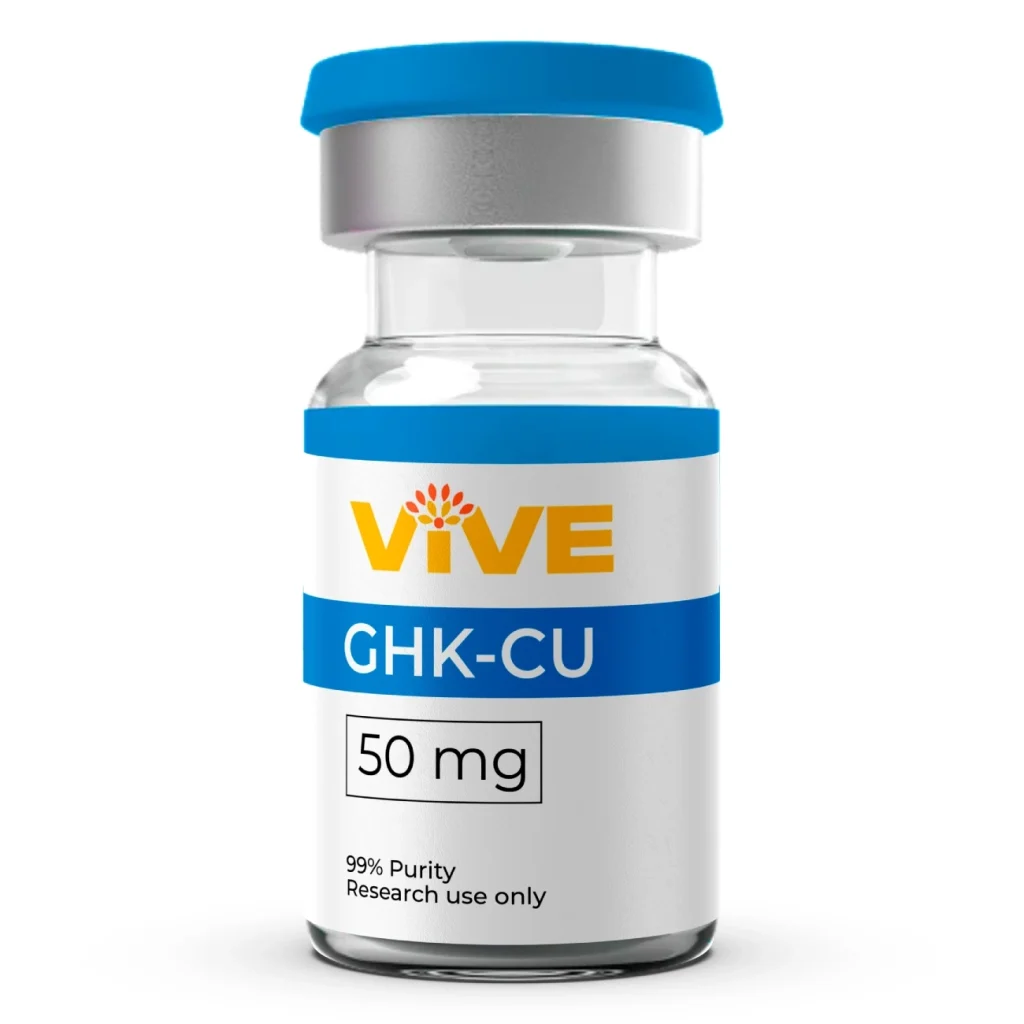
VivePeptides GHK-Cu 50 mg vial with blue cap, labeled 99% purity, research use only, featuring a clear glass container.

GHK-Cu

99%+ Purity USA Tested

Research Use Only. Not for Human or Veterinary Use

GHK-CCopper-binding tripeptide complex, CAS 49557-75-7, MW 403.92 g/mol, ≥99% purity. Lyophilized powder for laboratory use.

$60.00

13 in stock

Peptide Name GHK-Cu (Copper Peptide)
CAS Number 49557-75-7
Molecular Formula C₁₄H₂₃CuN₆O₄
Molecular Weight 403.92 g/mol
Sequence Gly-His-Lys:Cu²⁺ (1:1 complex)
Appearance Blue lyophilized powder
Purity ≥99% (HPLC)
Storage -20°C, desiccated, protected from light
Solubility Soluble in sterile water

This product is not intended for human or animal use. For scientific research only.

VivePeptides provides detailed analytical results including High-Performance Liquid Chromatography (HPLC) and mass spectrometry data for all peptides. These reports confirm peptide purity, composition, and molecular accuracy, giving researchers full transparency and confidence in the materials used for their studies.

VIEW COA

VivePeptides peptides should be stored in a cool, dry environment and protected from light and moisture. Lyophilized peptides are best kept refrigerated or frozen until use to maintain stability. Once reconstituted for research purposes, peptides should be stored according to standard laboratory protocols, typically under refrigeration, and handled using proper aseptic techniques to preserve integrity throughout the study period.

OVERVIEW

What Is GHK-Cu Peptide?

GHK-Cu is a naturally occurring copper peptide complex consisting of the tripeptide glycyl-L-histidyl-L-lysine bound to a copper(II) ion. First identified in human plasma by Dr. Loren Pickart in 1973, the GHK-Cu copper peptide was isolated based on observations that plasma from younger individuals contained factors that influenced liver cell behavior differently than plasma from older individuals. The GHK tripeptide has a strong natural affinity for copper(II) ions, forming the GHK-Cu complex at physiological pH.
GHK-Cu peptide research has expanded significantly since its discovery, with studies demonstrating that this copper peptide can influence the expression of a remarkable number of genes — research suggests GHK-Cu may modulate the activity of over 4,000 human genes. As one of the most studied copper peptides in the scientific literature, GHK-Cu skin research has been particularly prolific, with numerous published studies exploring its role in extracellular matrix biology, collagen synthesis, and tissue remodeling processes. Researchers looking to buy GHK-Cu online from a trusted USA supplier rely on VivePeptides for consistent GHK-Cu 99% purity.

Copper Tripeptide Complex

Naturally occurring Gly-His-Lys peptide complexed with copper(II) ion

≥99% HPLC Purity

Every batch verified via high-performance liquid chromatography

USA Tested & Verified

Third-party analytical testing performed in USA laboratories

RESEARCH

GHK-Cu Mechanism of Action in Research

The GHK-Cu mechanism of action involves multiple biological pathways, reflecting its broad gene-modulatory properties. GHK-Cu research has revealed that this copper peptide influences cellular processes through both direct copper delivery and peptide-mediated signaling.

Extracellular Matrix Remodeling

GHK-Cu research has extensively documented its role in extracellular matrix (ECM) biology. Studies indicate that GHK-Cu may stimulate the production of collagen types I, III, and V, as well as elastin, decorin, and glycosaminoglycans in fibroblast cell cultures. The copper ion component is essential for lysyl oxidase activity, an enzyme critical for collagen and elastin cross-linking. Published research by Pickart et al. demonstrates that GHK-Cu promotes ECM component synthesis while simultaneously modulating matrix metalloproteinase (MMP) activity (Pickart & Margolina, Biomedicines, 2018).

Gene Expression Modulation

One of the most remarkable aspects of the GHK-Cu mechanism of action is its broad influence on gene expression. Microarray studies have identified over 4,000 human genes responsive to GHK-Cu at very low concentrations. Research suggests GHK-Cu may upregulate genes associated with tissue repair and antioxidant defense while downregulating genes associated with inflammation and tissue degradation. This gene-regulatory profile has made GHK-Cu skin research a particularly active field.

Copper-Dependent Enzyme Activation

GHK-Cu serves as a bioavailable copper delivery system, providing copper(II) ions to copper-dependent enzymes including superoxide dismutase (SOD), cytochrome c oxidase, and lysyl oxidase. This copper-chaperoning function contributes to GHK-Cu’s observed effects on antioxidant defense and tissue structural integrity in research models. —

COMPARISON

GHK-Cu vs Standard Copper Peptides: Research Comparison

GHK-Cu is often compared to other copper peptide complexes used in research. Understanding how GHK-Cu differs from generic or standard copper peptides is important for researchers selecting the appropriate compound.
FeatureGHK-CuStandard Copper Peptides
CompositionSpecific Gly-His-Lys sequence + Cu²⁺Various peptide sequences + Cu²⁺
OriginNaturally occurring in human plasmaSynthetic or semi-synthetic
Gene Modulation4,000+ genes documentedVariable, less characterized
Copper AffinityHigh (log K = 16.44)Varies by peptide sequence
Research Literature100+ published studiesLimited comparative data
SpecificityDefined sequence and mechanismHeterogeneous mechanisms
ECM EffectsWell-documented collagen/elastin activityLess specifically characterized
StandardizationSingle defined compound (CAS 49557-75-7)Multiple undefined complexes
GHK-Cu’s defined structure, extensive research literature, and specific CAS number make it the preferred copper peptide for reproducible research. VivePeptides GHK-Cu for sale is manufactured to ≥99% purity, ensuring batch-to-batch consistency for laboratory investigations.

RESEARCH STUDIES

GHK-Cu Research Applications & Published Studies

GHK-Cu research encompasses nearly five decades of published literature, spanning dermatological research, wound biology, and gene expression studies.

Skin Biology and Dermatological Research

GHK-Cu skin research represents the most extensively published application area. Pickart & Margolina (Biomedicines, 2018) published a comprehensive review of GHK-Cu’s effects on skin biology, documenting its influence on collagen synthesis, glycosaminoglycan production, and fibroblast proliferation in cell culture models. Additional studies have examined GHK-Cu’s effects on skin thickness, elasticity markers, and photoaging models in research settings.

Wound and Tissue Remodeling Studies

Published GHK-Cu research includes multiple studies in wound healing models. Canapp et al. (Wounds, 2003) documented GHK-Cu’s effects in animal wound models, while additional studies have examined its role in bone remodeling, nerve tissue research, and hair follicle biology. These studies consistently highlight GHK-Cu’s broad tissue-remodeling properties in preclinical models.

Genomic Research

Campbell et al. (Journal of Investigative Dermatology, 2012) published landmark GHK-Cu research using microarray technology to map genome-wide expression changes. This study identified that GHK-Cu at 1 μM concentration could modulate the expression of over 4,000 genes, providing mechanistic insight into its broad biological activity profile.

QUALITY ASSURANCE

Quality & Testing Standards

HPLC & Mass Spectrometry

Every GHK-Cu batch undergoes HPLC and mass spectrometry to confirm peptide identity, copper content, and overall purity.

Third-Party Verified

All GHK-Cu is independently verified through third-party USA-based analytical laboratories with full lot documentation.

≥99% Purity Standard

VivePeptides GHK-Cu consistently meets or exceeds ≥99% purity as verified by HPLC analysis.

FAQ

Frequently Asked Questions About GHK-Cu

What is GHK-Cu used for in research?

GHK-Cu is used in preclinical research to study skin biology, extracellular matrix remodeling, gene expression modulation, copper-dependent enzyme pathways, and tissue repair mechanisms. It is sold for research use only.

What purity is VivePeptides GHK-Cu?

VivePeptides GHK-Cu copper peptide is manufactured to ≥99% purity as verified by HPLC. Each batch is independently tested at USA-based analytical laboratories to confirm purity, peptide identity, and copper content.

How should GHK-Cu be stored?

Lyophilized GHK-Cu should be stored at -20°C, protected from light and moisture. Reconstituted solutions should be stored at 2–8°C and used within 14 days. GHK-Cu is freely soluble in water.

Why is the copper ion important in GHK-Cu?

The copper(II) ion in GHK-Cu is essential for its biological activity. Copper serves as a cofactor for enzymes like lysyl oxidase (critical for collagen cross-linking) and superoxide dismutase. The GHK tripeptide acts as a copper chaperone, delivering bioavailable copper to these enzymatic systems in research models.

Is VivePeptides GHK-Cu third-party tested?

Yes. Every lot of VivePeptides GHK-Cu undergoes independent third-party testing at USA-based laboratories, including HPLC purity analysis, mass spectrometry, and copper content verification. Results are available upon request.

RELATED PRODUCTS

Related Research Peptides

Explore other research-grade peptides available from VivePeptides. Each product meets the same rigorous purity and testing standards.

Glow Blend (BPC-157 + TB-500 + GHK-Cu)

Multi-peptide blend featuring GHK-Cu for tissue research

BPC-157

Gastric pentadecapeptide for tissue biology research

SNAP-8

Anti-wrinkle research peptide (Acetyl Octapeptide-3)

NAD+

Research grade compound for cellular energy and aging studies

Explore More Research Peptides