
US 3rd Party Tested          Free BAC Water on All Orders          Free Shipping          For Lab Use          Secure Checkout          US 3rd Party Tested          Free BAC Water on All Orders          Free Shipping          Trusted By Pharmacies          Secure Checkout
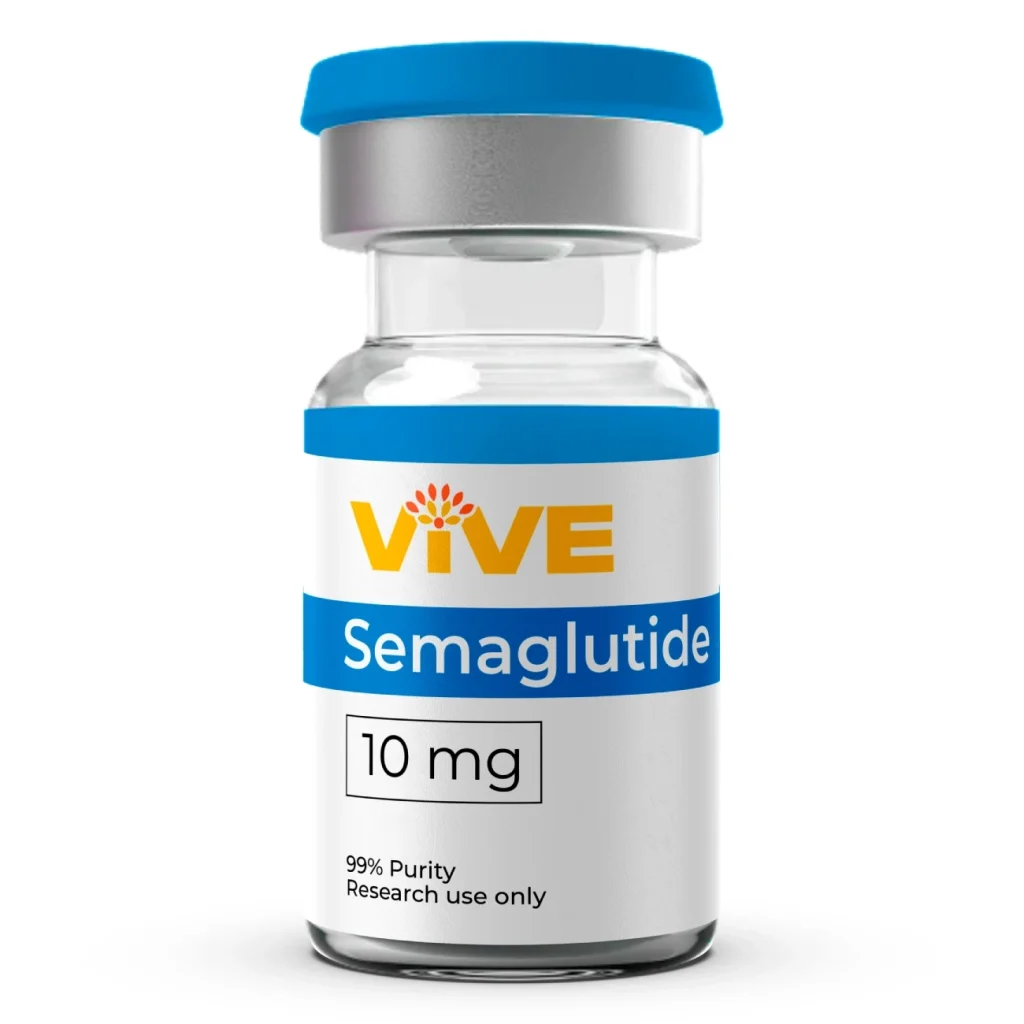
Vive Semaglutide 10 mg vial with 99% purity label, research use only indication, showcasing high-quality peptide for laboratory applications.

Semaglutide

99%+ Purity USA Tested

Research Use Only. Not for Human or Veterinary Use

Semaglutide: GLP-1 receptor agonist peptide, CAS 910463-68-2, MW 4113.58 g/mol, ≥99% purity. Lyophilized powder for laboratory use.

Price range: $90.00 through $150.00

Peptide Name Semaglutide
CAS Number 910463-68-2
Molecular Formula C₁₈₇H₂₉₁N₄₅O₅₉
Molecular Weight 4113.58 g/mol
Mechanism Class GLP-1 receptor agonist
Appearance White lyophilized powder
Purity ≥99% (HPLC)
Storage -20°C, desiccated, protected from light
Solubility Soluble in sterile water

This product is not intended for human or animal use. For scientific research only.

VivePeptides provides detailed analytical results including High-Performance Liquid Chromatography (HPLC) and mass spectrometry data for all peptides. These reports confirm peptide purity, composition, and molecular accuracy, giving researchers full transparency and confidence in the materials used for their studies.

VIEW COA

VivePeptides peptides should be stored in a cool, dry environment and protected from light and moisture. Lyophilized peptides are best kept refrigerated or frozen until use to maintain stability. Once reconstituted for research purposes, peptides should be stored according to standard laboratory protocols, typically under refrigeration, and handled using proper aseptic techniques to preserve integrity throughout the study period.

OVERVIEW

What Is Semaglutide Peptide?

Semaglutide is a synthetic peptide analog of human glucagon-like peptide-1 (GLP-1), originally developed as a research compound to study incretin biology and metabolic signaling pathways. The semaglutide peptide features key structural modifications — including an aminoisobutyric acid (Aib) substitution at position 8 and a C-18 fatty diacid chain attached via a linker at lysine-26 — that confer enhanced resistance to dipeptidyl peptidase-4 (DPP-4) degradation and increased albumin binding affinity.
As a semaglutide research peptide, this compound has become one of the most studied GLP-1 receptor agonists in the scientific literature. Its unique pharmacokinetic profile, resulting from the fatty acid acylation strategy, makes it a valuable tool for researchers investigating GLP-1 receptor signaling, glucose homeostasis, and metabolic pathway regulation in laboratory settings. Semaglutide research continues to generate significant interest across multiple areas of preclinical investigation.

GLP-1 Receptor Agonist

Acylated peptide analog of human glucagon-like peptide-1

≥99% HPLC Purity

Every batch verified via high-performance liquid chromatography

USA Tested & Verified

Third-party analytical testing performed in USA laboratories

RESEARCH

Semaglutide Mechanism of Action in Research

The semaglutide mechanism of action centers on its interaction with the GLP-1 receptor, a G-protein coupled receptor expressed in multiple tissue types. Semaglutide research has elucidated how the structural modifications of this peptide influence its receptor binding kinetics and downstream signaling cascades in laboratory models.

GLP-1 Receptor Binding and cAMP Signaling

Semaglutide binds to the GLP-1 receptor with high affinity, activating the adenylyl cyclase pathway and increasing intracellular cyclic adenosine monophosphate (cAMP) levels. In pancreatic beta cell research models, this cAMP elevation has been shown to potentiate glucose-dependent insulin secretion. The C-18 fatty diacid modification enables non-covalent albumin binding, significantly extending the compound’s half-life in research models and making it valuable for studying sustained GLP-1 receptor activation (Lau et al., Journal of Medicinal Chemistry, 2015).

Central Nervous System Pathway Research

Semaglutide GLP-1 research has expanded to include investigations of GLP-1 receptor signaling in the central nervous system. Studies in animal models suggest that semaglutide may cross the blood-brain barrier and interact with GLP-1 receptors in hypothalamic regions involved in appetite regulation and energy homeostasis. Published research has documented effects on neuronal activation patterns in specific brain regions following semaglutide administration in rodent models (Gabery et al., JCI Insight, 2020).

Inflammatory Pathway Modulation

Additional semaglutide research has explored its potential interactions with inflammatory signaling pathways. Preclinical studies indicate that GLP-1 receptor activation by semaglutide may modulate NF-κB signaling and reduce markers of inflammation in various tissue types. These findings have broadened the scope of semaglutide research beyond its originally characterized metabolic pathways. —

COMPARISON

Semaglutide vs Tirzepatide: Research Peptide Comparison

Semaglutide and tirzepatide represent two of the most actively studied incretin-based peptides in current research. While semaglutide is a selective GLP-1 receptor agonist, tirzepatide functions as a dual GIP/GLP-1 receptor agonist, creating distinct pharmacological profiles for laboratory investigation.
FeatureSemaglutideTirzepatide
Receptor TargetsGLP-1 receptor (selective)GIP and GLP-1 receptors (dual agonist)
CAS Number910463-68-22023788-19-2
Molecular Weight4113.58 Da4813.45 Da
Amino Acids31 (modified GLP-1 analog)39 (GIP-based backbone)
AcylationC-18 fatty diacidC-20 fatty diacid
DPP-4 ResistanceAib8 substitutionAib2 substitution
Research ClassificationGLP-1 receptor agonistDual incretin receptor agonist
Primary Research FocusGLP-1 signaling, metabolic researchDual incretin signaling, metabolic research
Both compounds are available from VivePeptides at research grade semaglutide 99% purity. The choice between these peptides depends on the specific receptor pathways and research questions under investigation. Researchers studying selective GLP-1 receptor activation often prefer semaglutide, while those investigating dual incretin signaling may select tirzepatide.

RESEARCH STUDIES

Semaglutide Research Applications & Published Studies

The semaglutide research literature encompasses hundreds of published studies across metabolic, cardiovascular, and neurological research domains. The following highlights represent key areas of investigation using semaglutide peptide in preclinical and research settings.

Metabolic Pathway Research

Semaglutide has been extensively studied in models of glucose homeostasis and metabolic signaling. Research by Knudsen et al. (Journal of Medicinal Chemistry, 2000) and subsequent studies have characterized the structure-activity relationships of GLP-1 analogs, establishing the foundation for understanding how semaglutide’s structural modifications influence receptor pharmacology. Studies in rodent models have documented semaglutide’s effects on insulin secretion dynamics, glucagon suppression, and gastric motility in research settings.

Cardiovascular Research Models

Published semaglutide research includes investigations of GLP-1 receptor signaling in cardiovascular tissue models. Preclinical studies have examined semaglutide’s effects on endothelial function, lipid metabolism, and vascular inflammation markers in animal models. Rakipovski et al. (JACC, 2018) published findings on semaglutide’s effects in atherosclerosis models, expanding the scope of cardiovascular-focused GLP-1 research.

Neuroscience Applications

Emerging semaglutide research has explored GLP-1 receptor agonism in neuroscience models. Published studies have examined semaglutide in models of neuroinflammation and neurodegeneration, with researchers investigating its ability to engage central GLP-1 receptors. This area of semaglutide research represents a rapidly growing field of preclinical investigation.

QUALITY ASSURANCE

Quality & Testing Standards

VivePeptides ensures every batch of semaglutide research peptide meets the highest analytical standards for purity, identity, and consistency.

HPLC & Mass Spectrometry

Every semaglutide batch undergoes HPLC and mass spectrometry analysis to verify peptide identity, purity, and correct molecular weight.

Third-Party Verified

All semaglutide is independently tested at third-party USA-based analytical laboratories. Results are available for each lot number.

≥99% Purity Standard

VivePeptides semaglutide consistently meets or exceeds ≥99% purity, ensuring research-grade quality for all laboratory applications.

FAQ

Frequently Asked Questions About Semaglutide

What is semaglutide used for in research?

Semaglutide is used in preclinical research to study GLP-1 receptor signaling, incretin biology, glucose homeostasis, and metabolic pathway regulation. It is a research chemical sold for laboratory use only and is not intended for human or veterinary use.

What purity is VivePeptides semaglutide?

VivePeptides semaglutide research peptide is manufactured to ≥99% purity as verified by HPLC. Each batch is independently tested at USA-based laboratories to confirm purity, identity, and molecular weight.

How should semaglutide be stored?

Lyophilized semaglutide should be stored at -20°C, protected from light and moisture. Once reconstituted, store at 2–8°C and use within 7 days. Avoid repeated freeze-thaw cycles to maintain peptide integrity.

What makes semaglutide different from native GLP-1?

Semaglutide contains two key structural modifications: an Aib substitution at position 8 that provides resistance to DPP-4 enzymatic degradation, and a C-18 fatty diacid acylation at Lys26 that enables albumin binding. These modifications significantly extend its biological half-life compared to native GLP-1 in research models.

Is VivePeptides semaglutide third-party tested?

Yes. Every batch of VivePeptides semaglutide undergoes independent third-party testing at USA-based analytical laboratories. Testing includes HPLC purity verification and mass spectrometry identity confirmation. Test results are available for qualified researchers upon request.

RELATED PRODUCTS

Related Research Peptides

Explore other research-grade peptides available from VivePeptides. Each product meets the same rigorous purity and testing standards.

Tirzepatide

Dual GIP/GLP-1 receptor agonist for dual incretin research

Retatrutide

Triple agonist peptide targeting GIP, GLP-1, and glucagon receptors

KLOW Blend

Proprietary weight management peptide blend for metabolic research

CJC-1295 No DAC + Ipamorelin

Growth hormone secretagogue research blend

Explore More Research Peptides