Research Article
CJC-1295 + Ipamorelin Blend Research Guide | VivePeptides
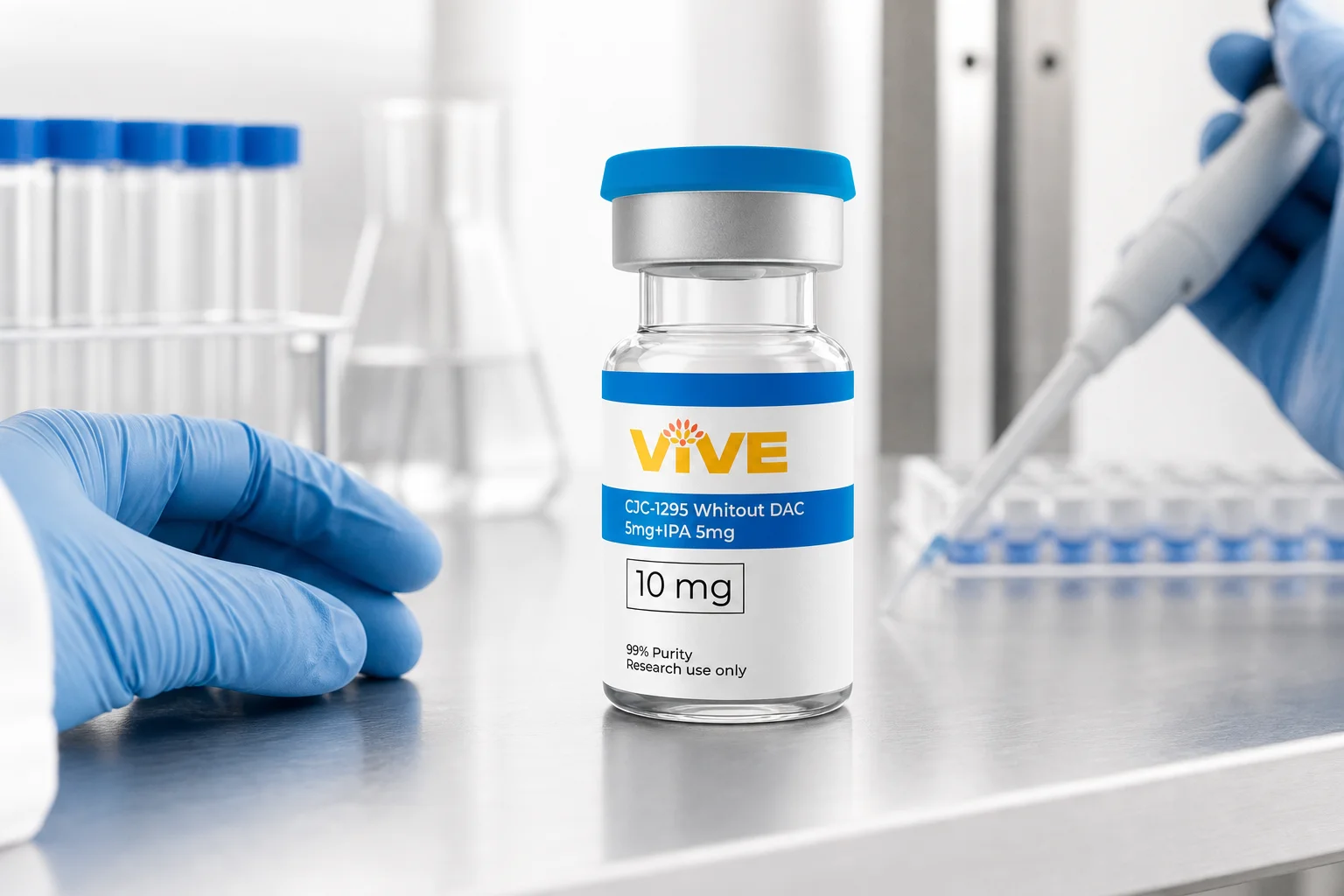
The cjc-1295 + ipamorelin blend pairs two mechanistically distinct growth hormone secretagogues to produce a coordinated, amplified GH release profile that neither compound achieves alone. Research teams investigating peptide therapy protocols turn to the CJC-1295 / Ipamorelin blend because the pairing targets separate receptor pathways within the same signaling cascade.
By Vive Team
What Is the CJC-1295 + Ipamorelin Blend?
CJC-1295 is a synthetic analogue of growth hormone-releasing hormone (GHRH), modified to extend its half-life beyond the few minutes typical of native GHRH. Ipamorelin is a selective ghrelin receptor agonist classified as a growth hormone secretagogue (GHS). When formulated together as a CJC- Ipamorelin compound, these two peptides act on complementary receptor pathways in the pituitary, stimulating somatotroph cells through distinct but convergent signaling mechanisms.
The interest in combining the two comes from the observation, documented in preclinical growth hormone secretagogue research, that GHRH receptor activation and ghrelin receptor activation are additive or synergistic rather than redundant. Work by Veldhuis et al. (Journal of Clinical Endocrinology and Metabolism, 1997) demonstrated that co-administration of a GHRH analogue with a GHS produced significantly higher GH pulses than either agent alone, establishing the mechanistic rationale that later informed the development of blended peptide therapy protocols.
Distinct Receptor Pathways: GHRH vs Ghrelin Receptor Agonism
Understanding why the cjc ipamorelin blend produces a more pronounced GH release profile requires tracing the two receptor pathways independently.
CJC-1295: GHRH Receptor Activation
CJC-1295 binds the GHRH receptor (GHRHR) on pituitary somatotrophs. Receptor occupancy triggers a Gs protein-coupled signaling cascade that elevates cyclic AMP (cAMP), activating protein kinase A and ultimately increasing both GH gene transcription and GH secretion. The No-DAC formulation produces a physiological pulse pattern rather than the sustained baseline elevation associated with DAC-modified forms. For a detailed analysis of how the DAC modification alters the pharmacokinetic profile, see CJC-1295 with DAC vs without DAC: Understanding the Critical Difference.
Ipamorelin: Selective Ghrelin Receptor Agonism
Ipamorelin is classified as ipamorelin selective among growth hormone secretagogue peptides because it acts almost exclusively through the GHS-R1a ghrelin receptor without meaningful activation of cortisol prolactin release pathways at research-relevant concentrations. This selectivity was characterized by Raun et al. (European Journal of Endocrinology, 1998), who showed that ipamorelin produced substantial GH release in rat models while causing negligible cortisol prolactin elevation, a profile distinct from older GHRP- GHRP-2 and GHRP-6 class peptides. Activation of GHS-R1a initiates a Gq/11-mediated signaling cascade, mobilizing intracellular calcium and amplifying the somatotroph response to concurrent GHRH receptor activation.
Synergistic GH Release: The Case for the Combination
The convergence of the GHRH receptor pathway and the ghrelin receptor pathway inside somatotroph cells creates conditions for supra-additive GH secretion. The GHRH receptor pathway drives cAMP accumulation; the ghrelin receptor pathway mobilizes intracellular calcium. Both second-messenger events are required for maximal GH exocytosis, which is why activating only one pathway at a time leaves measurable secretory capacity unused.

Clinical research has extended these mechanistic observations into human models. Svensson et al. (Journal of Clinical Endocrinology and Metabolism, 2000) reported that GHRP class compounds co-administered with GHRH produced GH release approximately two to four times greater than GHRH administration alone, establishing the practical rationale for dual-pathway activation in cjc ipamorelin blend protocols. For context on how ipamorelin compares to structurally related secretagogues administered without a GHRH partner, the Ipamorelin vs Sermorelin: Growth Hormone Secretagogue Research Comparison provides a methodologically grounded side-by-side analysis.
Evidence From Published Growth Hormone Secretagogue Studies
The published literature supporting the CJC-ipamorelin combination spans both peptide classes individually and their combined use.
CJC-1295 pharmacokinetics: Teichman et al. (Journal of Clinical Endocrinology and Metabolism, 2006) documented that a single dose of CJC-1295 without DAC produced measurable GH elevation for 6 hours in healthy adult subjects, with IGF-1 levels elevated for up to 24 hours, confirming the compound as a viable tool for pulsatile GH release research.
Ipamorelin selectivity vs GHRP- GHRP-2: Raun et al. (European Journal of Endocrinology, 1998) confirmed that ipamorelin's ghrelin receptor agonism did not significantly elevate cortisol prolactin or ACTH in rat models compared to earlier GHRP classes. This evidence supports ipamorelin as the preferred GHS component in combination protocols where cortisol prolactin contamination would confound results.
Dual-pathway synergy: Veldhuis and colleagues demonstrated in human physiological studies that simultaneous activation of GHRH receptor and GHS receptor pathways produces GH pulse amplitudes exceeding additive predictions. This quantitative evidence forms the scientific foundation of the cjc- ipamorelin combination as a research tool distinct from single-pathway protocols.
Protocols and Purity Standards for Peptide Therapy Research
Research-grade purity is a foundational requirement for any study using the cjc-1295 + ipamorelin blend. Contaminants or incorrect peptide ratios will confound GH release data and compromise cross-study reproducibility. High-performance liquid chromatography (HPLC) and mass spectrometry verification are the accepted purity standards, with 98% or greater purity as the recognized threshold for clinical and preclinical research contexts.
Reconstitution protocols for the blend require bacteriostatic water to maintain sterility across multiple draws from a single vial. Proper technique directly affects compound stability and the reliability of research outcomes. The full reconstitution workflow, including volume calculations and storage temperature guidance, is covered in The Complete Guide to Reconstituting Peptides with Bacteriostatic Water.
Some investigators exploring body composition endpoints in growth hormone research pair the cjc ipamorelin blend with a Sermorelin growth-hormone peptide reference arm to establish a within-study GHRH baseline. Understanding how different GHRH analogues influence GH release profiles is critical for experimental design integrity in growth hormone secretagogue research.
Frequently Asked Questions
What makes the cjc-1295 + ipamorelin blend different from using either peptide alone?
CJC-1295 activates the GHRH receptor pathway, while ipamorelin activates the ghrelin receptor pathway. Both pathways converge on somatotroph cell secretion through different second-messenger systems. Using both simultaneously produces a GH release response that published research shows to be greater than either compound alone, making the cjc ipamorelin blend the preferred dual-pathway tool for growth hormone secretagogue research.
Is ipamorelin truly selective, and does it elevate cortisol or prolactin?
At research-relevant concentrations, ipamorelin is documented as ipamorelin selective for the ghrelin receptor. Raun et al. (European Journal of Endocrinology, 1998) confirmed that ipamorelin caused negligible cortisol prolactin elevation in animal models compared to GHRP- GHRP-2 class peptides. This selectivity is a primary reason researchers prefer ipamorelin over older growth hormone secretagogue compounds when a clean secretagogue signal is required.
What is the difference between CJC-1295 with DAC and CJC-1295 No-DAC in this blend?
The No-DAC form has a shorter half-life and produces pulsatile GH release that closely mirrors physiological secretion patterns. The cjc- dac form extends the peptide half-life via albumin binding, producing prolonged GH elevation rather than discrete pulses. Most published research using the CJC-ipamorelin combination uses the No-DAC formulation. See our deep dive on CJC-1295 with DAC vs without DAC for a full pharmacokinetic comparison.
What purity level should researchers require for the cjc ipamorelin blend?
Research-grade purity at or above 98%, verified by HPLC and mass spectrometry, is the accepted standard for peptide therapy research. Lower purity batches introduce variables that compromise experimental validity and make published protocol replication unreliable across different research contexts.
How does growth hormone secretagogue research with this combination differ from single-agent protocols?
Single-agent protocols targeting GH release activate only one of the two major somatotroph receptor pathways, leaving the complementary pathway underutilized. Dual-pathway protocols using the cjc-1295 + ipamorelin blend capture the amplified GH release that results from co-activating both receptor systems simultaneously, as documented in human physiological studies by Veldhuis et al. and Svensson et al.
Source Verified Compounds for Your Growth Hormone Research
The published evidence for dual-pathway growth hormone secretagogue activation is well-established across both preclinical and early clinical human studies. Researchers ready to source verified, research-grade compounds can browse the VivePeptides catalog for the full range of peptides available for laboratory investigation.
Research Use Only
All information in this article is intended for educational and research purposes only. VivePeptides products are not intended for human or veterinary use.