Research Article
What Is LL-37? Antimicrobial Peptide Research Guide

LL-37 is a 37-residue human cathelicidin peptide encoded by the CAMP gene, functioning as a key effector of innate immunity. Researchers study it for its antimicrobial, anti-biofilm, and wound healing properties against bacteria, viruses, and fungi, making it one of the most characterized antimicrobial peptides in the human immune arsenal.
Molecular Profile: Formula, Weight, and Structure
LL-37 carries the molecular formula C205H340N60O53S and a molecular formula molecular weight of approximately 4,493.3 Da. The LL designation refers to the two leucine residues at the N-terminus, while 37 reflects the total residue count. It is the only known human cathelicidin, cleaved from the hCAP18 precursor protein by serine proteases such as kallikrein.
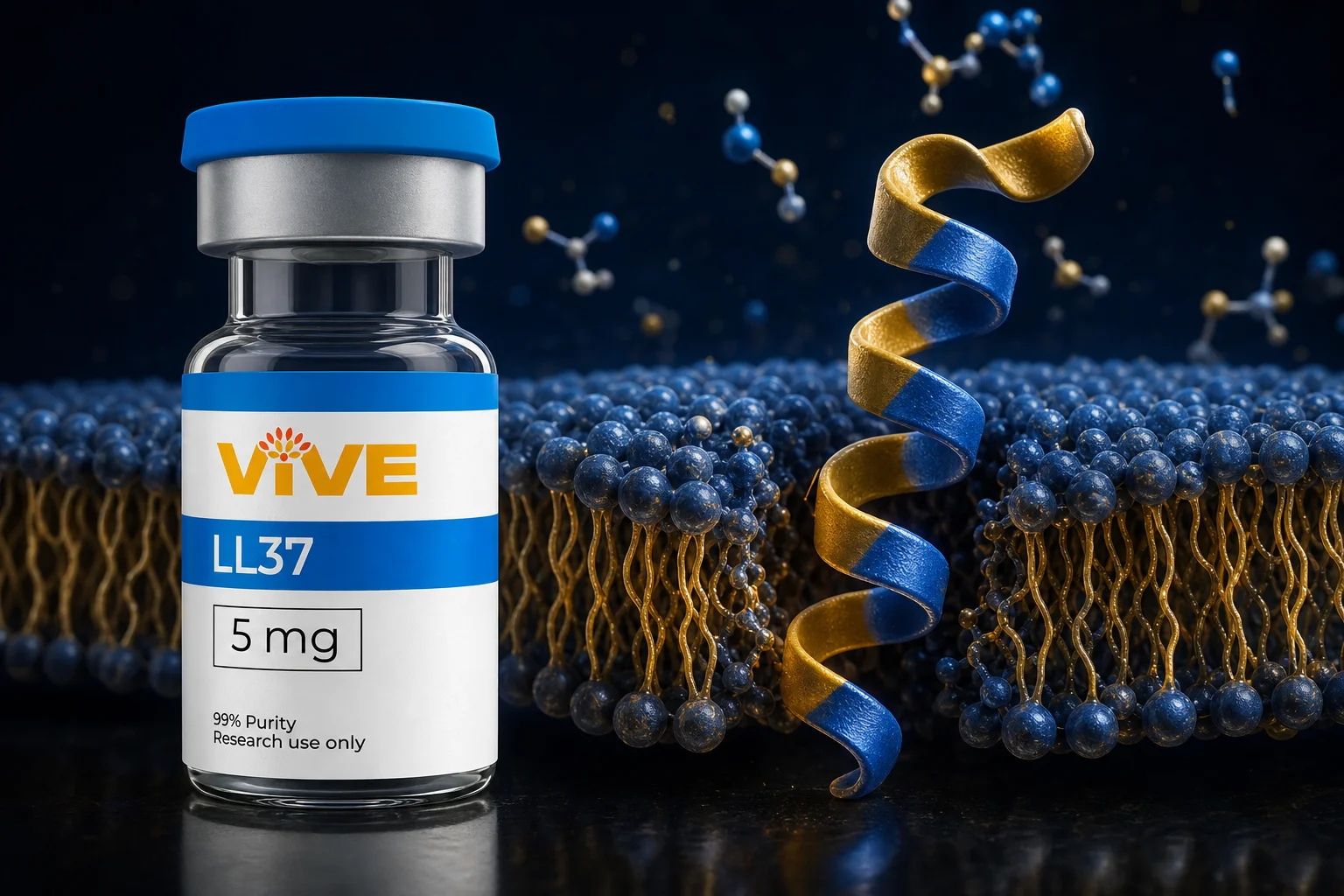
The peptide adopts an amphipathic alpha-helical conformation in hydrophobic environments. This helical geometry allows the cationic face to interact electrostatically with anionic bacterial membranes, while the hydrophobic face inserts into the lipid bilayer, disrupting membrane integrity and initiating cell death.
Sequence and Charge
LL-37 carries the sequence LLGDFFRKSKEKIGKEFKRIVQRIKDFLRNLVPRTES and a net positive charge of approximately +6 at physiological pH. This positive charge drives selectivity toward negatively charged prokaryotic membranes over the zwitterionic membranes of mammalian cells, a characteristic shared across cationic antimicrobial peptides but refined in LL-37 by its helical amphipathic architecture.
How LL-37 Functions in Innate Immunity
As the sole human cathelicidin, LL-37 occupies a non-redundant position in the innate immune landscape. Humans encode only one cathelicidin gene (CAMP), unlike rodents that express multiple cathelicidins, which positions LL-37 as a singular component of innate immunity at mucosal and epithelial barriers. It is expressed in neutrophils, epithelial cells, and macrophages and released at sites of infection or tissue damage.
Zasloff (2002, Science) described cathelicidins as critical first-line defenders acting before the adaptive immune system mounts a targeted response. The innate immunity role of LL-37 extends beyond direct killing: it modulates toll-like receptor (TLR) signaling, neutralizes lipopolysaccharide (LPS), and recruits immune cells through chemotaxis. Mookherjee et al. (2009, Journal of Leukocyte Biology) documented that LL-37 alters macrophage gene expression, upregulating cytokines and chemokines central to early pathogen clearance, further defining its scope within the innate immune network.
Antimicrobial and Anti-Biofilm Activity
The antimicrobial peptide LL-37 demonstrates broad-spectrum activity against gram-positive and gram-negative bacteria, as well as viruses and fungi. Wang et al. (2014, Antimicrobial Agents and Chemotherapy) documented minimum inhibitory concentrations in the low micromolar range for clinically relevant organisms under physiological salt conditions.
The antimicrobial anti-biofilm properties of LL-37 are particularly relevant in research contexts. Biofilms represent structured bacterial communities with significantly elevated resistance to conventional antibiotics. Overhage et al. (2008, Infection and Immunity) demonstrated that sub-inhibitory concentrations of LL-37 reduced Pseudomonas aeruginosa biofilm formation by disrupting quorum sensing signals, a mechanism distinct from direct bactericidal activity and relevant to chronic infection models.
Against bacteria viruses fungi, the ll- antimicrobial mechanism relies on membrane disruption, intracellular targeting, and immune activation rather than a single pathway. At high concentrations, rapid membrane lysis predominates; at sub-inhibitory levels, LL-37 modulates gene expression and biofilm architecture without direct killing. The antimicrobial peptide ll- has also been studied in respiratory epithelial defense, with Bals et al. (1998, Journal of Clinical Investigation) identifying it in lung tissue as part of the mucosal innate immune barrier.
Wound Healing and Tissue Repair Research
Beyond its antimicrobial role, LL-37 research has expanded into wound healing and tissue regeneration. Koczulla et al. (2003, Journal of Clinical Investigation) showed that LL-37 stimulates angiogenesis through activation of formyl peptide receptor-like 1 (FPRL1), promoting new blood vessel formation in wound tissue and linking the peptide to vascular remodeling at sites of injury.
Scratch-wound assays in keratinocytes demonstrate that LL-37 accelerates wound closure by stimulating cell migration and proliferation. Heilborn et al. (2003, Journal of Investigative Dermatology) noted significantly reduced LL-37 expression in chronic wound tissue compared to acute wounds, indicating a functional deficit in healing-impaired conditions that researchers use as a variable in repair and regeneration study design.
Researchers examining tissue models may find LL-37 a relevant variable given its dual role as a direct antimicrobial agent and a regulator of immune response and cellular repair signals at the wound site.
Storage, Reconstitution, and Research Handling
Proper handling preserves peptide activity across research applications. LL-37 should be stored lyophilized at -20 degrees C or below, protected from light and moisture. Reconstituted solutions are best prepared fresh using sterile or bacteriostatic water (BAC Water) to extend usable shelf life while maintaining peptide stability.
Avoid repeated freeze-thaw cycles, which can lead to aggregation and loss of the helical conformation critical to LL-37 function. Reconstituted peptide stored at 4 degrees C in low-bind tubes is typically stable for 48 to 72 hours under standard research conditions. For longer intervals, aliquot into single-use volumes and re-freeze at -80 degrees C immediately after reconstitution.
Peptide concentration can be verified by absorbance at 280 nm where aromatic residues allow, or by BCA/Bradford assay for samples without UV-active residues. Consistent handling protocols across replicates minimize variability in activity measurements.
Frequently Asked Questions
What is LL-37 and where is it found in the human body?
LL-37 is the only human cathelicidin peptide, derived from the precursor protein hCAP18. It is produced by neutrophils, NK cells, epithelial cells of the skin, lung, and gut, and keratinocytes in response to injury or infection. Its expression is regulated by vitamin D signaling and microbial exposure patterns across multiple tissue compartments.
How do antimicrobial peptides like LL-37 differ from conventional antibiotics?
Antimicrobial peptides primarily act by disrupting membrane integrity rather than targeting a single bacterial metabolic pathway. This multi-modal mechanism, which also involves intracellular targeting and immune modulation, reduces the likelihood of rapid resistance development compared to single-target antibiotic compounds used in parallel research models.
What organisms does LL-37 act against in research models?
Research documents activity against gram-positive bacteria (Staphylococcus aureus, Streptococcus), gram-negative bacteria (Escherichia coli, Pseudomonas aeruginosa), fungi (Candida albicans), and enveloped viruses. Activity against bacteria viruses fungi has been demonstrated across multiple in vitro models, with potency influenced by salt concentration, pH, and the lipid environment of the target membrane.
Does LL-37 have immunomodulatory functions beyond direct antimicrobial killing?
Yes. LL-37 activates chemokine receptor signaling, recruits monocytes and neutrophils, neutralizes LPS-mediated TLR4 activation, and promotes dendritic cell maturation. These innate immunity functions extend well past membrane disruption, classifying it as a host-defense peptide with broad immune response shaping capabilities across multiple innate cell types.
How should LL-37 be stored and handled in a research setting?
Store lyophilized LL-37 at -20 degrees C or below, away from moisture and light. Reconstitute with sterile or bacteriostatic water before use, store at 4 degrees C in low-bind tubes, and avoid repeated freeze-thaw cycles. Aliquot into single-use volumes before re-freezing to preserve peptide integrity and helical conformation across multiple research applications.
VivePeptides supplies research-grade LL-37 for qualified researchers. Browse the complete catalog of characterized peptides at the VivePeptides shop.
Research Use Only
All information in this article is intended for educational and research purposes only. VivePeptides products are not intended for human or veterinary use.