Research Article
Melanotan 1 vs Melanotan 2: Key Differences for Research
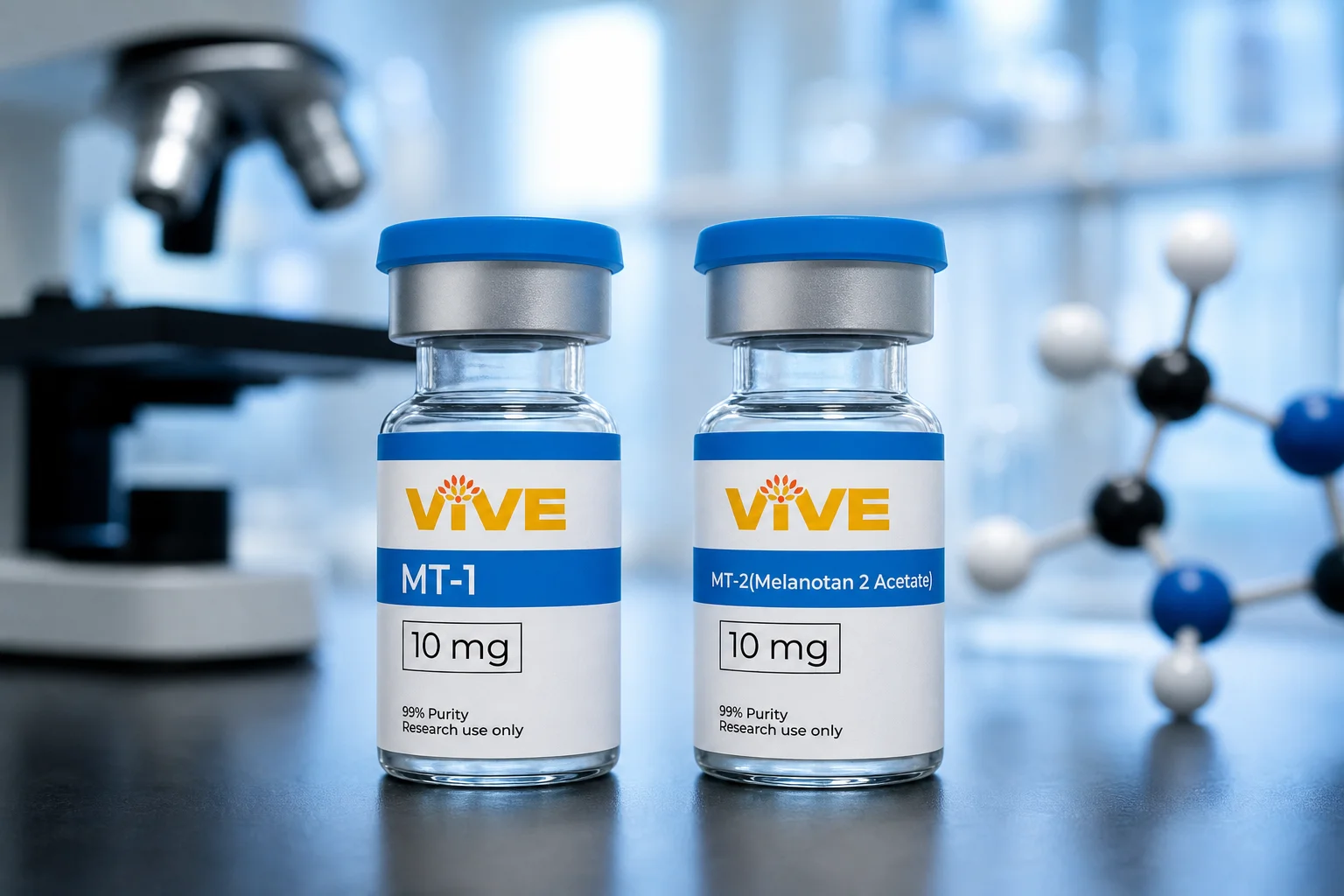
Melanotan 1 vs melanotan 2 are two distinct synthetic melanocortin analogs that share a structural origin but diverge sharply in receptor selectivity and research scope. The melanotan melanotan comparison comes down to MT-1's focused action on skin pigmentation versus MT-2's broader engagement of melanocortin receptors tied to sexual function and appetite suppression.
Structural Origins: How MT-1 and MT-2 Differ at the Molecular Level
Both MT-1 and MT-2 are synthetic analogs of alpha-melanocyte-stimulating hormone (alpha-MSH), a peptide cleaved from proopiomelanocortin (POMC) in the pituitary gland. Despite this shared lineage, their molecular architectures are distinct in ways that drive measurably different research outcomes.
MT-1, also known by its investigational name afamelanotide, is a linear 13-amino acid peptide. Its sequence closely mirrors native alpha-MSH, modified at specific positions to improve metabolic stability. MT-2 is a cyclic 7-amino acid peptide, formed through a lactam bridge between the amino and carboxyl termini. This cyclization makes MT-2 more compact and metabolically resistant, but it also shifts the peptide's three-dimensional geometry and, consequently, its receptor binding behavior.
Understanding the structural difference between melanotan 1 and melanotan 2 is the starting point for any comparative research design, because the molecular architecture of each compound determines which melanocortin receptor subtypes it activates.
Melanocortin Receptor Binding: The Basis of MT-1 vs MT-2 Research Divergence
The melanocortin system comprises five receptor subtypes, designated MC1R through MC5R. Each subtype is distributed across specific tissues and governs distinct physiological processes. The melanotan vs melanotan research literature consistently attributes the divergence between these compounds to receptor selectivity rather than their shared hormonal ancestry.
MT-1 demonstrates strong selectivity for MC1R, the receptor expressed primarily on melanocytes and responsible for regulating melanin production. This tight selectivity makes MT-1 a focused research instrument when the goal is to study skin pigmentation pathways without introducing confounds from other receptor subtypes.
MT-2, by contrast, binds with meaningful affinity across MC1R, MC3R, and MC4R. MC3R is expressed in the hypothalamus and brainstem, where it participates in energy homeostasis and appetite suppression. MC4R, also centrally expressed, has a well-documented role in sexual arousal and the physiology of penile erection. Hadley and Dorr (2006) outlined these differential receptor engagement profiles in the European Journal of Pharmacology, establishing the mechanistic framework that continues to guide MT-1 vs MT-2 comparisons in preclinical research.
Selectivity as a Research Variable
For studies isolating melanin production or skin pigmentation responses, MT-1's MC1R selectivity reduces experimental noise. For studies exploring multi-system melanocortin effects, MT-2's broader binding is the relevant property. Researchers selecting between melanotan peptides must treat receptor selectivity as a primary design variable, not a secondary consideration.
Skin Pigmentation and Tanning: Comparing Results Between the Two Compounds
Both compounds produce tanning responses in research models through MC1R-mediated stimulation of melanin production in melanocytes. The difference lies in the precision and experimental context of those results.
MT-1 has the more established research record for skin pigmentation specifically. Bohm et al. (2010) published findings in The Lancet demonstrating meaningful reductions in phototoxic episodes in erythropoietic protoporphyria patients treated with afamelanotide, with increased skin pigmentation documented as a secondary outcome. This trial represents the most rigorous human-model data on MT-1's pigmentation effects in a controlled setting.
MT-2 also drives melanin production through MC1R activation, but its simultaneous engagement of MC3R and MC4R means tanning results occur alongside appetite suppression and sexual function signals. For research designs where clean pigmentation data is the primary endpoint, MT-2's multi-receptor activity introduces additional variables that require careful experimental controls.
Sexual Function Research: Where MT-2 Has No Direct Parallel
The most cited difference between melanotan peptides in the research literature involves sexual function, and it belongs exclusively to MT-2.
Wessells et al. (1998) conducted a controlled study published in the Journal of Urology in which MT-2 administration produced penile erection responses in male subjects with psychogenic erectile dysfunction. The mechanism identified was MC4R activation in the central nervous system, which modulates pathways involved in sexual arousal independently of vascular mechanisms. This finding established a central, melanocortin receptor mediated route to sexual response distinct from phosphodiesterase inhibition.
MT-1, with its MC1R selectivity, does not produce these sexual function effects. This is not a limitation of MT-1 but a direct reflection of its receptor profile. For researchers studying melanocortin pathways in the context of erectile dysfunction, MT-2 is the appropriate compound. For researchers focused purely on skin biology, MT-1 remains the more targeted tool.
MT-2's MC4R activity also positions it in appetite suppression research. Early animal models reported reduced food intake following MT-2 administration, consistent with MC3R and MC4R involvement in hypothalamic energy regulation. This appetite suppression signal has been less pronounced in human research contexts compared to dedicated MC4R agonists, but it remains a documented variable in MT-2 study protocols. Researchers interested in related peptide mechanisms can also review PT-141, a metabolite of MT-2 developed specifically for the sexual function research pathway.
Side Effects Reported Across Both Research Compounds
Side effects are a meaningful practical differentiator, and any serious comparison of MT-1 vs MT-2 must address them directly.
MT-1's narrow receptor targeting produces a correspondingly limited side effect profile in research settings. The most consistently reported effects in human studies are transient nausea, facial flushing, and mild injection site reactions. Because MT-1 does not significantly engage MC3R or MC4R, the systemic effects linked to those receptor subtypes are absent from MT-1 data.
MT-2's broader receptor binding produces a wider range of side effects. In addition to nausea and facial flushing (both reported with greater frequency and intensity than with MT-1), research subjects have reported spontaneous penile erection, yawning, and appetite suppression. Kask et al. (2000) documented differential tolerability patterns in animal models published in Neuropharmacology, correlating broader melanocortin receptor engagement with more varied physiological response signatures.
For research protocols prioritizing tight mechanistic focus and minimal off-target signaling, MT-1's side effect profile is the cleaner option. For multi-system melanocortin studies, MT-2's broader signature is both expected and informative.
Frequently Asked Questions
What is the core structural difference between melanotan 1 and melanotan 2?
MT-1 is a linear 13-amino acid peptide closely modeled on native alpha-MSH, while MT-2 is a cyclic 7-amino acid peptide stabilized by a lactam bridge. This structural difference shifts MT-2's receptor binding toward broader melanocortin receptor targets including MC3R and MC4R, expanding its research applications beyond skin pigmentation into sexual function and appetite suppression territory.
Which compound is primarily used for tanning and skin pigmentation research?
MT-1 (afamelanotide) has the more rigorous clinical data for skin pigmentation specifically. Bohm et al. (2010) documented increased pigmentation in controlled human studies published in The Lancet. MT-2 also produces tanning through MC1R but introduces concurrent receptor activity that adds experimental variables to pigmentation-focused protocols.
How does MT-2 relate to erectile dysfunction research?
MT-2 activates MC4R in the central nervous system, a pathway documented to facilitate penile erection. Wessells et al. (1998) demonstrated in the Journal of Urology that MT-2 produced erectile responses in subjects with psychogenic erectile dysfunction, establishing a central melanocortin receptor mechanism distinct from vascular pathways.
Are side effects different between MT-1 and MT-2?
Yes. Both share nausea and facial flushing as reported side effects. MT-2 also produces spontaneous arousal, yawning, and appetite suppression tied to its MC3R and MC4R binding. MT-1's tighter MC1R selectivity limits its side effect profile primarily to pigmentation-related and local injection-site responses, making it the lower-noise option in single-system protocols.
Where can researchers source both melanotan peptides?
Both Melanotan 1 (MT1) and Melanotan 2 (MT2) are available for licensed research purposes through VivePeptides, sold strictly for in vitro and preclinical research applications only.
Researchers reviewing purity documentation and full specifications for both compounds can browse the complete research peptide catalog at the VivePeptides shop.
Research Use Only
All information in this article is intended for educational and research purposes only. VivePeptides products are not intended for human or veterinary use.