
US 3rd Party Tested          Free BAC Water on All Orders          Free Shipping          For Lab Use          Secure Checkout          US 3rd Party Tested          Free BAC Water on All Orders          Free Shipping          Trusted By Pharmacies          Secure Checkout
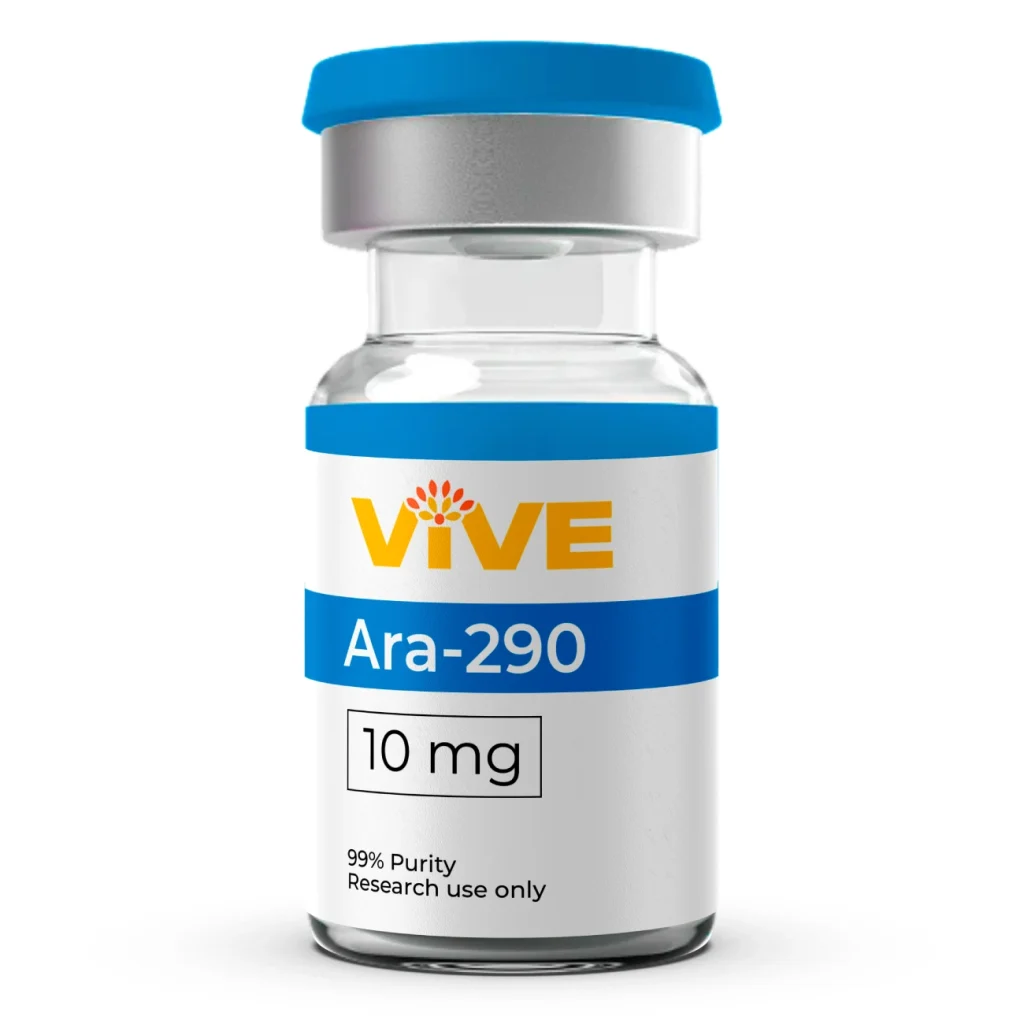
Vive ARA-290 peptide vial, 10 mg, labeled with 99% purity, research use only, showcasing a clear glass container with a blue cap and branding.

ARA-290

99%+ Purity USA Tested

Research Use Only. Not for Human or Veterinary Use

ARA-290 (Cibinetide): Non-erythropoietic innate repair receptor agonist peptide, CAS 1208243-50-8, MW 1257.43 g/mol, ≥99% purity. Lyophilized powder for laboratory use.

$65.00

Peptide Name ARA-290 (Cibinetide)
CAS Number 1208243-50-8
Molecular Formula C₅₄H₈₃N₁₅O₁₇S
Molecular Weight 1257.43 g/mol
Mechanism Class Non-erythropoietic innate repair receptor (IRR) agonist
Appearance White to off-white lyophilized powder
Purity ≥99% (HPLC)
Storage -20°C, desiccated, protected from light
Solubility Soluble in sterile water

This product is not intended for human or animal use. For scientific research only.

VivePeptides provides detailed analytical results including High-Performance Liquid Chromatography (HPLC) and mass spectrometry data for all peptides. These reports confirm peptide purity, composition, and molecular accuracy, giving researchers full transparency and confidence in the materials used for their studies.

VivePeptides peptides should be stored in a cool, dry environment and protected from light and moisture. Lyophilized peptides are best kept refrigerated or frozen until use to maintain stability. Once reconstituted for research purposes, peptides should be stored according to standard laboratory protocols, typically under refrigeration, and handled using proper aseptic techniques to preserve integrity throughout the study period.

OVERVIEW

What Is ARA-290 (Cibinetide) Peptide?

ARA-290 (Cibinetide) is a synthetic undecapeptide engineered from the B-helix region of erythropoietin (EPO). Developed by Araim Pharmaceuticals, ARA-290 was designed to retain the tissue-protective signaling properties of EPO while eliminating its erythropoietic (red blood cell-stimulating) activity. This non-erythropoietic EPO-derived peptide selectively activates the innate repair receptor (IRR), making it a unique research tool for studying tissue protection and repair mechanisms without the hematological confounders associated with EPO itself.
Published research on ARA-290 peptide spans neuroprotection, metabolic neuropathy, sarcoidosis-associated neuropathy, and tissue repair models. The peptide’s ability to activate the IRR — a heterodimeric complex of the EPO receptor (EPOR) and the beta common receptor (βcR/CD131) — without triggering classical erythropoiesis has made cibinetide a valuable tool in laboratories investigating cytoprotective signaling pathways. ARA-290 research has progressed from preclinical models through multiple clinical research studies.

IRR-Selective Peptide

11-amino-acid EPO-derived peptide targeting the innate repair receptor without erythropoietic activity

≥99% HPLC Purity

Every batch verified via high-performance liquid chromatography

USA Tested & Verified

Third-party analytical testing performed in USA laboratories

RESEARCH

ARA-290 Mechanism of Action in Research

The ARA-290 mechanism of action is distinct from classical erythropoietin signaling. While EPO activates homodimeric EPOR to stimulate erythropoiesis, ARA-290 selectively engages the innate repair receptor (IRR), triggering tissue-protective and anti-inflammatory signaling cascades. Published research has elucidated multiple downstream pathways activated by ARA-290’s IRR engagement, providing insight into non-erythropoietic cytoprotective mechanisms.

Innate Repair Receptor (IRR) Activation

ARA-290 binds to the innate repair receptor, a heterodimer composed of EPOR and βcR (CD131). Research by Brines et al. (2008) demonstrated that this receptor complex is expressed on a wide variety of cell types including neurons, endothelial cells, and immune cells. Upon ARA-290 binding, the IRR activates JAK2/STAT5 signaling, PI3K/Akt pathways, and NF-κB modulation, collectively producing cytoprotective and anti-inflammatory effects in research models. Critically, ARA-290’s affinity for the IRR is insufficient to activate the homodimeric EPOR, eliminating erythropoietic activity.

Anti-Inflammatory Signaling Pathways

Studies indicate that ARA-290 modulates inflammatory signaling through multiple mechanisms. Research published by Brines & Cerami (2012) in Molecular Medicine demonstrated that ARA-290 downregulates pro-inflammatory cytokines including TNF-α, IL-6, and IL-1β while upregulating anti-inflammatory mediators. In preclinical models, ARA-290 has been observed to shift macrophage polarization from M1 (pro-inflammatory) toward M2 (anti-inflammatory/reparative) phenotypes, suggesting a role in resolution of inflammation and tissue repair signaling.

Neuroprotective Research Applications

ARA-290 research has demonstrated notable effects in neuroprotection models. Brines et al. (2008) published findings showing that ARA-290 activated neuroprotective pathways in dorsal root ganglia neurons. Subsequent clinical research by Heij et al. (2012) investigated ARA-290 in sarcoidosis-associated small fiber neuropathy models, documenting improvements in nerve fiber density measures, further establishing the peptide’s relevance to neuroscience research. —

COMPARISON

ARA-290 vs EPO: Research Compound Comparison

ARA-290 (Cibinetide) and erythropoietin (EPO) share a structural origin but differ fundamentally in receptor targeting, biological activity, and research applications. Understanding these differences is critical for researchers working with cytoprotective and erythropoietic signaling pathways.
FeatureARA-290 (Cibinetide)EPO (Erythropoietin)
TypeSynthetic undecapeptideGlycoprotein hormone (165 aa)
Molecular Weight1257.43 Da~30,400 Da
CAS Number1208243-50-811096-26-7
Target ReceptorInnate Repair Receptor (EPOR/βcR)Homodimeric EPOR
Erythropoietic ActivityNonePrimary function
Primary Research FocusNeuroprotection, tissue repair, anti-inflammationErythropoiesis, red blood cell production
Safety Profile in ResearchNo hematological confoundersThrombotic risk at high doses
Administration Route (Research)Subcutaneous, intravenousSubcutaneous, intravenous
Research StagePhase 2 clinical studies completedFDA-approved therapeutic
ARA-290’s selective IRR targeting without erythropoietic activity represents a significant advancement for researchers studying tissue-protective EPO signaling without hematological confounders. VivePeptides offers research grade ARA-290 for sale at ≥99% purity from our USA-based facility.

RESEARCH STUDIES

ARA-290 Research Applications & Published Studies

ARA-290 research includes both preclinical and clinical investigations, with published findings spanning multiple therapeutic research areas. The following areas represent the most actively investigated applications of ARA-290 peptide. All references are to research contexts only.

Neuropathy and Neuroprotection Research

The most extensively studied application of ARA-290 involves neuroprotection and neuropathy models. Brines et al. (2008) published foundational work in the Proceedings of the National Academy of Sciences demonstrating ARA-290’s neuroprotective properties via IRR activation. Heij et al. (2012) subsequently published clinical research findings in Molecular Medicine showing that ARA-290 improved corneal nerve fiber measures in patients with sarcoidosis-associated small fiber neuropathy, representing a significant translational milestone.

Metabolic Neuropathy Research

Research has explored ARA-290 in metabolic neuropathy models. Brines et al. (2014) published findings in BMC Neurology from a randomized controlled study investigating ARA-290 in type 2 diabetes-associated neuropathy. The study documented effects on small nerve fiber measures and neuropathic symptoms, contributing to the understanding of IRR-mediated neuroprotection in metabolic disease research contexts.

Tissue Protection and Repair Studies

Preclinical ARA-290 research has examined the peptide’s tissue-protective properties across multiple organ systems. Collino et al. (2013) published studies demonstrating ARA-290’s effects in renal ischemia-reperfusion models. Additional research by Ahmet et al. (2011) investigated ARA-290 in cardiac injury models, observing cytoprotective effects consistent with IRR-mediated anti-apoptotic signaling, expanding the scope of ARA-290 research to cardiovascular biology.

QUALITY ASSURANCE

Quality & Testing Standards

VivePeptides maintains rigorous quality control for every batch of ARA-290 peptide. Our commitment to research-grade purity ensures that laboratories receive consistent, reliable compounds for their investigations.

HPLC & Mass Spectrometry

Every batch of ARA-290 undergoes high-performance liquid chromatography (HPLC) and mass spectrometry analysis to confirm identity, purity, and molecular weight.

Third-Party Verified

All VivePeptides ARA-290 is independently verified through third-party analytical laboratories based in the USA. Testing documentation is available for every lot.

≥99% Purity Standard

Our ARA-290 consistently meets or exceeds ≥99% purity as determined by HPLC analysis, ensuring research-grade quality for laboratory applications.

FAQ

Frequently Asked Questions About ARA-290

What is ARA-290 used for in research?

ARA-290 (Cibinetide) is used in laboratory research to study innate repair receptor (IRR) signaling, neuroprotection mechanisms, anti-inflammatory pathways, and tissue repair biology. As a non-erythropoietic EPO derivative, it enables study of tissue-protective EPO pathways without hematological effects. ARA-290 is sold for research use only.

What purity is VivePeptides ARA-290?

VivePeptides ARA-290 is manufactured to ≥99% purity as verified by HPLC analysis. Every batch is tested and verified through independent third-party USA-based laboratories to ensure consistent research-grade quality.

How should ARA-290 be stored?

Lyophilized ARA-290 should be stored at -20°C, protected from light and moisture. Once reconstituted, the solution should be stored at 2–8°C and used within 14 days for optimal stability. Avoid repeated freeze-thaw cycles.

What is the difference between ARA-290 and EPO?

ARA-290 is an 11-amino-acid synthetic peptide derived from EPO’s structure that selectively activates the innate repair receptor (IRR) without stimulating erythropoiesis. EPO is a 165-amino-acid glycoprotein that primarily activates homodimeric EPOR to stimulate red blood cell production. ARA-290 provides tissue-protective signaling without hematological confounders.

Is VivePeptides ARA-290 third-party tested?

Yes. Every lot of VivePeptides ARA-290 undergoes independent third-party testing at USA-based analytical laboratories. Testing includes HPLC purity analysis and mass spectrometry identity confirmation. Results are available upon request for qualified researchers.

RELATED PRODUCTS

Related Research Peptides

Explore other research-grade peptides available from VivePeptides. Each product meets the same rigorous purity and testing standards.

BPC-157

Research grade gastric pentadecapeptide for tissue biology studies

TB-500

Thymosin Beta-4 fragment for tissue repair and cell migration research

MOTS-c

Mitochondrial-derived peptide for metabolic research

Selank

Nootropic peptide for neuropeptide research

Explore More Research Peptides