Research Article
How to Verify Peptide Quality: 5 Tests Every Researcher Should Demand

Knowing how to verify peptide quality requires more than reading a product label. The five tests that form the backbone of research-grade quality control are high-performance liquid chromatography for purity, mass spectrometry for identity, amino acid analysis for sequence confirmation, endotoxin and sterility screening for biological contamination, and lot-specific certificate of analysis review. Suppliers who cannot provide documented results for all five do not meet the standard.
Synthetic peptides vary in quality far more than their product descriptions suggest. Manufacturing and purification processes differ across facilities, and the resulting peptide products can contain deletion sequences, truncated fragments, and biological contaminants that compromise experimental reproducibility. Generic claims of research-grade quality carry no evidentiary weight without documentation to support them. The only reliable method for evaluating what is actually in a vial is through standardized analytical testing.
Researchers sourcing compounds such as BPC-157 or TB-500 should treat complete analytical documentation as a baseline expectation, not an optional add-on.
Test 1: High-Performance Liquid Chromatography and Peptide Purity
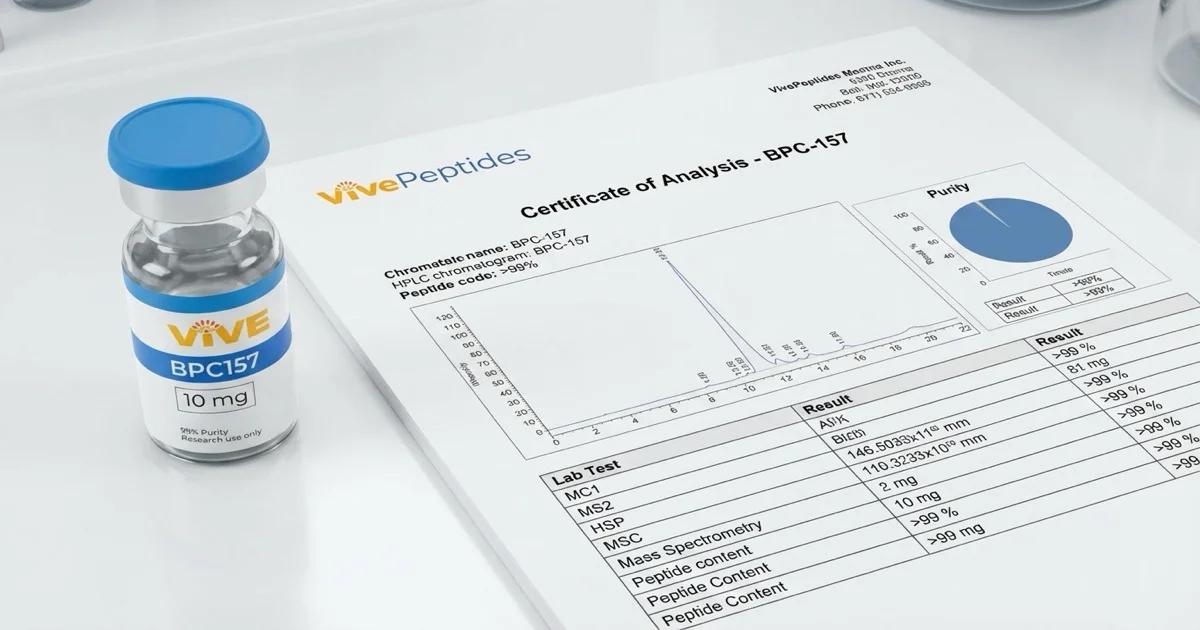
High-performance liquid chromatography (HPLC) is the primary method for measuring peptide purity. A liquid chromatography system separates the components of a peptide sample by pumping it through a chromatography column under high pressure. Each component interacts differently with the stationary phase, causing them to travel at different speeds and elute at distinct times. The resulting chromatogram is a graph of detector response over time, with peaks corresponding to detected compounds.
The tallest peak in a well-prepared chromatogram corresponds to the target peptide. Smaller secondary peaks represent impurities, which may include deletion sequences from missed coupling steps during synthesis, truncated fragments, and chemical byproducts from the manufacturing process. Peptide purity is expressed as the percentage of the main peak area relative to the total detected peak area.
Research-grade synthetic peptides are expected to reach a minimum purity of 98% by this method. A result below that threshold indicates that a measurable fraction of the product is not the intended compound. For protocols using mass-based dosing, an impure sample compounds dosing errors and undermines reproducibility.
Suppliers should provide the full HPLC chromatogram, not only a stated purity value. A number without a corresponding trace is not independently verifiable. The chromatogram allows a reviewer to confirm peak shape, retention time, and whether secondary peaks suggest co-eluting impurities.
What to Look for in an HPLC Report
When reviewing HPLC data, confirm the following:
- A sharp, well-resolved main peak with no significant shoulder features adjacent to it
- A purity percentage consistent with the calculated peak area ratio visible in the chromatogram
- The analytical methods section identifies the column type, mobile phase composition, and gradient conditions used
- The lot number on the chromatography report matches the lot number on the received product
Test 2: Mass Spectrometry for Molecular Weight Confirmation
High-performance liquid chromatography measures purity. It does not confirm compound identity. The test that answers the identity question is mass spectrometry.
Mass spectrometry identifies compounds by ionizing the sample and measuring the mass-to-charge ratio of the resulting ions. Applied to a peptide, the method produces a spectrum that includes the intact molecular weight of the compound. This observed molecular weight is compared against the theoretical molecular weight calculated from the known peptide sequence and the individual masses of each amino acid residue.
A match within the instrument's stated mass accuracy confirms identity. A discrepancy indicates a synthesis error, a modification to the expected sequence, or the presence of a different compound entirely. Any of these outcomes disqualifies the batch for research use.
Electrospray ionization mass spectrometry (ESI-MS) is the most common format applied to synthetic peptides because it handles large polar molecules without significant fragmentation. For sequences in the 10 to 30 amino acid range typical of many research peptides, modern instruments achieve mass accuracy better than 5 parts per million. Many quality control laboratories couple this approach directly with liquid chromatography, running LC-MS analyses that simultaneously verify peptide purity and confirm molecular weight within a single analytical run.
A supplier who provides HPLC data without a corresponding mass spectrometry report can confirm that something is present at high concentration. They cannot confirm that it is the correct compound. Both tests are necessary to verify peptide identity.
Test 3: Amino Acid Analysis and Peptide Sequence Verification

Mass spectrometry confirms the molecular weight of a peptide. Amino acid analysis takes sequence verification a step further by confirming the actual composition of the compound.
Amino acid analysis works by hydrolyzing the peptide under acidic conditions, breaking the molecule into its constituent amino acids. These individual components are then separated by liquid chromatography and quantified. The resulting amino acid profile is compared against the expected composition for the target peptide sequence. Any substituted, missing, or added amino acid is detectable through this comparison.
The practical significance of this test lies in the class of errors it catches. A substituted amino acid can produce a peptide with a molecular weight nearly identical to the intended compound. Mass spectrometry using intact molecular weight measurement may not detect this type of error. Amino acid analysis will.
Heinrikson and Meredith, writing in Analytical Biochemistry (1984), documented the reliability of reverse-phase HPLC-based amino acid analysis methods for peptide characterization, establishing an approach that quality control laboratories continue to apply as a compositional standard today. The combination of mass spectrometry data, high-performance liquid chromatography purity results, and amino acid analysis constitutes the complete analytical picture. For complex peptide sequences, amino acid analysis is not a redundant test. It is a necessary complement.
Test 4: Endotoxin and Sterility Testing
Chemical purity and identity testing address the composition of a peptide. Endotoxin and sterility testing address what else may be present in the vial alongside the compound.
Endotoxins are lipopolysaccharide components from the outer membrane of gram-negative bacteria. They are among the most potent biological contaminants encountered in injectable and reconstitutable research compounds. Even at trace concentrations, endotoxins can trigger inflammatory responses in biological models, interfere with receptor binding assays, alter cytokine expression patterns, and produce confounding variables that undermine experimental results.
The Limulus Amebocyte Lysate (LAL) test is the established method for detecting endotoxin levels. Results are expressed in endotoxin units per milligram (EU/mg). Documentation should include the measured level, the threshold applied, and a pass or fail determination. Some laboratories apply recombinant Factor C (rFC) assays as a modern alternative. Either method, properly documented, satisfies the requirement for endotoxin screening.
Sterility testing confirms the absence of viable bacterial and fungal contamination in the final product. For compounds that will be reconstituted and used in biological research, a passing sterility result is a minimum condition. A supplier who states a product is pyrogen-free without providing LAL test data has made a claim without analytical support.
Test 5: Certificate of Analysis and Lot Number Traceability
The Certificate of Analysis (COA) is the document that consolidates all quality control testing results into a single, traceable record. It is an audit document. A legitimate COA includes the lot number, synthesis or release date, HPLC purity result with supporting data, mass spectrometry result confirming molecular weight, amino acid analysis outcome where applicable, endotoxin level and sterility determination, and the name of the testing laboratory.
Lot number traceability connects the physical product to its specific analytical record. If a COA carries no lot number, or if the lot number on the COA does not match the lot number on the received vial or packaging, the document does not apply to the product in question.
Third-party testing is the condition that makes a COA independently credible. When the laboratory performing the analysis is separate from the manufacturer, the results cannot be altered or selectively generated by the supplier. An accredited external laboratory also maintains defined instrument calibration schedules, quality system documentation, and reporting standards that in-house teams may not be required to follow. Researchers should verify the name of the testing laboratory and confirm it is an accredited analytical facility.
Red Flags in COA Documentation
Reject a supplier whose documentation includes any of the following:
- A COA with no lot number, or a lot number that does not match the received product
- HPLC purity data only, without a corresponding mass spectrometry report
- Purity expressed as a range rather than a specific measured value
- No named or verifiable third-party laboratory on the COA
- Missing endotoxin data for compounds intended for biological research
- A single generic COA document applied to multiple batch numbers or product lines
These are not paperwork oversights. They indicate a quality control system that does not meet research-grade standards.
Frequently Asked Questions
What purity threshold is required for research-grade synthetic peptides?
A minimum of 98% purity by high-performance liquid chromatography is the accepted standard for research-grade peptide products. Applications requiring quantitative precision, such as receptor binding studies or mass spectrometry reference standards, may require 99% or higher. The HPLC chromatogram supporting the stated figure should always accompany the purity percentage, not appear as a standalone number.
Why is a mass spectrometry report necessary if HPLC already confirms purity?
Liquid chromatography confirms that the main compound is present at high concentration relative to detectable impurities. It does not confirm that the compound has the correct molecular weight or peptide sequence. Mass spectrometry provides identity confirmation that HPLC cannot. Both are required for a complete quality control package, and neither test is a substitute for the other.
What does a third-party COA mean in practice?
A third-party COA means the analytical testing was performed by a laboratory with no financial or operational relationship to the manufacturer. This removes the manufacturer's ability to alter or selectively report results. Researchers should verify the testing lab's name and accreditation status directly rather than accepting the designation based solely on the supplier's representation.
How does amino acid analysis differ from mass spectrometry for sequence verification?
Mass spectrometry measures the molecular weight of the intact peptide and can detect large sequence errors. Amino acid analysis hydrolyzes the peptide and quantifies each individual amino acid, detecting substitutions that produce peptides with similar molecular weights. The two methods are complementary and both are used in complete quality control protocols for complex or longer peptide sequences.
What should I do if a supplier cannot provide lot-specific documentation?
Do not order from that supplier for research use. A supplier without lot-specific COA data has no traceability system. Any quality claim made without traceable documentation is unverifiable. For research applications where reproducibility is a requirement, unverified source material introduces a fundamental validity problem that cannot be corrected after the experiment is run.
VivePeptides provides lot-specific COAs with HPLC and mass spectrometry data for every compound in the catalog, because researchers need documentation they can actually verify. Browse the complete selection of research peptide products at VivePeptides Shop.
Research Use Only
All information in this article is intended for educational and research purposes only. VivePeptides products are not intended for human or veterinary use.