Research Article
5 Best Peptides for Cognitive Enhancement Research

The 5 best peptides for cognitive enhancement research, based on peer-reviewed animal models and emerging clinical data, are Semax nootropic peptide, Selank, NAD+, BPC-157, and Tesamorelin. Each compound targets a distinct mechanism within the brain, from brain-derived neurotrophic factor upregulation to mitochondrial support, making this set the most-cited group in peptide therapy literature focused on cognitive function and brain health.
By Vive Team
Why Cognitive Peptide Research Has Accelerated
The brain depends on a precise interplay of amino acids, growth factors, and metabolic cofactors to sustain normal brain function. Disruptions to any of these systems, whether from aging, chronic stress, or neurological injury, are among the most-studied contributors to cognitive decline. Peptide therapy research has grown as one avenue for examining how short-chain signaling compounds interact with neural circuits, growth factor pathways, and mitochondrial biogenesis.
The five cognitive peptides reviewed here were selected because they carry the largest published evidence base addressing brain health and cognitive function in preclinical and, in one instance, controlled clinical settings. All content in this article is for research purposes only. None of these compounds carry regulatory approval for cognitive indications in humans.
Semax: BDNF Upregulation and Mental Clarity
Semax is a synthetic heptapeptide analog of adrenocorticotropic hormone fragment 4-7, extended with a Pro-Gly-Pro C-terminal tripeptide. Developed at the Institute of Molecular Genetics of the Russian Academy of Sciences, it has been studied in peer-reviewed literature on neuroprotection and brain health since the 1980s.
Mechanism
The most-cited mechanism for Semax in cognitive research is upregulation of brain-derived neurotrophic factor in hippocampal tissue. Kolomin et al. (2013, Neuroscience Letters) demonstrated dose-dependent BDNF increases in rat hippocampus following intranasal Semax administration. Brain-derived neurotrophic factor supports neuronal survival, synaptic plasticity, and learning consolidation, making it a primary molecular target in studies of cognitive decline.
Semax also modulates dopaminergic and serotonergic transmission in animal models. Shadrina et al. (2010, Journal of Molecular Neuroscience) reported that Semax administration in a rat ischemia model preserved brain function in peri-infarct tissue regions, with protective effects attributed to BDNF and VEGF signaling cascades. These data are frequently cited by researchers designing protocols that examine mental clarity proxies in rodent behavioral paradigms.
Research Standing
Semax carries the most extensive published evidence base among the 5 best peptides for cognitive enhancement research for direct neurological applications. Its nasal bioavailability, short half-life, and structural derivation from endogenous ACTH fragments make it a frequently cited model compound for studying BDNF-mediated cognitive effects.
Selank: Anxiolytic Effects and Cognitive Stability
Selank is a synthetic heptapeptide derived from the immunomodulatory peptide tuftsin (Thr-Lys-Pro-Arg), extended with a Pro-Gly-Pro tail. Developed jointly at the Institute of Molecular Genetics and the Zakusov Institute of Pharmacology in Russia, it has appeared in peer-reviewed literature since the early 2000s.
The Selank nootropic peptide is most frequently studied alongside Semax, forming the semax selank pairing commonly referenced in neuropeptide literature, because of their complementary but mechanistically distinct actions on brain function.
Mechanism
Selank's most-documented mechanism is modulation of GABAergic signaling, producing anxiolytic effects in animal models without the sedation characteristic of benzodiazepines. Semenova et al. (2010, Bulletin of Experimental Biology and Medicine) confirmed reduced anxiety-like behavior in rats via GABA-A receptor modulation at research-relevant doses. No significant sedation or motor impairment was recorded in the same study, a safety profile that distinguishes Selank from classical anxiolytics.
Beyond anxiolytic effects, Selank has been examined for its capacity to improve memory consolidation in stressed and non-stressed rodents. Narkevich et al. (2008, Doklady Biological Sciences) reported improved passive avoidance learning performance in rats, with proposed mechanisms including enkephalin metabolism modulation and secondary effects on brain-derived neurotrophic factor pathways. Because chronic stress accelerates cognitive decline and erodes synaptic plasticity, compounds that attenuate stress-related neural damage while supporting mental clarity occupy an important niche in brain health research.
NAD+: Mitochondrial Support for Brain Function
NAD+ (nicotinamide adenine dinucleotide) is a coenzyme present in every cell and an obligate substrate for sirtuins and PARP enzymes. Although not a peptide in the classical sense, it is regularly included in peptide therapy research protocols because of its central role in mitochondrial energy metabolism and its documented relevance to brain function.
Mechanism
NAD+ concentrations decline with normal aging, with long-term consequences for mitochondrial efficiency in high-demand tissues like neurons. Verdin (2015, Science) reviewed NAD+ biology in aging and demonstrated that NAD+ precursor administration restored mitochondrial function in aged animal models with direct implications for brain health.
Aman et al. (2018, Cell Metabolism) showed that NAD+ replenishment in aged mice produced significant improvements on Morris water maze performance, a validated paradigm for assessing spatial memory and cognitive function. The proposed mechanism runs through SIRT1 activation, which upregulates BDNF expression and enhances synaptic plasticity, creating a mechanistic overlap with the brain-derived neurotrophic factor pathway central to Semax research.
BPC-157 and Tesamorelin: Neuroprotection and Clinical Evidence
BPC-157: Growth Factor Signaling and Neural Cytoprotection
BPC-157 (Body Protection Compound 157) is a pentadecapeptide derived from a gastric protective protein. Its primary published literature covers gut and musculoskeletal healing, but a growing subset of animal model data has examined its relevance to brain function and neuroprotection.
Vukojevic et al. (2020, Journal of Neural Transmission) demonstrated that BPC-157 reduced neurological deficits and hippocampal damage in rat traumatic brain injury models. Proposed mechanisms include nitric oxide system modulation, upregulation of growth factor expression, and interactions with dopaminergic and serotonergic pathways, all of which intersect with circuits involved in mental clarity and cognitive performance.
Seiwerth et al. (2018, Current Neuropharmacology) reviewed BPC-157's cytoprotective profile, noting that its amino acids sequence (Gly-Glu-Pro-Pro-Pro-Gly-Lys-Pro-Ala-Asp-Asp-Ala-Gly-Leu-Val) confers stability and multitissue receptor activity, including in neural tissue. Researchers designing multi-compound protocols can review the research data on Best Peptide Stacks for Research for context on how BPC-157 is paired with other compounds in preclinical neuroprotection settings.
Tesamorelin: Human Trial Data on Cognitive Decline
Tesamorelin is a synthetic GHRH analog consisting of the full 44-amino-acid GHRH sequence with an N-terminal trans-3-hexenoic acid modification. It is the only compound among the 5 best peptides for cognitive enhancement research to have a randomized controlled human trial directly examining cognitive function.
Baker et al. (2012, Archives of Neurology) conducted a double-blind, placebo-controlled trial in adults over 55, reporting significant improvements in executive function and verbal memory among Tesamorelin-treated subjects at 20 weeks. Performance on the Stroop Color-Word interference test and paired-associate learning were the primary cognitive measures. The proposed mechanism runs through GH-stimulated IGF-1 production; IGF-1 crosses the blood-brain barrier and participates in neurogenesis, synaptic plasticity, and protection against cognitive decline.
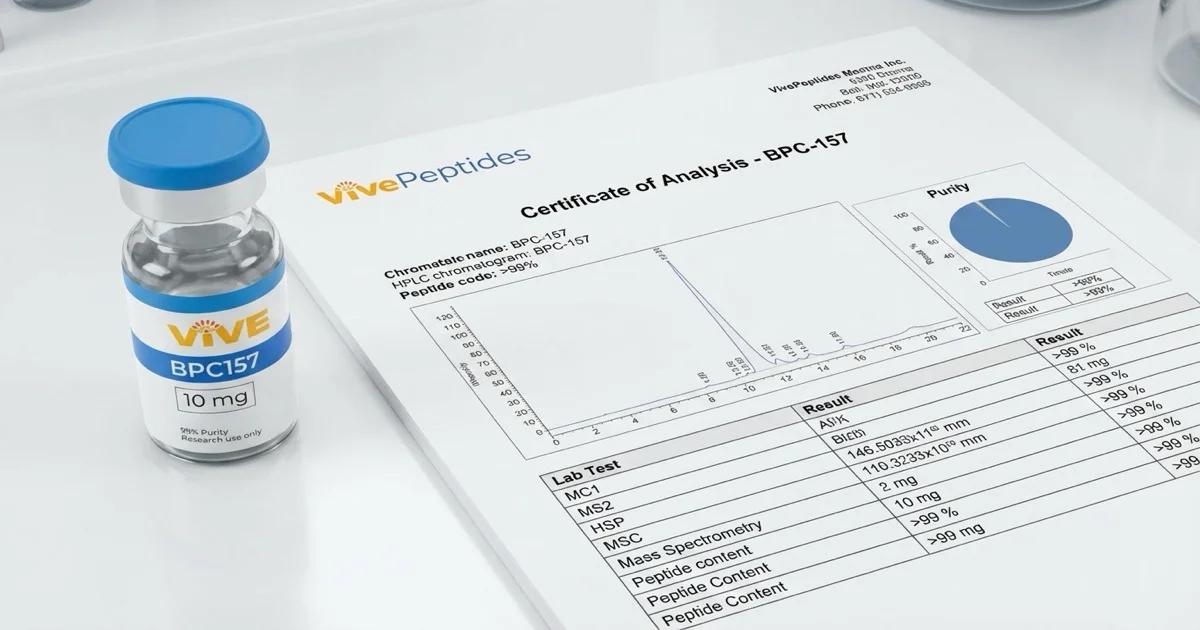
Researchers sourcing compounds for these protocols should account for compound purity from the start. The How to Read a Peptide Certificate of Analysis (COA) provides compound-level HPLC data that informs sourcing decisions for research-grade materials.
Side Effects and Selecting the 5 Best Peptides for Cognitive Enhancement Research
Understanding the side effects profile of each compound is fundamental to responsible protocol design. Published literature reports the following observations.
Semax: Animal studies report minimal adverse events at standard research doses. Human observational data from Russian clinical settings notes occasional transient nasal irritation with intranasal administration. No systemic adverse events have been reported at research-relevant doses in peer-reviewed publications.
Selank: Semenova et al. (2010) found no significant physiological adverse events at research doses in rodent studies. The GABAergic mechanism raises theoretical tolerance questions, but published animal data does not support tolerance development at the doses examined.
NAD+: High-dose NAD+ precursor studies in humans have occasionally noted flushing and gastrointestinal discomfort. The coenzyme form itself has a limited standalone side effects dataset outside of broader metabolic research contexts.
BPC-157: Across a substantial body of animal model literature, BPC-157 demonstrates a consistently clean side effects profile. No carcinogenicity signals have been observed in published rodent studies.
Tesamorelin: Baker et al. (2012) identified injection site reactions and mild fluid retention as the most common adverse events in their trial, consistent with GH-axis stimulation and well-characterized in the broader Tesamorelin clinical record.
Researchers selecting among these compounds should also account for source quality. How to Verify Peptide Quality: 5 Tests Every Researcher Should Demand outlines the analytical standards that separate research-grade purity from lower-quality alternatives.
Frequently Asked Questions
What are the 5 best peptides for cognitive enhancement research?
Based on peer-reviewed published data, the five most-studied compounds are Semax, Selank, NAD+, BPC-157, and Tesamorelin. Each addresses a distinct mechanism relevant to brain health and cognitive function, including BDNF upregulation, GABAergic modulation, mitochondrial support, neuroprotection, and GH-axis stimulation. Tesamorelin is the only one with a randomized controlled human trial focused on cognitive outcomes.
How does brain-derived neurotrophic factor connect these peptides to cognitive performance?
Brain-derived neurotrophic factor supports neuronal survival, synaptic plasticity, and learning. Semax directly upregulates BDNF in hippocampal tissue. Selank may influence BDNF secondarily via enkephalin metabolism. NAD+ activates SIRT1, which also upregulates BDNF expression. This convergence across multiple compounds on a single growth factor reflects BDNF's central role in cognitive decline research and its importance to brain function support.
Can these peptides be combined in research protocols?
Animal model literature has examined several pairings. Semax and Selank are frequently studied together because their mechanisms are complementary rather than overlapping. BPC-157 has been combined with neuroprotective compounds in multi-target injury models. Researchers should review pharmacokinetics and published combination study data before designing stacked protocols to avoid confounding the analysis.
What does it mean to improve memory in animal model research?
When researchers report that a compound may improve memory in animal models, this refers to performance on validated behavioral paradigms: Morris water maze for spatial memory, passive avoidance for aversive memory consolidation, and novel object recognition for short-term recognition. These are standardized measures but are not direct translational predictors of human cognitive outcomes.
Is peptide therapy for cognitive decline studied in human trials?
Selectively, yes. Tesamorelin has a published randomized controlled trial (Baker et al., 2012) directly examining cognitive function in older adults. Semax and Selank have limited human observational data from Russian clinical settings. NAD+ precursors have been studied in human aging trials. BPC-157 has no published human cognitive trial data as of 2026. All five remain research-use compounds without regulatory approval for cognitive indications.
Source Verified Peptides for Cognitive Research
Researchers investigating brain health, mental clarity, and cognitive decline need verified, high-purity compounds to produce reliable data. Browse the VivePeptides catalog for research-grade peptides documented to current purity standards, supporting the study of peptide therapy mechanisms across animal and in vitro models.
Research Use Only
All information in this article is intended for educational and research purposes only. VivePeptides products are not intended for human or veterinary use.