
US 3rd Party Tested          Free BAC Water on All Orders          Free Shipping          For Lab Use          Secure Checkout          US 3rd Party Tested          Free BAC Water on All Orders          Free Shipping          Trusted By Pharmacies          Secure Checkout
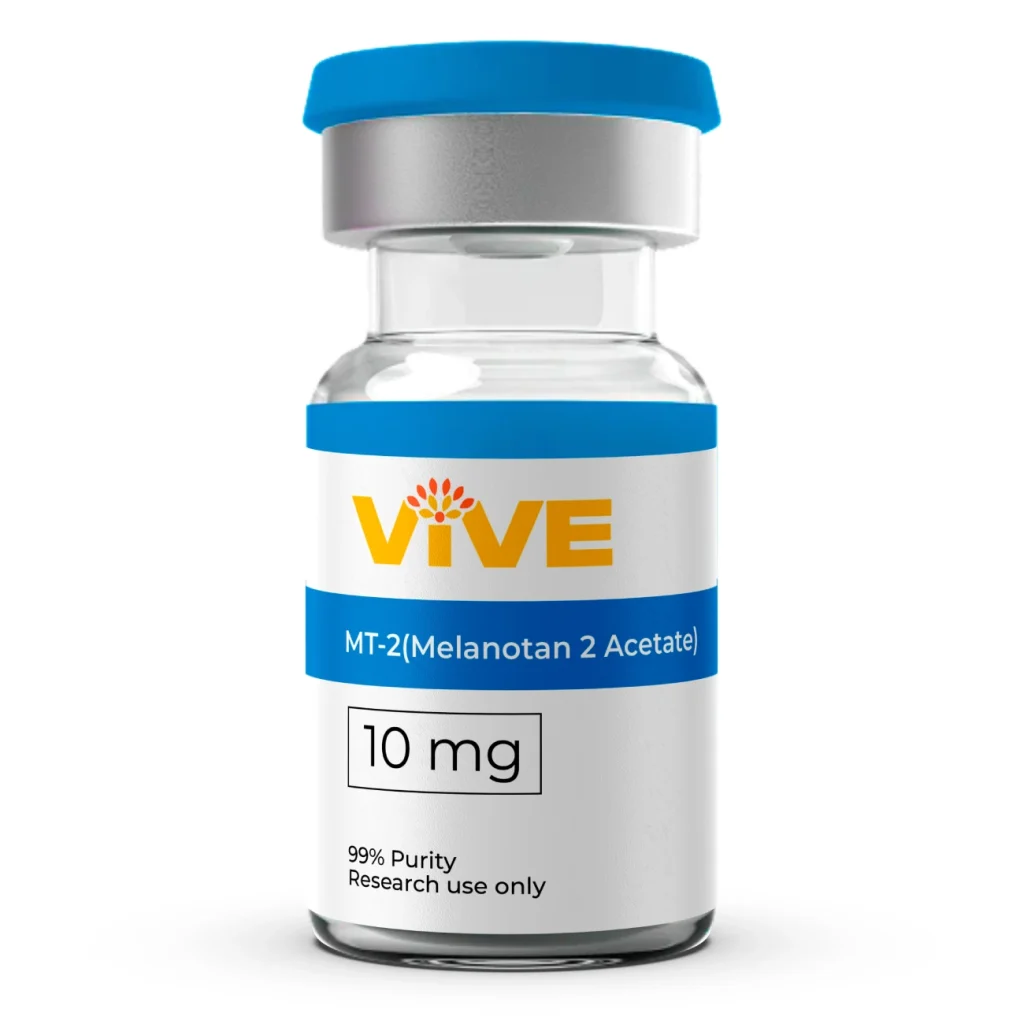
VivePeptides MT-2 (Melanotan 2 Acetate) 10mg vial, featuring 99% purity label and research use only indication.

Melanotan 2 (MT2)

99%+ Purity USA Tested

Research Use Only. Not for Human or Veterinary Use

MT-2 (Melanotan 2 Acetate): Non-selective melanocortin receptor agonist peptide, CAS 121062-08-6, MW 1024.18 g/mol, ≥99% purity. Lyophilized powder for laboratory use.

$50.00

Peptide Name MT-2 (Melanotan 2 Acetate)
CAS Number 121062-08-6
Molecular Formula C₅₀H₆₉N₁₅O₉
Molecular Weight 1024.18 g/mol
Mechanism Class Non-selective melanocortin receptor agonist
Appearance White to off-white lyophilized powder
Purity ≥99% (HPLC)
Storage -20°C, desiccated, protected from light
Solubility Soluble in sterile water

This product is not intended for human or animal use. For scientific research only.

VivePeptides provides detailed analytical results including High-Performance Liquid Chromatography (HPLC) and mass spectrometry data for all peptides. These reports confirm peptide purity, composition, and molecular accuracy, giving researchers full transparency and confidence in the materials used for their studies.

VIEW COA

VivePeptides peptides should be stored in a cool, dry environment and protected from light and moisture. Lyophilized peptides are best kept refrigerated or frozen until use to maintain stability. Once reconstituted for research purposes, peptides should be stored according to standard laboratory protocols, typically under refrigeration, and handled using proper aseptic techniques to preserve integrity throughout the study period.

OVERVIEW

What Is Melanotan 2 (MT-2) Peptide?

Melanotan 2 (MT-2) is a synthetic cyclic heptapeptide originally developed at the University of Arizona as a more potent analog of alpha-melanocyte-stimulating hormone (α-MSH). First synthesized by Hruby et al. in the 1980s, MT-2 peptide features a lactam bridge that confers enhanced metabolic stability compared to the native α-MSH sequence. With over 200 published studies, Melanotan 2 is one of the most extensively researched melanocortin receptor agonists in the scientific literature.
As a research peptide, MT-2 is distinguished by its non-selective binding profile across multiple melanocortin receptor subtypes, including MC1R, MC3R, MC4R, and MC5R. This broad receptor activity has made Melanotan 2 acetate a versatile tool for investigating diverse melanocortin-mediated pathways in laboratory settings. MT-2 research encompasses melanogenesis, energy homeostasis, and sexual function pathways, reflecting the wide distribution of melanocortin receptors throughout biological systems.

Cyclic Heptapeptide

Lactam-bridged 7-amino-acid α-MSH analog with activity at MC1R, MC3R, MC4R, and MC5R

≥99% HPLC Purity

Every batch verified via high-performance liquid chromatography

USA Tested & Verified

Third-party analytical testing performed in USA laboratories

RESEARCH

MT-2 Mechanism of Action in Research

The MT-2 mechanism of action involves activation of multiple melanocortin receptor subtypes, triggering diverse downstream signaling cascades. Published research has extensively characterized MT-2 as a potent non-selective melanocortin agonist. MT-2 research provides insight into the complexity of the melanocortin system and its role in multiple physiological pathways studied in laboratory settings.

Multi-Receptor Melanocortin Activation

MT-2 binds to and activates melanocortin receptors MC1R through MC5R with varying affinities. Research demonstrates that at MC1R, MT-2 triggers the cAMP/PKA/MITF signaling cascade driving melanogenesis, similar to MT-1. However, MT-2’s activity at MC3R and MC4R — receptors expressed in the central nervous system — enables researchers to study additional melanocortin-mediated pathways. Hruby et al. (1995) characterized MT-2’s binding affinities, establishing it as one of the most potent synthetic melanocortin agonists, with sub-nanomolar affinity at multiple receptor subtypes.

Melanogenesis and Pigmentation Pathways

Through MC1R activation, MT-2 promotes eumelanin synthesis via upregulation of tyrosinase and related melanogenic enzymes. Research indicates that MT-2’s cyclic structure contributes to enhanced potency at MC1R compared to linear α-MSH analogs in certain assay systems. Studies by Dorr et al. (1996) demonstrated measurable increases in melanin density in research subjects, providing foundational data for understanding melanocortin-driven pigmentation. The peptide’s melanogenic activity has made MT-2 a standard reference compound in pigmentation research.

MC4R-Mediated Research Pathways

MT-2’s activity at the melanocortin 4 receptor (MC4R) has opened additional areas of investigation. MC4R is predominantly expressed in the hypothalamus and plays a role in energy homeostasis and appetitive behavior pathways studied in animal models. Research by Wikberg & Mutulis (2008) explored how MT-2’s MC4R agonism contributes to the peptide’s observed effects in various preclinical models, expanding the scope of melanocortin research beyond pigmentation. —

COMPARISON

MT-2 vs MT-1: Research Peptide Comparison

MT-2 (Melanotan 2) and MT-1 (Melanotan 1) are both synthetic α-MSH analogs used extensively in melanocortin research. Their structural differences lead to distinct pharmacological profiles, making each suited to different research applications. Understanding these differences helps researchers select the appropriate peptide for their melanocortin receptor studies.
FeatureMT-2 (Melanotan 2)MT-1 (Melanotan 1)
StructureCyclic heptapeptide (lactam bridge)Linear tridecapeptide
Amino Acids713
CAS Number121062-08-675921-69-6
Molecular Weight1024.18 Da1646.85 Da
Receptor SelectivityNon-selective (MC1R, MC3R, MC4R, MC5R)Highly selective for MC1R
Primary Research FocusBroad melanocortin system researchMC1R-specific melanogenesis research
PotencySub-nanomolar at multiple MCRsPotent and selective at MC1R
Metabolic StabilityEnhanced via cyclizationModerate (linear structure)
Research Volume200+ published studies100+ published studies
The choice between MT-2 and MT-1 depends on the specific melanocortin receptor pathways under investigation. MT-2 is preferred for multi-receptor studies, while MT-1 provides cleaner data for MC1R-specific research. VivePeptides offers both Melanotan 2 for sale and MT-1 at research grade purity from our USA-based facility.

RESEARCH STUDIES

MT-2 Research Applications & Published Studies

Melanotan 2 research encompasses one of the largest bodies of literature among synthetic melanocortin peptides. The following areas represent the most actively investigated applications of MT-2 peptide. All references are to research contexts only.

Melanogenesis and Skin Pigmentation Research

The foundational MT-2 research focuses on melanogenesis. Dorr et al. (1996) published early clinical research findings in Life Sciences demonstrating MT-2’s melanogenic effects in human subjects, establishing the peptide’s potency as a melanocortin agonist. Subsequent studies by Hadley & Dorr (2006) reviewed the extensive body of work on melanotropic peptides, documenting MT-2’s central role in pigmentation research. These studies established Melanotan 2 as a reference standard in melanogenesis investigation.

Melanocortin Receptor Pharmacology

MT-2 has been instrumental in characterizing melanocortin receptor pharmacology. Hruby et al. (1995) published seminal work on the structure-activity relationships of cyclic melanocortin peptides, with MT-2 serving as a key compound. Cai et al. (2004) used MT-2 derivatives to map receptor binding domains and selectivity determinants across the melanocortin receptor family, contributing foundational knowledge to the field.

Energy Homeostasis Research Models

MT-2’s activity at MC3R and MC4R has enabled research into energy homeostasis pathways. Fan et al. (1997) published influential findings in Nature demonstrating the role of melanocortin signaling in feeding behavior using MC4R agonists including MT-2-related compounds. This research expanded understanding of how melanocortin receptor subtypes coordinate metabolic signaling in animal models.

QUALITY ASSURANCE

Quality & Testing Standards

VivePeptides maintains rigorous quality control for every batch of Melanotan 2 peptide. Our commitment to research-grade purity ensures that laboratories receive consistent, reliable compounds for their investigations.

HPLC & Mass Spectrometry

Every batch of MT-2 undergoes high-performance liquid chromatography (HPLC) and mass spectrometry analysis to confirm identity, purity, and molecular weight.

Third-Party Verified

All VivePeptides MT-2 is independently verified through third-party analytical laboratories based in the USA. Testing documentation is available for every lot.

≥99% Purity Standard

Our Melanotan 2 consistently meets or exceeds ≥99% purity as determined by HPLC analysis, ensuring research-grade quality for laboratory applications.

FAQ

Frequently Asked Questions About MT-2

What is MT-2 used for in research?

MT-2 (Melanotan 2) is used in preclinical and laboratory research to study melanocortin receptor signaling, melanogenesis pathways, and related melanocortin-mediated biological processes. Its non-selective melanocortin receptor profile makes it a versatile research tool. MT-2 is sold for research use only.

What purity is VivePeptides MT-2?

VivePeptides Melanotan 2 is manufactured to ≥99% purity as verified by HPLC analysis. Every batch is tested and verified through independent third-party USA-based laboratories to ensure consistent research-grade quality.

How should MT-2 be stored?

Lyophilized MT-2 should be stored at -20°C, protected from light and moisture. Once reconstituted, the solution should be stored at 2–8°C and used within 14 days for optimal stability. Avoid repeated freeze-thaw cycles.

What is the difference between MT-2 acetate and MT-2?

MT-2 acetate refers to Melanotan 2 supplied as an acetate salt form. The acetate counter-ion is commonly used during peptide synthesis and purification. Both forms contain the same active cyclic heptapeptide sequence. VivePeptides MT-2 is supplied as the acetate salt in lyophilized form.

Is VivePeptides MT-2 third-party tested?

Yes. Every lot of VivePeptides Melanotan 2 undergoes independent third-party testing at USA-based analytical laboratories. Testing includes HPLC purity analysis and mass spectrometry identity confirmation. Results are available upon request for qualified researchers.

RELATED PRODUCTS

Related Research Peptides

Explore other research-grade peptides available from VivePeptides. Each product meets the same rigorous purity and testing standards.

MT-1 (Melanotan 1)

Linear MC1R-selective melanocortin agonist for pigmentation research

BPC-157

Research grade gastric pentadecapeptide for tissue biology studies

GHK-Cu Copper Peptide

Research grade copper peptide for skin and tissue biology studies

SNAP-8

Anti-wrinkle research peptide (Acetyl Octapeptide-3)

Explore More Research Peptides