Research Article
Semaglutide vs Tirzepatide: Head-to-Head Research Comparison
Both semaglutide and tirzepatide belong to the incretin-based research class, yet they operate through distinct receptor mechanisms that produce meaningfully different outcomes across weight reduction, glycemic modulation, and cardiometabolic markers. Published trial data through 2025 now allows a direct, data-driven comparison of these two compounds at equivalent research parameters.
All content on this page is intended for research purposes only. These compounds are not approved for human use and are not intended for diagnostic, therapeutic, or veterinary application.
Receptor Pharmacology: Single vs. Dual Agonism
The most fundamental distinction between semaglutide and tirzepatide lies at the receptor level.
Semaglutide is a selective GLP-1 receptor agonist. Its pharmacology is built on a modified GLP-1 peptide backbone with a C18 fatty acid chain that extends plasma half-life to approximately seven days, enabling once-weekly dosing in research protocols. At the GLP-1 receptor, semaglutide drives glucose-dependent insulin secretion, suppresses glucagon, slows gastric emptying, and activates hypothalamic satiety pathways. Its receptor selectivity is high and well-characterized across decades of incretin research.
Tirzepatide introduces a structurally different approach. It is a 39-amino acid synthetic peptide derived from the native GIP sequence, modified with a C20 fatty diacid moiety that binds albumin and extends its half-life to approximately five days. Critically, tirzepatide functions as a dual GIP/GLP-1 receptor agonist, demonstrating high affinity at the GIPR comparable to native GIP, while its GLP-1 receptor affinity is approximately 18 to 20-fold weaker than native GLP-1. Research published in JCI Insight characterizes tirzepatide as an "imbalanced and biased" dual agonist, meaning the ratio of GIP-to-GLP-1 receptor engagement is not equal.
The significance of this dual mechanism centers on the GIP receptor's role in adipose tissue metabolism and the additive satiety signaling produced when both incretin receptors are engaged simultaneously. This co-agonist profile appears to account for the superior body weight and glycemic outcomes observed across tirzepatide trial data relative to semaglutide.
Research framing note: The pharmacological data discussed throughout this article originates from peer-reviewed clinical trials using standardized populations and controlled dosing protocols. All findings are presented in the context of research characterization, not clinical prescription guidance.
Head-to-Head Trial Data: SURMOUNT-5
For years, comparisons between semaglutide and tirzepatide relied on cross-trial analysis, a methodology limited by differences in study populations, endpoints, and timeframes. The SURMOUNT-5 trial, published in the New England Journal of Medicine in 2025, provided the first randomized, controlled, head-to-head comparison.
SURMOUNT-5 enrolled 751 adult participants with obesity or overweight and at least one weight-related comorbidity, excluding type 2 diabetes. Participants were randomized 1:1 to receive maximum tolerated doses of tirzepatide (10 mg or 15 mg) or semaglutide (1.7 mg or 2.4 mg) administered subcutaneously once weekly for 72 weeks.
-20.2%
Mean body weight reduction with tirzepatide at 72 weeks (SURMOUNT-5)
Key findings at week 72:
- Tirzepatide produced a mean body weight reduction of 20.2% versus 13.7% for semaglutide
- Tirzepatide participants were significantly more likely to achieve threshold reductions of 10%, 15%, 20%, and 25% body weight
- 31.6% of the tirzepatide group achieved at least 25% body weight reduction versus 16.1% in the semaglutide group
- Waist circumference reduction was also significantly greater with tirzepatide
The absolute weight difference between groups represents approximately 16 to 17 kg in favor of tirzepatide at the population level, a statistically meaningful separation that held across the full duration of the trial.
Cross-Trial Context: STEP and SURMOUNT Programs
While SURMOUNT-5 provides the cleanest direct comparison, the broader STEP and SURMOUNT trial programs offer important context for understanding each compound's standalone efficacy profile.
Parameter | Semaglutide (STEP 1) | Tirzepatide (SURMOUNT-1)
---|---|---
Population | Obesity without T2D | Obesity without T2D
Duration | 68 weeks | 72 weeks
Top dose | 2.4 mg/week | 15 mg/week
Mean weight loss (top dose) | 14.9% | 22.5%
Lead researcher | Wilding et al. | Jastreboff et al.
Journal | New England Journal of Medicine | New England Journal of Medicine
STEP 1 (Wilding et al., 2021) established semaglutide 2.4 mg as a benchmark, producing 14.9% mean body weight reduction over 68 weeks in a non-diabetic obesity population. SURMOUNT-1 (Jastreboff et al., 2022) demonstrated tirzepatide's 22.5% mean body weight reduction at the 15 mg dose over 72 weeks in a comparable population. While these are not direct comparisons, the magnitude of separation is consistent with what SURMOUNT-5 later confirmed under controlled head-to-head conditions.
Glycemic Modulation: SURPASS vs. STEP Data
In populations with type 2 diabetes, both compounds demonstrate meaningful HbA1c reductions, though tirzepatide shows a quantitative advantage at comparable doses.
The SURPASS-2 trial (Frias et al., 2021, NEJM) directly compared tirzepatide against semaglutide 1 mg in type 2 diabetes participants:
- Tirzepatide 5 mg: HbA1c reduction of -2.01%
- Tirzepatide 10 mg: HbA1c reduction of -2.24%
- Tirzepatide 15 mg: HbA1c reduction of -2.30%
- Semaglutide 1 mg: HbA1c reduction of -1.86%
Real-world data published in 2025 across GLP-1 naive populations aligned with these trial findings. Tirzepatide users reduced HbA1c by approximately 1.3% and lost 10.2 kg on average, while semaglutide users reduced HbA1c by 0.9% and lost 6.1 kg on average over comparable follow-up periods.
Mechanistic note: Tirzepatide's enhanced glycemic effects are attributed to the GIP receptor's role in potentiating glucose-dependent insulin secretion and improving beta-cell function. The dual receptor engagement appears to produce additive glycemic benefits beyond what GLP-1 receptor activation alone achieves.
Cardiovascular Research Signals
A 2025 post-hoc analysis of the SURMOUNT-5 trial published in the European Heart Journal Open examined predicted 10-year cardiovascular disease risk reduction between the two compounds. Tirzepatide was associated with a 2.4% absolute reduction in predicted 10-year CVD risk from baseline, compared to 1.4% for semaglutide.
A separate observational study published in Nature Medicine (2025) conducted a trial emulation analysis in patients with type 2 diabetes at elevated cardiovascular risk. In that analysis, semaglutide and tirzepatide showed broadly comparable cardiovascular benefit profiles at the population level, with tirzepatide's greater risk reduction largely attributable to its superior weight and metabolic effects rather than differential cardiovascular receptor activity.
Both compounds carry meaningful cardiometabolic research relevance. Semaglutide's cardiovascular data is more mature, supported by the SUSTAIN and SELECT trial series. Tirzepatide's cardiovascular data set continues to expand as longer follow-up periods accumulate.
Tolerability and Adverse Event Profiles
Semaglutide Profile
- Well-characterized safety data across 7+ years of trial programs
- Gastrointestinal effects typically mild to moderate
- Dose escalation over 16-20 weeks manages tolerability
- Stable receptor selectivity minimizes off-target variability
Tirzepatide Profile
- Comparable GI adverse event frequency to semaglutide
- Higher dose cohorts show modestly elevated nausea/vomiting rates
- Newer compound with shorter long-term surveillance window
- Dual receptor mechanism introduces broader physiological engagement
In SURMOUNT-5, gastrointestinal adverse events were the most common in both groups and were predominantly mild to moderate, occurring primarily during dose escalation phases. The two compounds did not demonstrate a statistically significant difference in serious adverse events. Pancreatitis remained rare across both arms.
The overall tolerability comparison between semaglutide and tirzepatide does not show a clear safety advantage for either compound in the available trial data. The selection between them in research protocols tends to be governed by the magnitude of metabolic outcomes required rather than by differential tolerability profiles.
Research Compounds Available at VivePeptides
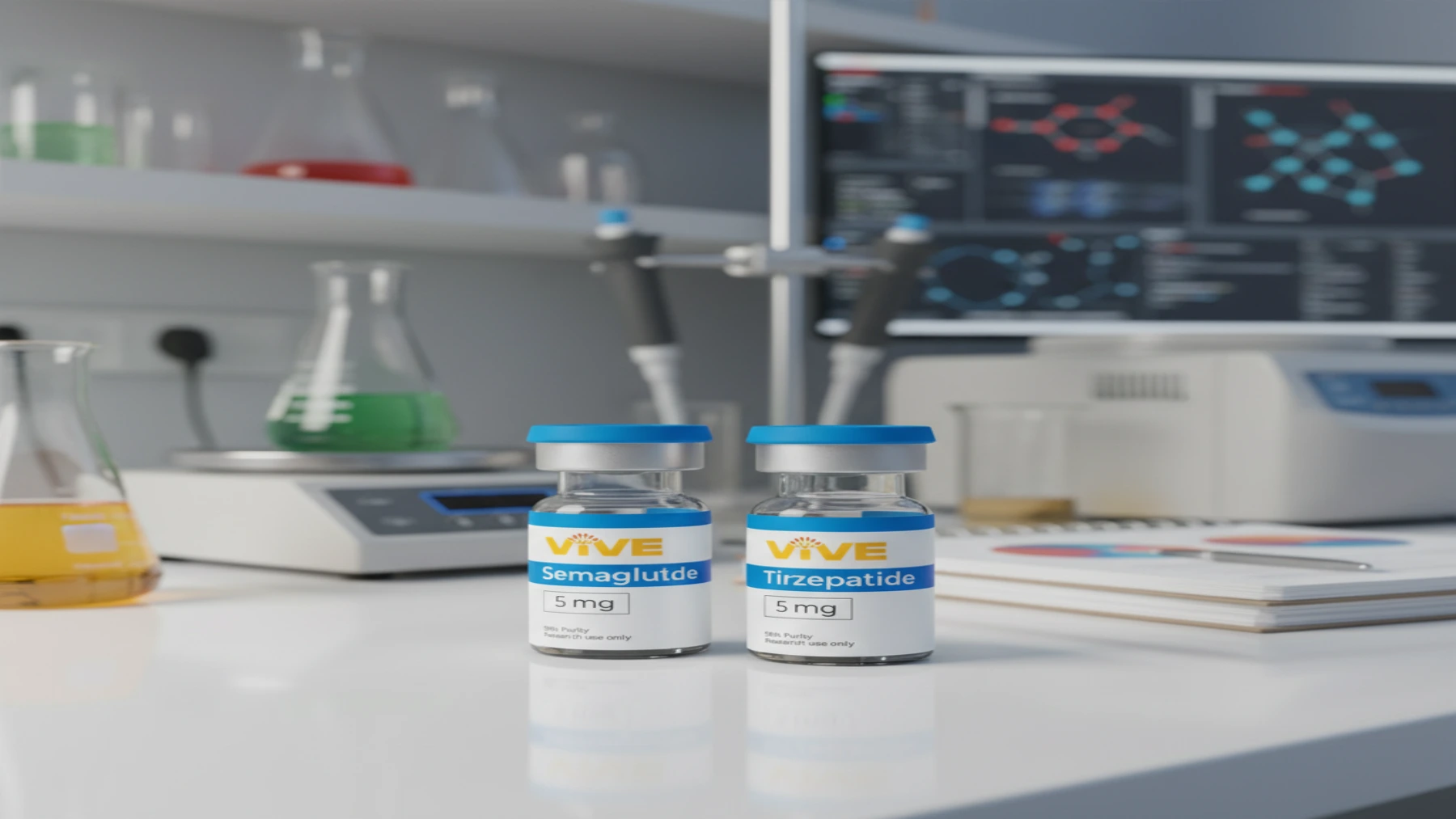
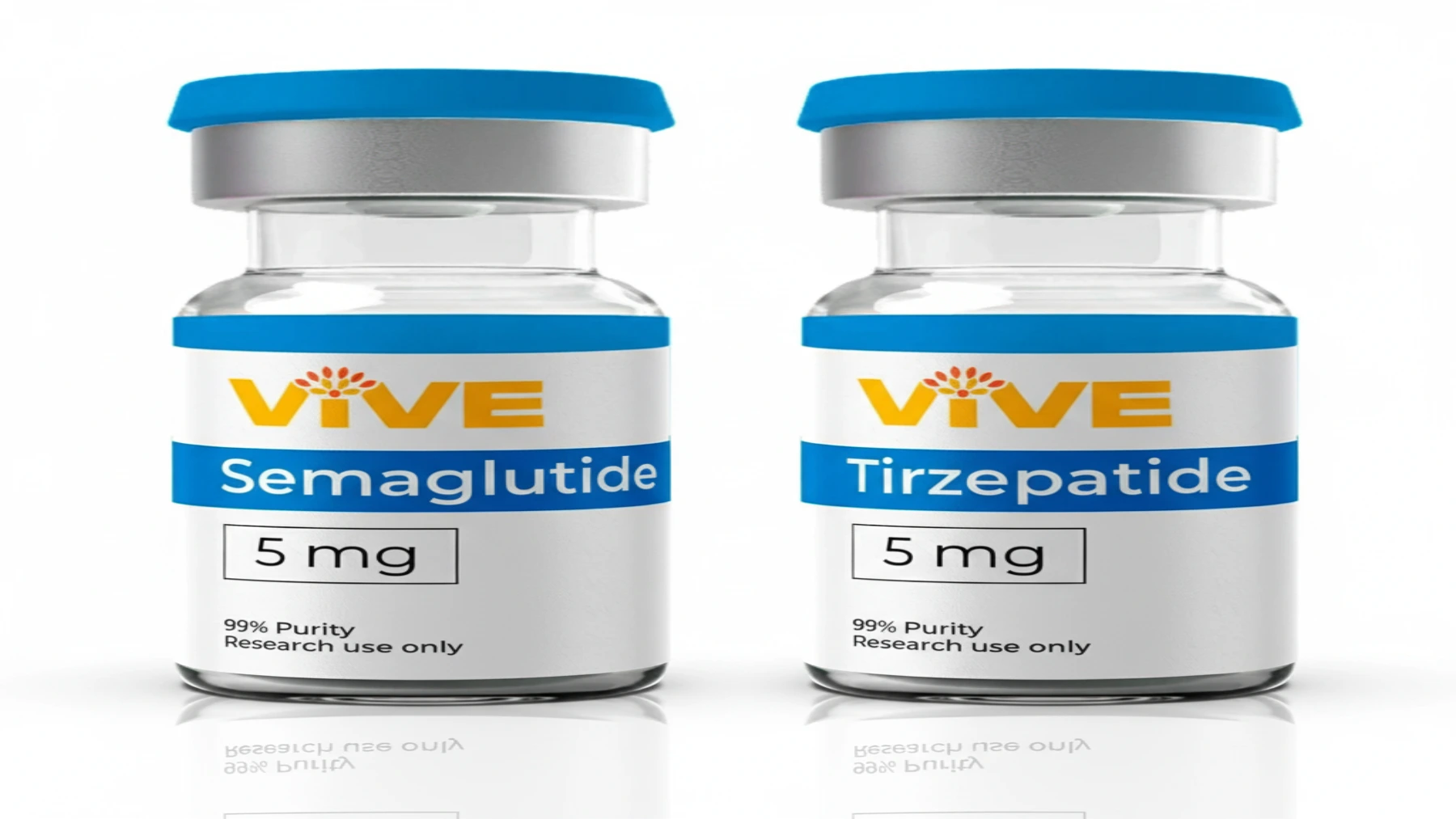
For researchers sourcing peptide reference standards, VivePeptides provides research-grade semaglutide and tirzepatide with batch-specific Certificates of Analysis, HPLC and mass spectrometry verification, and 99%+ purity standards.
GLP-1 Agonist
Semaglutide
Research-grade semaglutide for GLP-1 receptor agonism studies. Each vial ships with a batch-specific COA and HPLC/MS verification. Third-party tested in U.S. labs.
Dual GIP/GLP-1 Agonist
Tirzepatide
Research-grade tirzepatide for dual GIP/GLP-1 receptor studies. Verified 99%+ purity, temperature-controlled shipping, and full documentation included.
Researchers studying the next generation of incretin peptides may also be interested in VivePeptides' research-grade retatrutide, a triple agonist targeting GIP, GLP-1, and glucagon receptors simultaneously, representing the next structural advancement beyond tirzepatide's dual mechanism.
Explore the full catalog at the VivePeptides peptide shop for a complete listing of research-grade compounds with verified purity documentation.
Frequently Asked Questions
What is the primary mechanistic difference between semaglutide and tirzepatide?
Semaglutide is a selective GLP-1 receptor agonist, engaging a single incretin receptor pathway to modulate insulin secretion, glucagon suppression, gastric emptying, and hypothalamic satiety signaling. Tirzepatide is a dual GIP/GLP-1 receptor agonist, engaging both the GIP receptor and the GLP-1 receptor simultaneously. The GIP receptor's role in adipose tissue metabolism and its additive interaction with GLP-1 signaling is the proposed mechanism behind tirzepatide's enhanced metabolic outcomes in research models.
What did the SURMOUNT-5 trial find when comparing tirzepatide and semaglutide directly?
SURMOUNT-5 (NEJM, 2025) was the first randomized, controlled head-to-head trial comparing these two compounds. Over 72 weeks in 751 participants with obesity and no type 2 diabetes, tirzepatide produced a mean body weight reduction of 20.2% versus 13.7% for semaglutide. The tirzepatide group also showed superior reductions in waist circumference and greater rates of achieving 15%, 20%, and 25% body weight reduction thresholds.
How do semaglutide and tirzepatide compare on glycemic outcomes in type 2 diabetes research?
In the SURPASS-2 trial (Frias et al., NEJM, 2021), tirzepatide at doses of 5, 10, and 15 mg produced HbA1c reductions of 2.01%, 2.24%, and 2.30% respectively, compared to 1.86% for semaglutide 1 mg over 40 weeks. Real-world data from 2025 similarly shows tirzepatide producing greater HbA1c reductions in GLP-1 naive populations compared to semaglutide across equivalent follow-up periods.
Are the tolerability profiles meaningfully different between the two compounds?
Both compounds share a gastrointestinal adverse event profile, with nausea, vomiting, and diarrhea being the most commonly reported events, occurring primarily during dose escalation. The SURMOUNT-5 trial did not find a statistically significant difference in serious adverse events between the two arms. Tirzepatide's long-term safety data set is narrower given its more recent entry into research programs, while semaglutide carries over a decade of accumulated data across multiple trial series.
What is retatrutide and how does it relate to semaglutide and tirzepatide in the incretin research landscape?
Retatrutide is a triple incretin receptor agonist targeting GIP, GLP-1, and glucagon receptors, representing the next structural evolution beyond tirzepatide's dual mechanism. Phase 2 data published in the NEJM (Jastreboff et al., 2023) showed retatrutide producing up to 24.2% mean body weight reduction over 48 weeks. Research interest in triple agonism continues to grow as the incretin receptor landscape expands.
Research Use Only
All information in this article is intended for educational and research purposes only. VivePeptides products are not intended for human or veterinary use.