
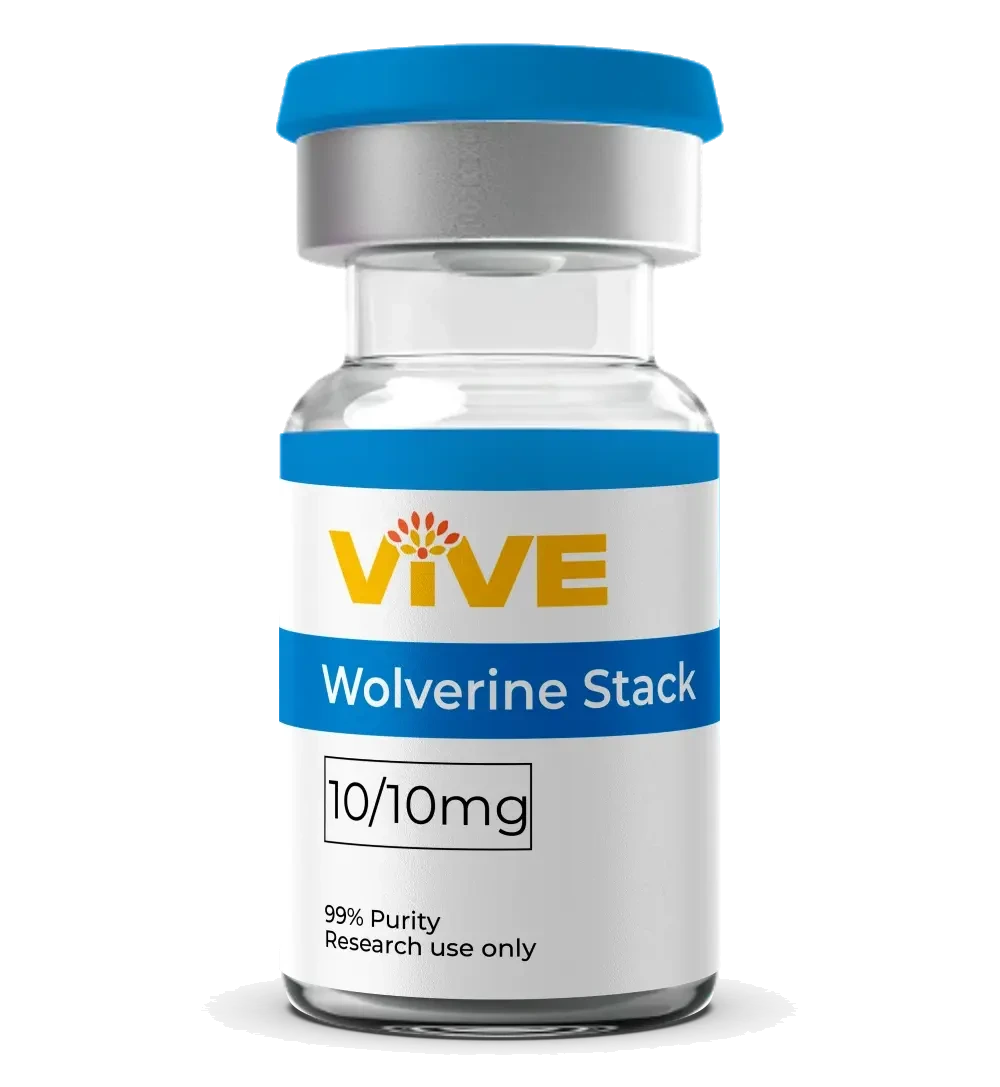
Wolverine Stack
Research Use OnlyThese products are sold strictly for laboratory and research use only and are not approved for human consumption, diagnosis, or therapeutic treatment. Not for human or veterinary use. These statements have not been evaluated by the Food and Drug Administration, and nothing on this page constitutes medical advice or a health claim.
- Size
- 10/10mg
Specifications
Wolverine Stack Technical Profile
OVERVIEW
What Is the Wolverine Stack? (BPC-157 + TB-500)
The Wolverine Stack is a research-grade peptide blend combining two of the most extensively studied tissue-biology peptides in preclinical literature: BPC-157 (Body Protection Compound-157) and TB-500 (Thymosin Beta-4 fragment). Each vial contains 10mg BPC-157 and 10mg TB-500 for a total of 20mg of active peptide content, co-lyophilized to a white powder at research-grade purity.
The name 'Wolverine Stack' has become widely used in the research community as a shorthand for the BPC-157 and TB-500 combination, referencing the two peptides' complementary tissue-repair research profiles. The Wolverine peptide stack pairs BPC-157's nitric oxide system modulation and growth factor pathway interactions with TB-500's actin-sequestering and cell migration mechanisms, making this BPC-157 TB-500 blend a popular choice for laboratories investigating multi-pathway tissue biology.
BPC-157 (CAS 137525-51-0) is a synthetic 15-amino-acid gastric pentadecapeptide derived from a partial sequence of human gastric juice protein. TB-500 (CAS 77591-33-4) is a synthetic fragment of Thymosin Beta-4, a naturally occurring 43-amino-acid protein involved in actin regulation. Most published literature studies each compound independently. VivePeptides supplies the Wolverine Stack peptide as a co-lyophilized blend at ≥99% HPLC purity per component, for laboratory and preclinical research use only.
- 01
Dual-Peptide Research Blend
BPC-157 (10mg) + TB-500 (10mg) combined in a single 20mg co-lyophilized vial
- 02
≥99% HPLC Purity Per Component
Each peptide individually verified via high-performance liquid chromatography
- 03
USA Made and Verified
Third-party analytical testing performed in USA-based laboratories for every lot
RESEARCH
Wolverine Stack Mechanism of Action: BPC-157 and TB-500 Complementary Pathways
The rationale for studying BPC-157 and TB-500 together centers on their complementary, non-overlapping mechanisms at the molecular level. BPC-157 operates primarily through the nitric oxide system, growth factor pathways, and the FAK-paxillin cell adhesion cascade. TB-500 operates through G-actin sequestration, influencing cytoskeletal dynamics and endothelial cell motility. In preclinical tissue-biology research, these two mechanisms are frequently described as acting at different stages of the cellular repair process, which has driven interest in studying them as the BPC-157 TB-500 blend researchers now commonly call the Wolverine Stack.
It is important to note that the published scientific literature primarily studies BPC-157 and TB-500 as separate compounds. Direct head-to-head or combination studies of the two peptides are limited in number compared to the individual compound literature. Researchers should consult primary sources for each peptide's established preclinical profile before designing protocols that use both compounds simultaneously.
BPC-157: Nitric Oxide System and Growth Factor Modulation
Within the Wolverine Stack, BPC-157 contributes its well-characterized interactions with the nitric oxide (NO) system, a critical signaling pathway involved in vascular biology and endothelial cell function. Published research indicates BPC-157 may modulate NO synthase activity, influence VEGF-mediated angiogenesis, and interact with the FAK-paxillin cell adhesion pathway. Studies in animal models also suggest BPC-157 may upregulate growth hormone receptor expression, providing a growth factor-level input to tissue signaling processes (Sikiric et al., 2014).
TB-500: Actin Sequestration and Cell Motility
TB-500, the synthetic Thymosin Beta-4 fragment in the Wolverine Stack peptide, contributes actin-regulatory and cell migration mechanisms. Research demonstrates that TB-500 sequesters G-actin monomers, which influences actin polymerization dynamics and promotes cell motility. Published studies indicate TB-500 may promote endothelial cell migration and differentiation in preclinical models, with researchers documenting effects on new vessel formation in animal-model tissue contexts (Bock-Marquette et al., 2004; Goldstein et al.).
Complementary Tissue Biology Pathways
Researchers studying the BPC-157 and TB-500 combination note that BPC-157's growth factor and NO pathway modulation operates upstream of many cytoskeletal processes, while TB-500's actin-sequestering activity operates at the cytoskeletal and cell-motility level. This non-redundant mechanism pairing is the core scientific rationale for the Wolverine peptide stack in multi-pathway tissue biology research. The two peptides' mechanistic profiles do not overlap significantly, which is cited as a reason why the combination may be more informative than either peptide studied alone for certain research questions.
Angiogenesis Research Convergence
One area where BPC-157 and TB-500 research profiles converge is angiogenesis, the formation of new blood vessels. BPC-157 has been studied for its VEGF-pathway contributions to angiogenesis in preclinical models, while TB-500 research has documented its promotion of endothelial cell migration, a prerequisite step in new vessel formation. This shared downstream interest in angiogenic biology is a reason the Wolverine Stack is used by laboratories studying vascular tissue biology, though combination-specific angiogenesis data remain limited compared to single-compound studies.
COMPARISON
BPC-157 vs TB-500: Component Comparison
BPC-157
The Wolverine Stack combines BPC-157 and TB-500 in a single vial, but each component has a distinct origin, structure, and primary research focus. Understanding the individual profiles of BPC-157 and TB-500 helps researchers interpret the combined Wolverine Stack peptide research profile and select appropriate experimental controls.
TB-500
Most published studies examine BPC-157 and TB-500 independently. The table below summarizes the key structural and mechanistic distinctions between the two components of the BPC-157 TB-500 blend. VivePeptides also offers each compound as a standalone research peptide for single-pathway investigations.
| Feature | BPC-157 | TB-500 |
|---|---|---|
| Origin | Derived from human gastric juice protein (body protection compound) | Synthetic fragment of Thymosin Beta-4, a naturally occurring protein |
| Amino Acids | 15 (gastric pentadecapeptide) | 43 (full Thymosin Beta-4); TB-500 is the active fragment region |
| CAS Number | 137525-51-0 | 77591-33-4 |
| Molecular Weight | 1419.53 Da | 4963.50 Da |
| Primary Research Focus | Gastric biology, tissue repair, growth factor pathways, NO system | Cell migration, actin biology, endothelial cell motility, tissue repair |
| Proposed Mechanism | NO synthase modulation, VEGF-pathway angiogenesis, FAK-paxillin signaling | G-actin sequestration, actin polymerization regulation, cell motility promotion |
| Stability | Stable across a range of pH environments | Requires careful cold storage; sensitive to temperature and light |
| Research Volume | 100+ published preclinical studies | 50+ published preclinical studies |
| Dose in Wolverine Stack | 10mg per vial | 10mg per vial |
RESEARCH STUDIES
Wolverine Stack Research Applications and Published Studies
The Wolverine Stack is a VivePeptides research formulation. While published literature on the BPC-157 and TB-500 combination specifically is limited, each component has substantial independent preclinical research supporting its mechanistic profile. The following research areas represent the most actively investigated applications for the individual components of this BPC-157 TB-500 blend. All references are to preclinical, laboratory, and animal-model contexts only.
BPC-157: Gastrointestinal and Tissue Biology (Sikiric et al.)
BPC-157 was originally characterized from gastric juice, and gastrointestinal biology remains a foundational research area. Sikiric et al. (Journal of Physiology-Paris, 2003) published comprehensive reviews documenting BPC-157's preclinical activity across gastrointestinal, musculoskeletal, and vascular tissue models in animal subjects. Subsequent work by the same group (Current Pharmaceutical Design, 2014) expanded the mechanistic characterization of BPC-157's NO system and growth factor pathway interactions. These studies form the primary scientific foundation for BPC-157's inclusion in the Wolverine Stack.
TB-500: Thymosin Beta-4 Cell Migration and Angiogenesis Research
Published research on Thymosin Beta-4 and its synthetic fragment TB-500 has characterized their roles in actin biology and cell migration. Bock-Marquette et al. (Nature, 2004) published findings on Thymosin Beta-4's effects on cardiac cell survival and migration in animal models, establishing foundational mechanistic data for the peptide's angiogenic and cell motility properties. Goldstein et al. contributed characterization studies for the broader Thymosin Beta-4 family, including cell migration and endothelial differentiation in preclinical tissue models.
Complementary Pathway Research: Convergent Angiogenesis Models
Independent research on BPC-157 and TB-500 has produced overlapping findings in the domain of angiogenesis and vascular endothelial biology. Chang et al. (2011) documented BPC-157's VEGF-pathway contributions to new vessel formation in preclinical models. Complementary TB-500 studies have documented endothelial cell migration effects in similar models. This convergent research activity is cited by investigators as the basis for studying the Wolverine peptide stack in integrated vascular tissue biology protocols.
Musculoskeletal and Connective Tissue Preclinical Models
Both BPC-157 and TB-500 have been independently studied in animal models related to connective tissue and musculoskeletal biology. Staresinic et al. (2003) and Pevec et al. (2010) published preclinical BPC-157 findings in tendon and muscle injury models in rats. TB-500 research has been applied to similar connective tissue model categories, examining cell migration and tissue remodeling endpoints. The overlapping research interest in connective tissue biology across both peptides contributes to the Wolverine Stack's profile as a multi-pathway tissue research tool.
QUALITY ASSURANCE
Quality and Testing Standards for the Wolverine Stack
VivePeptides maintains rigorous quality control for every batch of the Wolverine Stack. Both BPC-157 and TB-500 components are individually tested before blending, and the co-lyophilized final product is held to ≥99% HPLC purity standards per component. Researchers can rely on consistent compound identity, purity, and dosing ratios across lots.
Per-Component HPLC and Mass Spectrometry
Both BPC-157 and TB-500 in the Wolverine Stack undergo independent high-performance liquid chromatography (HPLC) and mass spectrometry analysis to confirm identity, purity, and molecular weight before blending. This per-component verification ensures each peptide in the BPC-157 TB-500 blend meets research-grade standards.
Third-Party USA Laboratory Verification
All VivePeptides Wolverine Stack lots are independently verified through third-party analytical laboratories based in the USA. Testing documentation is available for every lot upon request for qualified researchers.
≥99% Purity Per Component
The Wolverine Stack consistently meets or exceeds ≥99% purity per component as determined by HPLC analysis. Both BPC-157 and TB-500 meet this standard independently, ensuring the blend's research-grade integrity.
Lyophilization and Storage
The Wolverine Stack is supplied as a white lyophilized powder in a sealed vial, desiccated and protected from light. Lyophilization preserves peptide integrity during storage and shipping. Recommended storage is at -20°C, desiccated and protected from light. The product is soluble in bacteriostatic or sterile water.
FAQ
Frequently Asked Questions About the Wolverine Stack
What is the Wolverine Stack?
Why are BPC-157 and TB-500 studied together in the Wolverine Stack?
What is the purity of VivePeptides Wolverine Stack?
How should the Wolverine Stack be stored?
Is VivePeptides Wolverine Stack third-party tested?
Add To Research Cart
Wolverine Stack
99%+ purity · USA lab tested · secure shipping
You May Also Research
Related Compounds
These products are sold strictly for laboratory and research use only and are not approved for human consumption, diagnosis, or therapeutic treatment. Not for human or veterinary use. These statements have not been evaluated by the Food and Drug Administration, and nothing on this page constitutes medical advice or a health claim.