
Longevity & Cellular
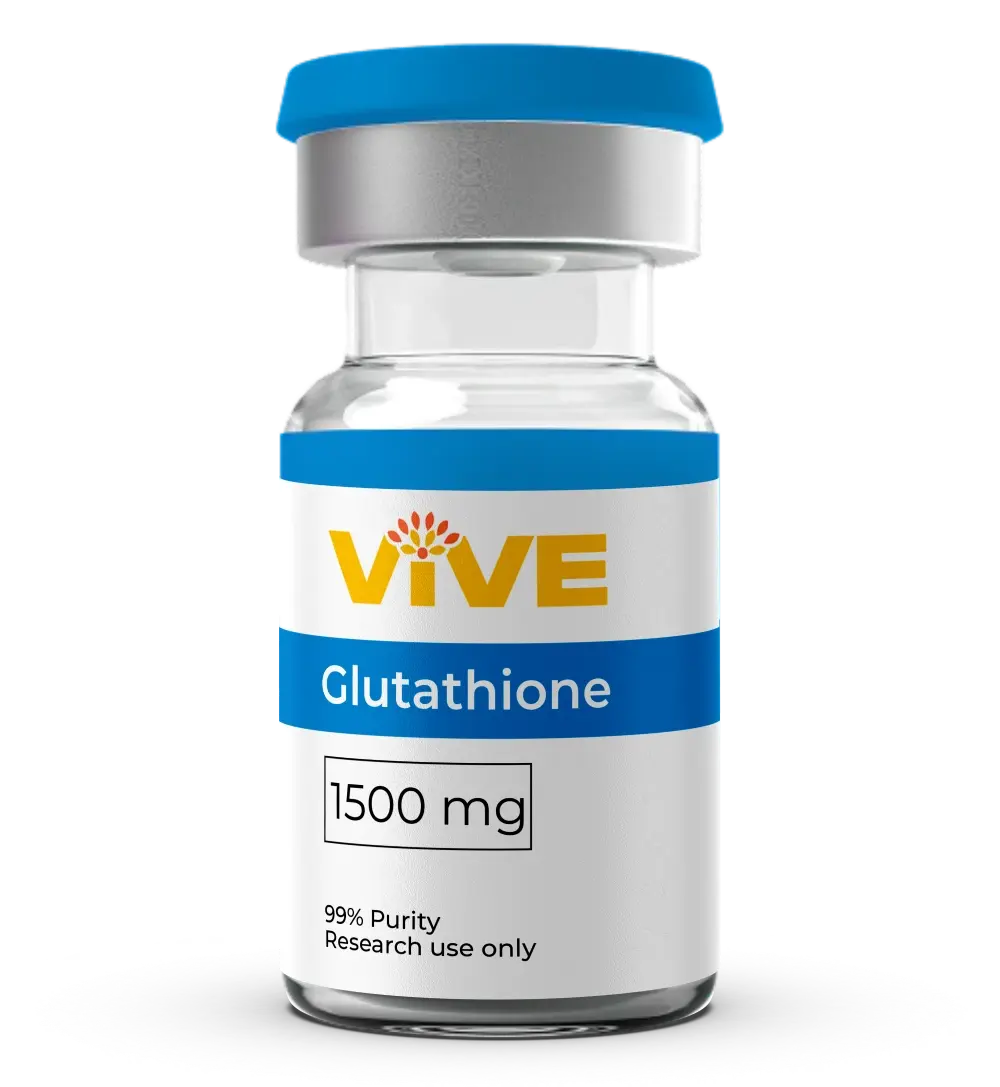
Glutathione
Research Use OnlyThese products are sold strictly for laboratory and research use only and are not approved for human consumption, diagnosis, or therapeutic treatment. Not for human or veterinary use. These statements have not been evaluated by the Food and Drug Administration, and nothing on this page constitutes medical advice or a health claim.
- Size
- 1500mg
Specifications
Glutathione Technical Profile
OVERVIEW
What Is Glutathione (GSH)?
Glutathione (GSH) is an endogenous tripeptide composed of three amino acids, glutamate, cysteine, and glycine, joined by an unusual gamma-glutamyl peptide bond. Present in virtually every mammalian cell at millimolar concentrations, glutathione is widely described as the body's master antioxidant. Its reactive cysteine thiol (-SH) group is the chemical feature that lets GSH neutralize reactive oxygen species, recycle other antioxidants, and maintain the reducing environment cells depend on. First characterized in detail by Alton Meister and colleagues, glutathione remains one of the most extensively studied small molecules in redox biology.
Glutathione research spans oxidative stress, detoxification, immune function, and cellular aging. GSH cycles between its reduced form (GSH) and an oxidized disulfide form (GSSG), and the GSH/GSSG ratio is a standard laboratory index of cellular redox state. Because intracellular glutathione declines with oxidative load and age, glutathione antioxidant research is central to studies of mitochondrial function, xenobiotic metabolism, and the Nrf2 stress-response pathway. Researchers who buy glutathione from VivePeptides receive a lyophilized preparation at greater than or equal to 99% purity from a trusted USA supplier.
- 01
Master Antioxidant Tripeptide
Gamma-glutamyl-cysteinyl-glycine, the dominant thiol antioxidant in mammalian cells
- 02
≥99% HPLC Purity
Every batch verified via high-performance liquid chromatography
- 03
USA Made & Verified
Third-party analytical testing performed in USA laboratories
RESEARCH
Glutathione Mechanism of Action in Research
The glutathione mechanism of action centers on the redox chemistry of its cysteine thiol. Through enzymatic and non-enzymatic reactions, GSH scavenges free radicals, supports conjugation-based detoxification, and preserves protein thiols, making it a hub of cellular redox homeostasis (Meister & Anderson, Annual Review of Biochemistry, 1983).
Direct Radical Scavenging & Peroxide Detoxification
Glutathione peroxidase enzymes use GSH as the electron donor to reduce hydrogen peroxide and lipid hydroperoxides to water and corresponding alcohols, producing oxidized glutathione (GSSG) in the process. Glutathione reductase then regenerates GSH from GSSG using NADPH. This GSH/GSSG cycle is a primary cellular defense against oxidative damage and a core readout in glutathione antioxidant research (Sies, Free Radical Biology and Medicine, 1999).
Phase II Detoxification (Glutathione S-Transferases)
Glutathione S-transferases (GSTs) catalyze conjugation of GSH to electrophilic xenobiotics, reactive intermediates, and drug metabolites, tagging them for export and elimination. This conjugation chemistry makes glutathione a central reagent in toxicology, drug-metabolism, and hepatocyte research investigating detoxification pathways.
Redox Signaling & Protein S-Glutathionylation
Beyond bulk antioxidant capacity, GSH participates in reversible protein S-glutathionylation, forming mixed disulfides with cysteine residues to protect and modulate protein function under oxidative conditions. The intracellular GSH/GSSG ratio is a widely used index of redox status in cell-signaling and mitochondrial research (Forman, Zhang & Rinna, Molecular Aspects of Medicine, 2009). ---
COMPARISON
Glutathione vs NAC: Research Compound Comparison
Glutathione
Glutathione (GSH) and N-acetylcysteine (NAC) are frequently compared in redox research because they are chemically related but occupy different points in the glutathione pathway. Understanding the distinction is important when designing antioxidant and detoxification studies.
NAC
Glutathione is the active, intact tripeptide antioxidant used directly by glutathione peroxidases, reductases, and transferases. NAC is a cysteine precursor studied primarily because cysteine availability is the rate-limiting step in de novo GSH synthesis. VivePeptides glutathione for sale is manufactured to greater than or equal to 99% purity for reliable laboratory research.
| Feature | Glutathione (GSH) | NAC (N-Acetylcysteine) |
|---|---|---|
| CAS Number | 70-18-8 | 616-91-1 |
| Molecular Weight | 307.32 g/mol | 163.19 g/mol |
| Structure | Tripeptide (Glu-Cys-Gly) | Acetylated single amino acid (cysteine) |
| Role | Active master antioxidant (end product) | Cysteine precursor for GSH synthesis |
| Enzymatic Function | Direct substrate for GPx, GR, and GSTs | Supplies cysteine; not a direct enzyme substrate |
| Research Applications | Redox assays, detoxification, S-glutathionylation studies | GSH-repletion and cysteine-availability models |
| Stability | Thiol readily oxidizes; handle under low-oxygen conditions | Comparatively more stable in solution |
RESEARCH STUDIES
Glutathione Research Applications & Published Studies
Glutathione is one of the most cited molecules in redox biochemistry, with a research literature spanning oxidative stress, detoxification, immunology, and aging biology.
Oxidative Stress & Redox Homeostasis
Foundational reviews by Meister & Anderson (Annual Review of Biochemistry, 1983) and Sies (Free Radical Biology and Medicine, 1999) established glutathione as the principal intracellular thiol buffer. Contemporary studies use GSH and the GSH/GSSG ratio to quantify oxidative stress in cell and tissue models, making research-grade glutathione a standard reagent in redox assays.
Biosynthesis & Metabolism
Glutathione is synthesized in two ATP-dependent steps by glutamate-cysteine ligase (rate-limiting) and glutathione synthetase. Reviews such as Lu (Biochimica et Biophysica Acta, 2013) detail how synthesis, transport, and turnover regulate cellular GSH pools, a focus of metabolic and hepatocyte research.
Detoxification & Cellular Protection
Glutathione S-transferase conjugation and glutathione peroxidase activity are studied extensively in toxicology and drug-metabolism models. Research-grade GSH is used in cell-free enzymatic assays and cellular systems to investigate xenobiotic clearance, lipid-peroxidation defense, and mitochondrial protection.
QUALITY ASSURANCE
Quality & Testing Standards
HPLC & Mass Spectrometry
Every glutathione batch undergoes HPLC and mass spectrometry analysis to confirm identity, purity, and molecular weight.
Third-Party Verified
All glutathione is independently tested at third-party USA-based analytical laboratories with lot-specific documentation.
≥99% Purity Standard
VivePeptides glutathione consistently meets or exceeds ≥99% purity as verified by HPLC for reliable research results.
FAQ
Frequently Asked Questions About Glutathione
What is glutathione used for in research?
What purity is VivePeptides glutathione?
How should glutathione be stored?
What is the difference between GSH and GSSG?
How is glutathione different from NAC?
Is VivePeptides glutathione third-party tested?
Add To Research Cart
Glutathione
99%+ purity · USA lab tested · secure shipping
You May Also Research
Related Compounds
These products are sold strictly for laboratory and research use only and are not approved for human consumption, diagnosis, or therapeutic treatment. Not for human or veterinary use. These statements have not been evaluated by the Food and Drug Administration, and nothing on this page constitutes medical advice or a health claim.