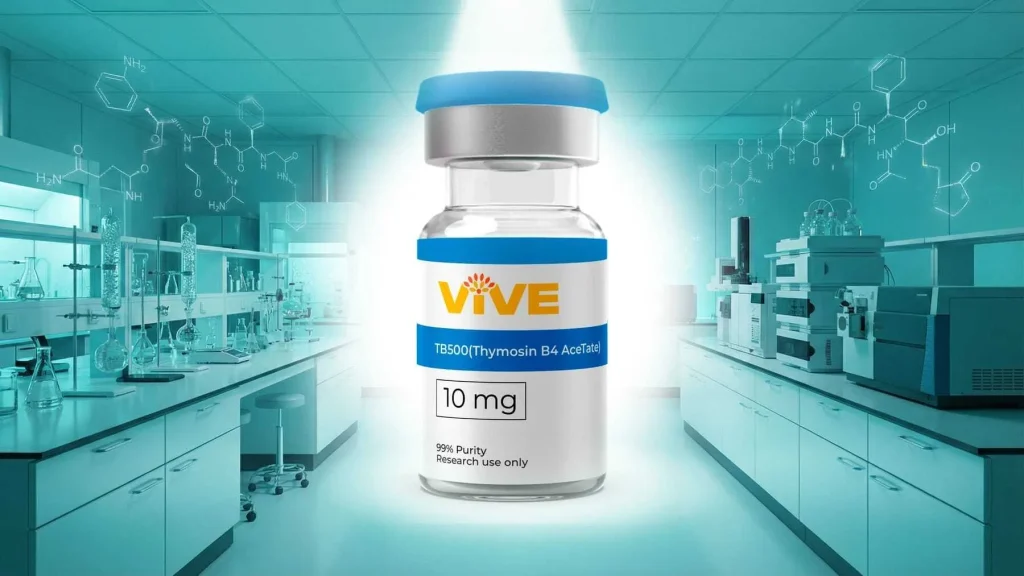
TB-500 is a synthetic peptide fragment of Thymosin Beta-4 that has attracted attention within regenerative medicine and laboratory research. This guide provides a systematic overview of the peptide’s definition, proposed mechanisms of action, and reported benefits, with attention to biochemical characteristics, research applications, handling considerations, and sources of high-purity material for qualified investigators.
The scientific community’s interest in TB-500 for tissue repair applications is documented in preclinical and exploratory studies.
TB-500: Scientific Interest & Tissue Repair Applications
The scientific community has documented interest in TB-500 on account of its proposed applications in medical and athletic research. Multiple studies have examined the peptide’s effects on tissue repair and related endpoints.
TB-500 OVERVIEW
TB-500 is a synthetic peptide investigated for its role in tissue repair and regeneration. Derived from endogenous Thymosin Beta-4, the peptide has been reported to facilitate cell migration and to modulate inflammatory responses. Research to date has explored applications in wound healing, cardiac tissue research and ocular models, indicating its relevance to regenerative medicine research agendas.
TB-500 is a laboratory-synthesised peptide that reproduces functional domains of endogenous Thymosin Beta-4. It consists of a 43–amino-acid sequence and is associated with processes that promote cell motility and tissue repair. By facilitating directed cell movement toward sites of injury, TB-500 is utilised in experimental studies of regenerative mechanisms.
Consistent with its experimental usage, peer-reviewed and preclinical reports identify TB-500 as a synthetic peptide employed in cellular repair and regeneration investigations.
TB-500: Synthetic Peptide for Cellular Repair & Regeneration Studies
Within contemporary peptide research, TB-500 has attracted sustained scientific attention. This synthetic derivative of Thymosin Beta-4 is evaluated in laboratories worldwide for its putative effects on cellular repair and regenerative processes.
What is TB-500: A Comprehensive Guide to This Research Peptide
The experimental applications of TB-500 span multiple domains of regenerative research and are subject to ongoing investigation.
These applications reflect the peptide’s potential utility as a research reagent in studies of tissue repair and cellular dynamics.
Additional preclinical research further characterises TB-500’s roles in wound repair, structural cell support, and exploratory assessments of neurological tissue responses.
TB-500: Thymosin Beta-4 for Wound Healing & Cellular Repair
TB-500 is also referred to as a functional fragment of Thymosin Beta-4 (TB4). In animal models, investigators have proposed that Thymosin Beta-4 influences cell morphology and cytoskeletal organisation. Preclinical data suggest TB-500 may support wound closure, augment cellular stress responses, and influence cell survival by modulating structural proteins. Such findings have prompted examination of its potential in wound healing, vascular repair and ocular regeneration models.
TB-500 Research Concerning Brain Tissue
TB-500 is reported to engage multiple biochemical pathways relevant to tissue repair. Notably, it influences actin dynamics, which facilitates cell motility. It also exhibits modulatory effects on inflammatory mediators, thereby reducing local inflammatory responses in injured tissues. The combination of these activities is postulated to support tissue regeneration in experimental systems.
TB-500’s reported advantages in research contexts include enhancement of tissue regeneration, acceleration of recovery processes, and utility as an investigative tool for regenerative strategies.
Collectively, these reported effects support TB-500’s role as a relevant reagent in preclinical studies of tissue repair.
TB-500 is defined by biochemical properties that enable interaction with cellular pathways involved in repair. Its molecular configuration permits modulation of cytoskeletal elements and signalling cascades that govern cell movement and tissue remodelling. Precise characterisation of these properties is essential for experimental design and interpretation.
Thymosin Beta-4 is an endogenous peptide comprising 43 amino acids that participates in cellular repair and regenerative processes. Its primary sequence and three-dimensional conformation underpin biological activities such as promotion of cell migration and attenuation of inflammation, which are relevant to tissue healing.
Ensuring TB-500 purity is critical for reproducibility and safety in laboratory studies. High-purity material is generally produced by solid-phase peptide synthesis (SPPS), which permits precise control of sequence assembly. Adherence to validated purity specifications and analytical testing is required to confirm the absence of contaminants prior to experimental use.
The regenerative support attributed to Thymosin Beta-4 involves promotion of actin polymerisation and enhancement of cell survival in damaged tissues. These mechanisms facilitate cellular relocation to injury sites and contribute to structural restoration, providing a mechanistic basis for experimental investigations of TB-500.
In cellular repair models, TB-500 functions primarily by facilitating cell migration to injured areas, modulating inflammatory responses, and supporting cell viability within compromised tissues. These biological activities are central to its experimental application in tissue-regenerative research.
Documented research applications for TB-500 encompass wound healing, cardiac tissue repair and ocular regeneration studies. Empirical reports describe its capacity to influence structural repair processes across these experimental contexts.
These documented applications illustrate TB-500’s applicability as a research reagent in multiple domains of regenerative investigation.
Within regenerative medicine research, TB-500 is employed as an experimental agent to study mechanisms of tissue repair and to evaluate prospective therapeutic strategies in preclinical models. Investigations typically focus on wound models, myocardial repair paradigms and ocular injury systems to assess functional outcomes.
Adherence to recommended dosage ranges and sterile handling procedures is necessary for experimental consistency and material integrity. Reported dosing in research contexts commonly ranges from 2 to 5 mg per week, depending on protocol objectives. Standard sterile technique and appropriate laboratory practices must be observed during handling.
Proper preparation and storage of TB-500 are required to maintain stability. Reconstitute the lyophilised peptide with sterile water under aseptic conditions and store aliquots in a cool, dry environment protected from light. Such conditions help preserve the peptide’s integrity for research use. For proper reconstitution, it’s important to use bacteriostatic water.
Established protocols for TB-500 dosing vary by research objective; commonly referenced ranges are 2 to 5 mg per week. Investigators should select dosing regimens that align with study design and ethical approvals, and document all parameters to ensure reproducibility.
Qualified researchers may procure high-purity TB-500 from specialised suppliers of research-grade peptides. Selection criteria should include documented quality assurance measures, batch-specific analytical data and adherence to applicable regulatory standards to ensure material suitability for laboratory use.
For researchers seeking alternative investigational peptides, BPC-157 is another compound evaluated for regenerative properties and potential utility in tissue-repair studies.
Compliance and quality assurance are essential criteria for suppliers of TB-500. Reputable vendors implement rigorous testing, provide certificates of analysis, and maintain documentation to demonstrate that supplied peptides meet established purity and identity specifications.
To support experimental objectives, researchers often prioritise suppliers that also provide validated reagents such as GHK-Cu, which is characterised for skin and tissue regeneration studies.
Bacteriostatic water for peptide reconstitution is typically obtained from pharmaceutical suppliers or specialised laboratory vendors. Maintain recommended storage and handling practices and verify supplier documentation to ensure the product’s suitability for aseptic reconstitution procedures.
Investigators interested in alternative research peptides may consider ARA-290 as an additional experimental compound of interest.
If researchers intend to purchase peptides, they must ensure procurement from reputable sources that provide appropriate analytical documentation to verify purity and efficacy.
Another research option available to investigators is CJC-1295/Ipamorelin, a blend utilised in experimental protocols to evaluate potential synergistic effects.