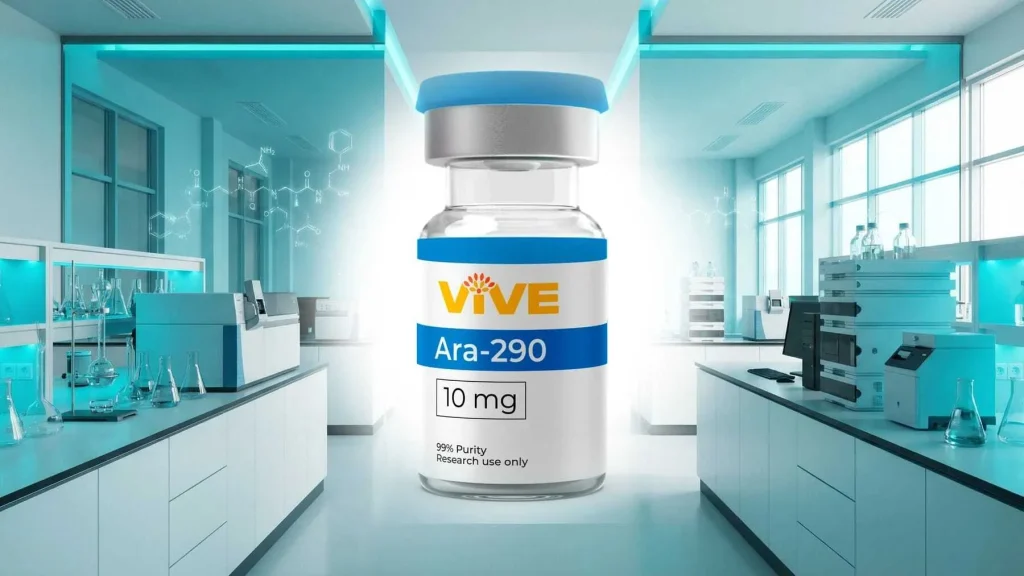
ARA-290, also designated Cibinetide, is a synthetic peptide investigated for therapeutic applications in neuroprotection and metabolic disease. This article examines the compound’s mechanism of action, summarizes relevant research findings, describes potential clinical applications, and reviews its chemical composition, synthesis considerations, and quality-control requirements. The document aims to provide a precise overview suitable for research and clinical evaluation.

ARA-290 functions principally via activation of the innate repair receptor (IRR), a receptor implicated in cellular signalling pathways that facilitate tissue repair and regeneration. Receptor engagement by the peptide triggers intracellular cascades that enhance cell survival and functional recovery. This mode of action confers neuroprotective effects through mitigation of neuronal injury and by modulating inflammatory responses relevant to neurological pathology.
This interpretation is supported by research demonstrating Cibinetide’s multifaceted biological effects.
Cibinetide: Synthetic Peptide for Neuroprotection & Tissue Repair
Cibinetide, a synthetic peptide derived from erythropoietin, exhibits anti-inflammatory activity, tissue-protective effects, and neuroprotective properties. These attributes support its evaluation as a potential therapeutic agent.
Cibinetide: Unlocking the Potential of Peptide Therapy for Inflammation, Neuropathy, and Tissue Repair, 2024
Multiple preclinical and clinical investigations have assessed ARA-290. Data indicate neuroprotective activity, including reduction of neuronal injury in models of neurodegeneration and preservation of cognitive-related endpoints in experimental systems. Additional studies report beneficial effects on metabolic parameters and complications associated with diabetes. Collectively, these findings support further evaluation of ARA-290 as a candidate therapeutic agent.
Subsequent studies further delineate ARA-290’s anti-apoptotic and anti-inflammatory mechanisms in disease models such as diabetes.
ARA 290: Anti-Apoptotic & Anti-Inflammatory for Diabetes & Sarcoidosis
ARA 290, an innate repair receptor agonist, demonstrates anti-apoptotic and anti-inflammatory activity and has been reported to ameliorate inflammation-associated clinical symptoms in sarcoidosis patients and individuals with type 2 diabetes. The referenced investigation evaluated whether ARA 290 treatment would enhance the efficacy of pancreatic islet transplantation (PITx) in a rat model.
An engineered innate repair receptor agonist, ARA 290, protects rat islets from cytokine-induced apoptosis, Y Saito, 2016

ARA-290 has potential clinical applications in neuroprotection and the management of metabolic disease complications. Potential uses include:
Clinical studies have specifically reported improvements in metabolic control and reductions in neuropathic symptoms among patients with type 2 diabetes following ARA-290 administration.
ARA 290: Metabolic Control & Neuropathy Treatment in Type 2 Diabetes
ARA 290, a nonerythropoietic peptide engineered from erythropoietin, was reported to improve metabolic control and neuropathic symptoms in patients with type 2 diabetes. In summary, ARA 290 shows significant potential for the treatment of diabetic small fiber neuropathy.
ARA 290, a nonerythropoietic peptide engineered from erythropoietin, improves metabolic control and neuropathic symptoms in patients with type 2 diabetes, M van Velzen, 2014
Organizations seeking to procure ARA-290 for laboratory research may source research-grade material from VivePeptides, which supplies peptides conforming to established purity and efficacy specifications.
ARA-290 consists of a defined amino acid sequence that determines its structural and functional characteristics. Knowledge of molecular formula and molecular weight is required for accurate pharmacokinetic characterisation and dose calculations in experimental settings. Peptide synthesis utilises established solid-phase and purification techniques to achieve target purity. Analytic verification is performed to confirm identity and compliance with specification limits prior to research use.
For peptide reconstitution and stability in laboratory protocols, consider using BAC Water, supplied for research applications.
Maintaining high purity for ARA-290 is essential for reproducible results and safety in experimental contexts. The following quality-assurance measures are commonly applied:
Strict adherence to handling and administration procedures preserves peptide integrity and experimental validity. Key guidelines include:
For research on recovery and tissue repair processes, investigators may also evaluate BPC-157, a peptide studied for related effects.
ARA-290 demonstrates several attributes that differentiate it from other investigational peptides. Its mechanism of action, focused on activation of the innate repair receptor, provides a distinct biological approach. Reported clinical data indicate a favourable safety and tolerability profile in studied cohorts. The peptide’s activity across neurodegenerative and metabolic domains supports its consideration as a multifunctional research candidate.
Researchers seeking peptide combinations for experimental protocols may consider the CJC 1295/Ipamorelin blend as an alternative investigational option.
| Attribute | Value |
|---|---|
| Molecular Weight | 3,075 Da |
| Purity Standard | >95% |
| Administration Route | Subcutaneous |
The comparison summarises ARA-290’s capacity to address multiple pathophysiological targets via a single therapeutic mechanism.
To review the complete product range, visit the VivePeptides shop for additional information.
Additionally, for research into skin health and wound-healing processes, GHK-Cu is available as an investigational peptide.